• Skip to primary navigation
  • Skip to main content
  • Skip to primary sidebar

Manten Resources

Supporting your Japanese language program

  • Manten Resources
  • About
  • Teachers
    • Stage 6 Beginners
    • Jblog Textbooks
      • Jblog 1
      • Jblog 2
      • Jblog 3
      • Programming
    • Base Camp
    • Student Workbooks
    • Amazing Races
    • Assessment
      • Manten Exams
      • Assessment Inspiration
      • Script Resources
    • Blog Spot
  • Parents
  • Contact

Teacher Wellbeing

Assessment – time to reconsider your beliefs

January 29, 2019 by Manten Resources

Last year I attended the National symposium of Japanese language education. At one point, I was chatting to my very clever friend Christine, and we were discussing assessment. I asked her if she felt she had learned anything at the conference and she agreed that she had. I then asked her, how did she know she had learned something as she had taken no form of assessment to indicate the degree of her improvement. She agreed then, that as adults we regularly learn new skills and information without having to succumb to any form of assessment. We can feel our progress internally, we can recognise the increase in our knowledge or skills. I ask you then, is this not also possible for students?

We sometimes use the term assessment almost synonymously for learning, as though one cannot occur without the other.  I can already hear people protesting the need for assessment to direct teaching and indicate to students, areas for development and of achievement. Yes, that is true, but I ask you, is that what is really happening as a result of your assessments? Or are you simply assessing to justify the grade you give them on a report? If the students do a task such as an exam, on work already covered in class, then from a students’ perspective you are just judging them against others – like they need any more of that in their lives! If they don’t have a chance to improve their performance or to use the feedback in a subsequent task in an obvious way (such as the Patch system), then chances are they will just ignore that feedback. You have spent hours writing a test, marking it, ranking students and all you have really done is wear yourself out and made the kids feel bad about themselves. (The top 10 probably feel fine I concede.) There really is more to life than exams.

This year I challenge you to think more carefully about the workload you are creating for your students and yourselves. As the saying goes “One of the very worst uses of time is to do something very well that need not be done at all.” (Brian Tracy, Eat that frog!)

We will be discussing more ideas for alternate ways to assess at our Noosa Workshop July 13th, 2019. Or, we have an online self-paced course on formative assessment if that interests you. As always, feel free to contact me if you have questions at jblog1help@gmail.com .

Good luck with 2019!
Filed Under: Assessment, Teacher Wellbeing

ENDING THE YEAR WELL

December 20, 2018 by Manten Resources

Many teachers have said goodbye to the students and now face the prospect of a day or two planning time. You don’t need me to tell you that this boils down to just a few hours by the time meetings are scheduled. Many of us are operating on reduced levels of “genkiness” post the end of year rush. So, what is the best use of your limited time?

1.       Organise your copying for the start of term

This may sound like a procrastination strategy, but you can guarantee that the school photocopier will breakdown week 1 term 1. If you are using the Hiragana Patch for example, print off your flashcards now and have the workbooks ready to go in a box. Print the levels tests and top up your filing cabinet or folder. 

2.       Prepare your welcome email to the class and parents

Many language teachers complain that they receive little parental support. Conversely, many parents complain that they don’t understand what their child is doing in the language classroom and they worry that they cannot help them at home. One way around this is to open the doors of communication week 1 with a blanket email introducing yourself to the parents of your students. Provide some background information about your own path to bilingualism and why you feel your course is so important. You can find some sample emails at: https://www.mantenresources.com.au/teachers/blog/developing-parental-allies/

We also have some free fliers you can share with the parents answering such questions as “Why should their child being learning a language?” and “How can I help my child learn a language?”.

https://www.mantenresources.com.au/parents/

3.       Target your weakest area

We all have one aspect of our profession that we like less than other aspects. What generally happens is that we avoid that aspect with “busy” tasks all year. Then we spend our precious summer holidays catching up or worrying about catching up on this work. Be honest with yourself and begin work on that task. You don’t have to finish it – you just need to start. Even an overview or draft document will be a welcome sight when you return to school next year. If there are resources out there that can help you, buy them! You can still edit the resource to make it your own, but it might save you hours in the holidays. Popular choices for this type of support currently include programming resources, systems for teaching script and assessment tasks. Or team up with another teacher and make a day of it. Stop for lunch at a Japanese restaurant and reward yourself for your hard work. If you’re working at home, try to make it a pleasant experience. Decorate your desk with a flower or candle or plan a nice morning tea break for yourself. I try to go for a swim with my family early in the morning. This wakes me up and stops me feeling so bad when I have to return to the desk later. It doesn’t matter what you choose but the key is to make your work more of a pleasurable experience.

Well done everyone on all you have achieved with your classes this year!

Filed Under: Assessment, Teacher Wellbeing, Teaching and Learning

Choose your weapons wisely

May 11, 2018 by Manten Resources

This week I had an interesting conversation with a dedicated Japanese teacher. She mentioned casually that she felt “guilty” about purchasing some of our resources. I found this comment to be a real insight into our practice. It is also not a sentiment shared by many other industries or even other subjects. For some reason, as language teachers we are made to feel that not only do we need to know our subject well, our students well and have a good range of pedagogical strategies to draw upon, but that we also need to create every resource from scratch. Can you imagine a plumber rushing off to design his own pipes or a doctor being expected to manufacture his own medicines? Nobody has such expectations for other industries so please shrug off this unnecessary yoke of teaching.

In this month’s newsletter I am writing in more detail about some of the technological applications available to us to support formative assessment. Here are a few ideas we all need to consider when making decisions about ICT in general.

1. Choose the teacher strategy and content first

It is so tempting to jump on a bandwagon and start using technology because other people are doing it. This may have short-term benefits by grabbing the attention of the students due to the novelty factor. You may also become more enthusiastic as a teacher as you are excited about the new direction. These are both legitimate short-term benefits, but you also need to consider the longer term. Eventually the newness will wear off for both you and the students, so you need to ensure that there are other benefits from this technological choice. Is it more efficient? Is it saving you time because you can easily reuse or modify it for future lessons? Does it provide you with insights into the students’ progress and/or perspective/experience of the lesson?

2. Be mindful

Sometimes you may find a great youtube clip that you just want to use to settle the class or as a transition activity, rather than as a main source of content. That is fine, as long as you are mindful of what you are doing. Question each resource and activity before and after each lesson. Are you doing that task because you did it last year or because you feel it will suit this year’s cohort as well? What information is allowing you to make that decision?

3. What is your learning intention?

The term “fit for purpose” is often used when considering types of assessment. It suggests that formative assessment is preferable for certain purposes, and summative for others. Similarly, your technology and use of it, needs to match the purpose of your lesson. If you are promoting a growth mindset, you may want to question why you have grades/marks on your google form, or why the students do not have the option of editing the form? How you use the tools is just as important as how you select them.

Three Resources that will save you time and don’t cost the earth

  1. Manten Exams. Choose from our content library to create your own exams. Listening tasks rendered to your personal selection without an embargo date! https://www.mantenresources.com.au/teachers/assessment/manten-exams/
  2. Hiragana Patch and the Katakana and Kanji equivalents. Script resources that emphasise growth mindset and a formative approach to script mastery. https://www.mantenresources.com.au/teachers/resources-teaching-scripts/
  3. Amazing Race sets. Collaborative tasks covering all skills and mapped to Australian Curriculum outcomes and cross-curriculum content such as literacy and Aboriginal and Torres Strait Islander perspectives. https://www.mantenresources.com.au/teachers/our-resources/amazing-races/

Yes, we know you are capable, of creating everything from scratch, because language teachers are creative and talented people. But is this the best use of your precious time? You do deserve a weekend too!

Filed Under: Assessment, Growth mindset, Teacher Wellbeing, Teaching and Learning

DEVELOPING PARENTAL ALLIES

January 26, 2018 by Manten Resources

Language teachers often work in small departments or by themselves and can suffer from a lack of support. A key ally can be the parents of your students. Here are 2 quick ideas to kick start your rapport with the parental body this year.

The Welcome email

My department has a policy to always email the parents at the start of the year and introduce themselves as the class teacher for the year. These emails are highly valued by parents as it opens up a line of communication for them. Parents have told me that they find the transition from primary school to high school difficult as they are unsure whom to contact or how. In the primary setting, they describe how they were often at their child’s school every day for pick-up so they could meet with the class teacher informally or ask other parents for advice. In the high school setting this face to face experience is often limited to parent teacher nights. The “welcome to the course” email also allows you to outline your experience and generate an interest in the subject. Here is a sample:

Dear year 8 parents,

My name is Liberty Campbell and I am your son’s Japanese teacher this year. Many people feel like they cannot help their child with subjects such as Japanese as they are unfamiliar with the language.

My emails will hopefully help you know what is happening in the classroom. Everyone is busy these days so you do not need to respond, although we love to hear from you. Do feel free to email me anytime though if you have a question. Your son is also encouraged to do so via this email. It is better to ask, then turn up to class unprepared.

For Japanese your son will use the following materials: ….

I did not begin my study of Japanese until I began university, so your son already is ahead of me in his learning at his age! (I actually studied German until Year 10. I moved to live in Japan after university for 4 years and return most years now at least once.) I hope your son will enjoy this year learning about a country that has such an interesting history ranging from ninjas and samurai, to the WW2 conflict. My grandfather was a WW2 POW so I find it inspirational how close our nations have become in a few generations. It gives me hope that greater understanding of our cultures and languages, can eventually help us bridge the gap between nations around the world.

All the best,

Liberty

Provide the parents with skills to help

Parents can be useful allies but they need some direction as to how they can be of help. We have developed several fliers to share with parents. These cover the following topics:

  • How can I help my child learn a language?
  • Why is my child learning Japanese?
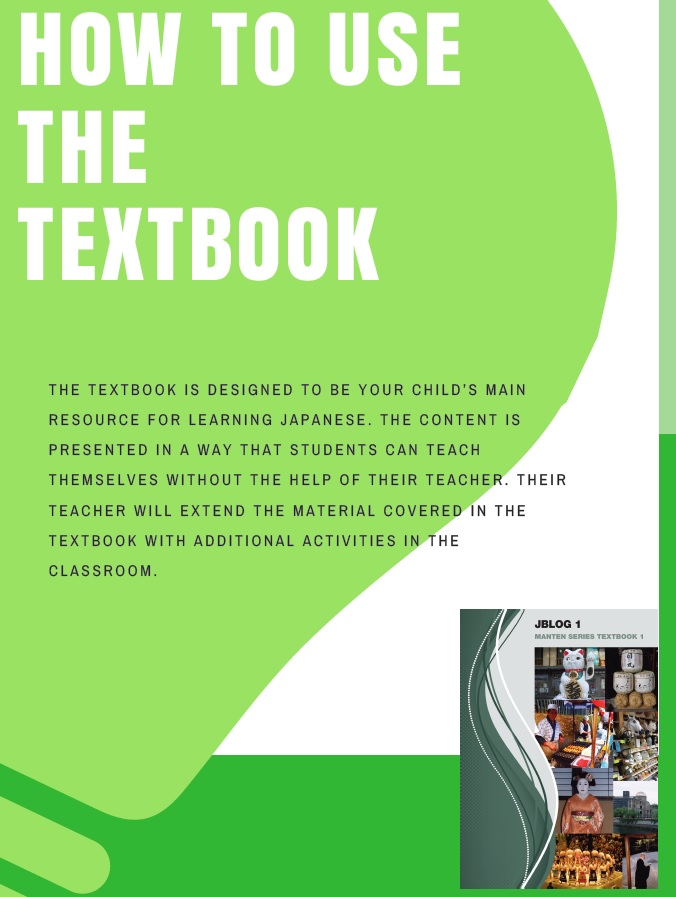
  • How to use the textbook
  • Is it too hard to learn a scripted language?

I would suggest that you space out the sending of these over time so as to not overwhelm them. Sending information regularly also keeps your subject fresh in their mind. We have a designated page for parents on our website outlining such topics, as we recognise the positive influence of an educated and supportive parent on student learning outcomes.

You can download PDFS of our fliers from the Parents page on our website at https://www.mantenresources.com.au/parents/


Further reading:

You may also be interested in our post on increasing positivity in your classrooms and staffrooms:

https://www.mantenresources.com.au/teachers/blog/hows-your-losada-ratio/


Filed Under: Advocacy, Teacher Wellbeing

We’re going to Noosa! Do you want to come too?

January 23, 2018 by Manten Resources

This year we are excited to announce that we will be holding our first workshop for Manten Resources on July 17th 2018. We have met many of you at other conferences, during school visits or online but this year we thought we would try something new. We have so many ideas and we realised we needed more time to unpack these with you. So come and escape the winter blues with some time at Noosa in July!

Why is it at Noosa?

There are two main reasons why we are running our first workshop at Noosa. The first is that chapter 6 of Jblog textbook 3 is set in Noosa. The chapter revolves around a house swap exchange between Noosa locals the Clark family, and the Yamada family from Tokyo. So we thought if you are teaching this unit, you will be sure to get some ideas to make it more real whilst you are here.

The second reason is about you. Teachers work so hard with very little “perks” of the job. Tired of hearing about friends in other industries swanning off to conferences in fancy locations, we thought it was time Japanese teachers had their day in the sun too – literally! The workshop is on a Tuesday so we encourage you to fly up with your family the weekend before, if you are from out of town. Don’t forget to talk to your tax accountant about how you can claim your expenses for accommodation, travel and daily expenses.

When is the workshop?

Tuesday July 17th 2018. This is the second week of the school holidays for NSW, ACT, Tasmania, South Australia and Northern Territory schools. It is the first week of Term 3 for Queensland, Victoria and Western Australian schools.

Where is the venue?

The workshop will be held at Peppers Noosa resort & Villas, 33A Viewland drive, Noosa heads, QLD, 4567. It is a few minutes walk from Hastings street and the beach.

Where can we stay?

There are various forms of accommodation in Noosa ranging from hotels to apartments and caravan parks. Contact http://www.visitnoosa.com.au/ for more information about what would suit your needs best. You may want to share accommodation or lifts with other teachers, so start talking with your colleagues and start planning your Noosa escape!

Is the workshop suitable for all teachers?

Yes! The workshop will be divided into a series of shorter modules that will discuss topics such as Growth mindset, soft CLIL, differentiation, and feedback to improve student performance. Check out the schedule below for more detail.

The day will be presented by Liberty Campbell and Junko Nichols.

Junko Nichols has taught Japanese and English as a Foreign Language at pre-primary, primary, secondary and tertiary levels in Japan, China, England and Australia over the past 20 years. She has taught at a Japanese immersion program at Central Queensland University and has been involved in language teaching and language teacher training at a variety of schools, using a range of methodologies and approaches. She has many fabulous ideas for primary teachers including how to use “soft-CLIL” in a variety of topics such as poetry and art.

Liberty is the Catholic Education Commission’s representative on the NSW Languages advisory Panel, the Project officer for Languages in the Broken Bay diocese and the author of the Jblog textbook series. She is passionate about supporting Japanese teachers and students with research based resources and practical teaching strategies. Liberty has spoken at various conferences for the MLTANSW, JTAN, JLTAV, DETNSW and at the National Symposium for Japanese Teaching in 2016.


How much is it?

The full day workshop is $135. This includes a fabulous buffet lunch and snacks, a beautiful location, lots of ideas and great company in the form of other inspiring Japanese teachers. This is designed as an intimate workshop so places are limited to 31 delegates. Make sure you are one of them!

How can I book?

You can book and pay for the workshop via the Trybooking link below.

https://www.trybooking.com/TQDQ

If you have any other questions about the day, please email us at jblog1help@gmail.com .

Workshop Schedule Session Overview

Session 1 : 9:00-10:30am : 1.5 hours

  • Growth mindset versus fixed mindset – How to develop more resilience in our students
  • Closing the feedback loop – Using peer and self-feedback to improve writing skills

Morning tea : 10:30-11am

Session 2 : 11:00am -1:00pm : 2 hours

  • Soft CLIL : What is it? What does it look like in a primary and secondary context?
  • How can I dabble in CLIL without committing to it every day?

Lunch : 1-2pm

Session 3 : 2:00-3:30pm : 1.5 hours

  • Differentiation – Acknowledging that teachers and students need to accommodate their own strengths, weaknesses and learning preferences
  • PERMA in language teaching – How can we teach hope? How can we develop it in ourselves and our staff?

Total 5 hours PD

Filed Under: Assessment, Differentiation, Growth mindset, Professional development, Teacher Wellbeing, Teaching and Learning

Using Data to Increase Enrolments

September 5, 2017 by Manten Resources

Term 4 can be a traumatic time of year for language teachers. Teachers of compulsory subjects have little understanding of the pressure that teachers of elective subjects are under. Nobody enjoys the wait to hear whether their subject will run as an elective in the coming year.

The goal of many teachers is to lure approximately 20-25% of a Year 8 cohort into the year 9 elective course, in order to guarantee a class. Some states are lucky and have guaranteed classes until Year 9 or 10, but inevitably the elective challenge arises at some point.

Regardless of whether you managed to get an elective class or not, term 4 is the most important time of year as it is the perfect time to plan for next year’s direction. So what do you need to do now to ensure long term success and growth?

  1. Befriend the administrative assistant who enters the students’ elective choices and ask to see how many students picked your subject prior to the final lines being established. This will let you know how successful you were attracting students prior to other factors tainting the results (such as line clashes, students leaving the school etc).
  2. Keep a record of how your department is going regarding electives across several years, and annotate factors that may have impacted your numbers both positively (eg changing textbooks or purchasing new resources) and negatively (eg teachers on leave, new subject being offered in competition etc). You are aiming for a steady increase.
  3. Now get access to what students picked for their other electives. What are the most popular subjects in your school? This is valuable information as it can provide you with an overview of trends in your school community. You then need to consider what aspects of these popular subjects you can tap into, to enhance your course. For example if PASS (a sport based subject) is popular, they you may like to include sport based incursions such as kendo or karate lessons into your Stage 5 program. When “MasterChef fever” was as its peak, we introduced a pop-up restaurant assessment task in the schedule.
  4. Start planning your assessment and incursion/excursion activities for next year with this data in mind. Often it is just a matter of tweaking what you already do to better market your course. We know what we do is awesome but unfortunately many parents and students don’t realise this until it is too late.
  5. Don’t let it wear you down. What you do is incredible. You just need to ensure more people realise this through reflective practice, use of data and strategic planning. Good luck!

Filed Under: Student Engagement, Teacher Wellbeing, Teaching and Learning

  • « Go to Previous Page
  • Page 1
  • Page 2
  • Page 3
  • Page 4
  • Go to Next Page »

Primary Sidebar

Copyright © 2026 · Manten Resources - All Rights Reserved