• Skip to primary navigation
  • Skip to main content
  • Skip to primary sidebar

Manten Resources

Supporting your Japanese language program

  • Manten Resources
  • About
  • Teachers
    • Stage 6 Beginners
    • Jblog Textbooks
      • Jblog 1
      • Jblog 2
      • Jblog 3
      • Programming
    • Base Camp
    • Student Workbooks
    • Amazing Races
    • Assessment
      • Manten Exams
      • Assessment Inspiration
      • Script Resources
    • Blog Spot
  • Parents
  • Contact

Advocacy

The Over-Justification Effect

November 20, 2023 by Manten Resources

In December, many teachers are either rejoicing or lamenting the numbers in their elective cohort. Our teaching community is incredibly generous, and I have seen many extensive lists shared, promoting the numerous positive outcomes of studying a language.

I was thus horrified to learn of the “Over-justification effect” and whilst I do not suggest you abandon your current marketing campaign, you may want to declutter it somewhat in light of the following research.

In 1973 a study was conducted by psychologist Mark Lepper that discovered that having too many incentives actually decreases the effectiveness of the original incentive and can undermine or dilute the central reason we pursue an activity. (page 39, Get it done – surprising lessons from the science of motivation” by Dr Ayelet Fishbach)

This concept was developed further by research by Maimaran and Fishbach. The 2014 project encouraged preschoolers to eat healthy foods by telling them eating such foods had benefits including making you strong or helping you learn to count. This had the surprising effect of actually reducing the children’s consumption of the healthy snacks as they assumed that a snack that served multiple purposes (such as making you strong and helping you learn) was less likely to be meet the main reason they were originally interested in the snacks – because they tasted good. This is also supported by another concept called the “Dilution principle” that suggests that the more incentives there are the more a person is distracted from their original intrinsic motivation. (page 41, Fishbach)

This gave me cause to reflect on the mixed messages I may be sending my students.

If they are naturally motivated to study Japanese because they want to communicate in that language, want to visit Japan and are interested in Japanese culture, am I really helping the cause my mentioning it will improve their literacy skills and brain function.

I then became curious and googled the question “Why should you learn a second language, art or music?”.

The gist of the quote was that music would help bring balance and harmony into my life, art could make me better at whatever I do whilst languages would help me retain lists and concentrate for longer!

If I was a kid choosing an elective, it stands to reason that the more we tell them it is “good for them” the less it will seem to be a fun option. 

Despite what we are told, people don’t hate learning languages and don’t find it boring – when it is not in the school context. My own teenage son and his mates have been learning random languages based purely on interest via Duolingo. Their language choices were not based on any cultural affiliation or actual desire to study that language for gains in the future, they just thought it would be fun.

Duolingo are obviously doing something right as they are quoted as having generated $250 million in revenue in 2021, a 55% year-on-year increase with over 500 million registered users and 37 million users active each month. By contrast, the HSC enrolments in Japanese for both Beginners and Continuers hover around 1200 per course each year – we could use some Duolingo 55% year-on-year increases!

If you look at the Duolingo website the benefits they list for learning a language are all about human connection. They sight examples of how it has helped a footballer connect with his teammates, others to connect with their spouse’s family or the local community, or as a fun activity to do with a partner. This fun perspective of language learning is not crowded out by any extraneous incentives.

Perhaps it is time we also begin to focus on these original reasons why people learn a language, predominately for human connection, and just maybe then our cohorts will remember too, why they loved us in the first place.

Filed Under: Advocacy, Student Engagement, Teaching and Learning

Making language relevant in regional areas

June 4, 2019 by Manten Resources

The challenge of building a profile for language courses in what Tony Liddicoat has described as the “monolingual mindset of Australia” is well known. If those of us struggle to do so in metropolitan areas when we have access to resources such as restaurants staffed by native speakers, foreign language bookshops and libraries, spare a thought for our regional colleagues.

I recently wrote on the topic of “the new differentiation”, inspired by Seth Godin’s book “This is Marketing.” In it, he writes:

It doesn’t make sense to make a key and then run around and looking for a lock to open. The only productive solution is to find a lock and then fashion a key. It is easier to make products and services for the customers you seek to serve than it is to find customers for your products and services. (pages 5-6)

I linked this idea to our efforts to establish language programs. How many of us are trying to sell a language program rather than creating a languages product that meets the needs of your key stakeholders? Do you even know what the needs and desires are of your stakeholders are?

I discussed this topic recently with a regional teacher and asked her what the most popular elective class is at her school. She replied that agriculture was and that her Japanese class was constantly running against it on the elective line. It would be a momentous task to change the culture of the school and the community which obviously values agriculture and the role in plays in local industry. Equally, the timetable/ curriculum coordinator is not going to listen to your pleas to have your subject moved away from the popular one. So, what can one do in such a situation?

This dilemma inspired me to create a Stage 4 assessment task called the “Japanese investment Expo”. The idea is that students use their knowledge of their region and agriculture to lure Japanese investment into a product of their choice. Here is a brief extract from the task:

Task overview

Australia is well known internationally for its agricultural success. We are a popular country for trade and investment due to our political and economic stability, our natural resources, safe and ethical practices and high level of research and development.

This assessment requires you to use your knowledge of agriculture in your region with your developing Japanese language skills. This is a group task that will develop your skills in collaboration, project management and creativity.

The brief

A new mayor has been elected to your town. They are keen to increase the profile of your town on the international stage. The mayor has two key projects in mind.

The first is to establish a new sister city relationship with a town in Japan.

The second is to attract Japanese investment into local agricultural businesses to expand production and increase employment.

Your team will need to work through the attached tasks to help the mayor achieve these targets.

Students work through the reflection tasks that have them analyse details from a Japanese text, use hiragana and katakana tables to categorise export products and produce a bilingual video promoting their chosen agricultural industry using simple language and the scaffold provided. An optional extra would be to hold the “Expo” during a visit by Japanese students. The local students could share their videos at small stands and attempt to lure the students to invest in their product using the (fake) investment yen distributed by the teacher to each visitor.

I live in a metropolitan area now, but I grew up on the South coast of NSW and studied agriculture myself for the HSC. We had an “ag plot” that we all loved and we experimented with raising chickens, driving tractors and the power of the electric fence (not recommended!). A few weeks ago, I was visiting Austrade and was impressed by the documents they produce on “investment opportunities in Australian agribusiness and food”. I had no idea Japanese companies like Hakubaku have built a noodle processing plant here or that Kagome have a tomato processing plant in Victoria. There are legitimate opportunities for Australian agribusiness to work with Japan so let’s start preparing our regional students to make the most of these in the future.

Let us now return to the original dilemma of what to do when up against the popular agriculture subject on an elective line. My advice would be to run an assessment task such as this one in Stage 4 and demonstrate to the timetable/ curriculum coordinator that these subjects work well together so should be on a different line. I would reinforce this with different agriculture linked assessment in Stage 5 and joint visits to the agriculture farm with visiting sister school students. Piggy-back onto the popularity of agriculture rather than fight it, and you may find they become your greatest allies. Don’t forget to share your Japanese cooking with the agriculture teachers either – and maybe use that opportunity to discuss how you are creating cross-curriculum tasks in your subject.

Good luck regional teachers!

The Japanese investment Expo assessment task is available for purchase for $70. It can be modified and reused each year to suit your cohort. Email jblog1help@gmail.com to order.

Filed Under: Advocacy, Assessment, Student Engagement, Teaching and Learning

The new differentiation

May 11, 2019 by Manten Resources

Are you struggling with elective class enrolments? Feel like you are constantly fighting for support from the executive? Your problem may lie in differentiation – although not from the traditional perspective.

Differentiation is how we shape our teaching and learning activities to support the needs and interests of the students. Traditionally we focus on making materials accessible to students who are at different levels of understanding and ability at a given point in time. For example, the NSW syllabus groups content appropriate to mainstream, prior-learning and background student levels. In the Jblog textbook series, we differentiate questions at the green, blue and black level based on ski runs.

But what if we looked at differentiation from a different perspective?

I was recently inspired by Seth Godin’s book “This is Marketing.” In it, he writes:

It doesn’t make sense to make a key and then run around and looking for a lock to open. The only productive solution is to find a lock and then fashion a key. Its easier to make products and services for the customers you seek to serve than it is to find customers for your products and services. (pages 5-6)

How many of us are trying to sell a language program rather than creating a languages product that meets the needs of our key stakeholders? Do you even know what the needs and desires of your stakeholders are?

When I refer to stakeholders, I am considering the students, their parents, the school executive and the larger community. These stakeholder groups will influence to different degrees how relevant my languages product will be perceived. Some of you may argue that we shouldn’t have to do this, and that simply stating the many benefits of language learning should be enough. Seth Godin argues though, that “The status quo doesn’t shift because you’ re right. It shifts because the culture changes”. (page 122)

It is a mighty task to change the dominant culture of your stakeholders to align with a languages’ viewpoint. But it is less difficult to align your course with the dominant culture. How about differentiating your languages course to meet the needs and interests of those stakeholders? Can you differentiate to better reflect their values, rather than swim against the tide? One of our schools has a dominant culture that exults commerce and business. So we embraced that with a unit titled “The Intercultural marketing business case study”. Students learned about how marketing to a Japanese audience differs to an Australian audience. They learned how customer expectations of customer service are deeply embedded in the language and culture that we identify with. Those of you in NSW currently reprogramming for the new syllabus may like to embrace this shift in mindset as you develop new task-based programs.

We will be discussing this topic in more detail at our Noosa workshop July 13th. The extended workshop will give us time to look at examples of assessment tasks that align with different stakeholder values and dominant cultures. You can book online using Trybooking or email me at jblog1help@gmail.com to request an invoice for your school. We look forward to escaping the winter chill with you then.

Good luck with your programming!

Filed Under: Advocacy, Assessment, Australian Curriculum, Differentiation, Student Engagement

EARLY BIRD SALE – NOOSA WORKSHOP 2019

November 27, 2018 by Manten Resources

As we slide into the end of the year, many of us may be lacking the energy to feel inspired about 2019. Luckily, Junko Nichols and I have been working on some new ideas and activities to re-energise you next year at Noosa. The workshop is held July 13th which falls in the holidays for all the states, so we hope you can slot in a day with us. This year we are focusing on lots of take-away ideas and hands-on activities for primary and secondary teachers of Japanese.

We will be covering the following:

·       How to take a topical issue like “gender” and make the language accessible to students

·       How to use a newspaper article in English to develop speaking, reading and writing skills in Japanese

·       How to analyse stereotypes in the media using simple language and cover Learning Across the Curriculum content

·       Developing peer feedback skills in speaking tasks – your chance to sample our new Speaking stations resource

·       Effective ways to communicate with parents and increase school support at the primary level

·       Strategies to enable your students to contribute to the local community through language and charity work

·       Battling your nemesis subject at secondary schools – how to fight back and drive up those elective numbers

·       Incorporating soft-CLIL into primary art lessons

·       Simple print-making techniques inspired by Hokusai

·       Developing an appreciation of art and nature in students

·       Dabbling in Comprehensible Input theory – beginner strategies for circling questions and mini-grammar sub-lessons

·       Task-based learning – sample assessment task ideas

·       Embedding Aboriginal and Torres Strait Islander perspectives in your programs – actual resources and activities to get you started

It is going to be a HUGE day of learning, escaping the winter cold at the beautiful Pepper’s Resort, Noosa. The range of ideas is sure to raise your motivation levels during the mid-winter slump.

Early bird prices apply to the end of Term 1 only and places are strictly limited as this is designed as an intimate workshop.

To book your place, click here or email me at jblog1help@gmail.com  to discuss any aspects of the day. We hope to see you there!

Filed Under: Advocacy, Assessment, Australian Curriculum, Professional development, Teaching and Learning

Ideas for Japanese visits to your school

July 21, 2018 by Manten Resources

Term 3 is a popular time for Japanese students to visit your school. Having students visit your class and interact with your students is great fun but it can be nerve-wracking planning enough activities to keep everyone engaged. Here are 3 of my favourite ideas that get your students interacting.

1.Paired Kahoot

These kahoots are bilingual with questions in one language and answer options in another. This encourages the Australian and Japanese students to talk together to work out each answer. Lots of gestures and laughs to be had. Below are links to two different versions. If you can’t gain access via the link search kahoot for games made by Manten resources or jblog textbooks and should find these. Feel free to make a copy and edit them to better suit your students.

Japanese group quiz re Australia

Japanese visitor quiz 

2.Bilingual Amazing Race

Again, this activity is bilingual requiring collaboration between the Japanese and Australian students. There is a free download of an entire game including worksheets, answers, game cards and sound file. The instructions can also be found on our site via the link below.

https://www.mantenresources.com.au/teachers/our-resources/amazing-races/

3.Use your visitors to help with speaking assessments

We run our Year 8 assessment task during the annual school visit from Japan. Our students plan 3 questions to ask the visitors in Japanese and they must answer one question in Japanese. This is all filmed on their mobile phones or devices and submitted. Our students are so excited that their Japanese actually “works” and are often keen to show their parents when they get home.

For our Year 9 students, we ran a joint speaking contest where the students are buddied up for an interview style contest. They worked together in the previous term prior to the visit online, to draft sample answers. When the visitors arrive, they have one lesson to practice face to face and then we run the speech contest in real time. We award a joint trophy and have a pizza and sushi lunch together. 

Check out our Facebook page August 4 2017 for more details.You will need to scroll down to that date to find it, sorry!) https://www.facebook.com/mantenresources/ 


Filed Under: Advocacy, Student Engagement, Teaching and Learning

DEVELOPING PARENTAL ALLIES

January 26, 2018 by Manten Resources

Language teachers often work in small departments or by themselves and can suffer from a lack of support. A key ally can be the parents of your students. Here are 2 quick ideas to kick start your rapport with the parental body this year.

The Welcome email

My department has a policy to always email the parents at the start of the year and introduce themselves as the class teacher for the year. These emails are highly valued by parents as it opens up a line of communication for them. Parents have told me that they find the transition from primary school to high school difficult as they are unsure whom to contact or how. In the primary setting, they describe how they were often at their child’s school every day for pick-up so they could meet with the class teacher informally or ask other parents for advice. In the high school setting this face to face experience is often limited to parent teacher nights. The “welcome to the course” email also allows you to outline your experience and generate an interest in the subject. Here is a sample:

Dear year 8 parents,

My name is Liberty Campbell and I am your son’s Japanese teacher this year. Many people feel like they cannot help their child with subjects such as Japanese as they are unfamiliar with the language.

My emails will hopefully help you know what is happening in the classroom. Everyone is busy these days so you do not need to respond, although we love to hear from you. Do feel free to email me anytime though if you have a question. Your son is also encouraged to do so via this email. It is better to ask, then turn up to class unprepared.

For Japanese your son will use the following materials: ….

I did not begin my study of Japanese until I began university, so your son already is ahead of me in his learning at his age! (I actually studied German until Year 10. I moved to live in Japan after university for 4 years and return most years now at least once.) I hope your son will enjoy this year learning about a country that has such an interesting history ranging from ninjas and samurai, to the WW2 conflict. My grandfather was a WW2 POW so I find it inspirational how close our nations have become in a few generations. It gives me hope that greater understanding of our cultures and languages, can eventually help us bridge the gap between nations around the world.

All the best,

Liberty

Provide the parents with skills to help

Parents can be useful allies but they need some direction as to how they can be of help. We have developed several fliers to share with parents. These cover the following topics:

  • How can I help my child learn a language?
  • Why is my child learning Japanese?
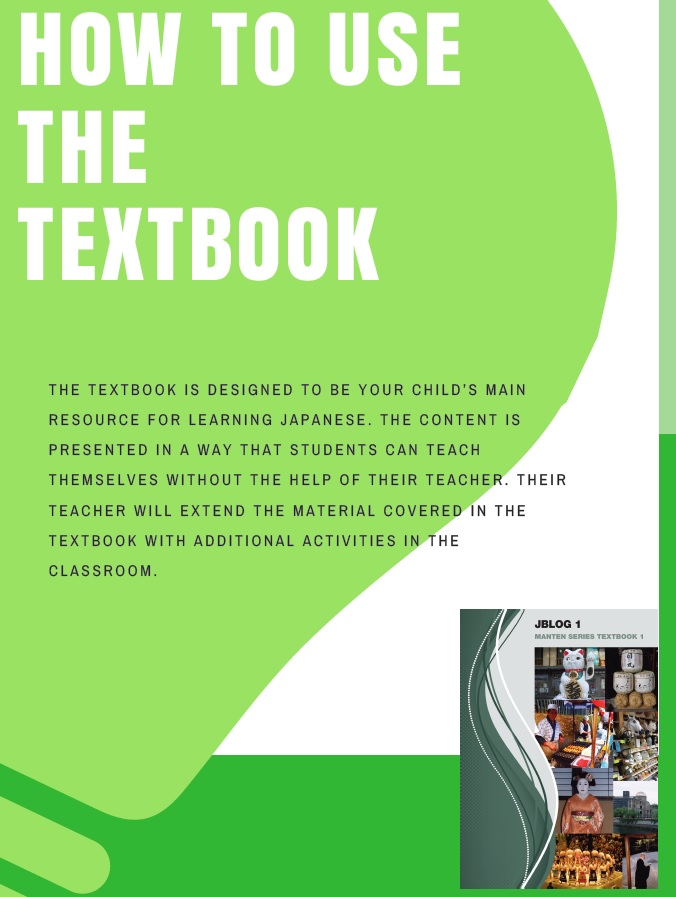
  • How to use the textbook
  • Is it too hard to learn a scripted language?

I would suggest that you space out the sending of these over time so as to not overwhelm them. Sending information regularly also keeps your subject fresh in their mind. We have a designated page for parents on our website outlining such topics, as we recognise the positive influence of an educated and supportive parent on student learning outcomes.

You can download PDFS of our fliers from the Parents page on our website at https://www.mantenresources.com.au/parents/


Further reading:

You may also be interested in our post on increasing positivity in your classrooms and staffrooms:

https://www.mantenresources.com.au/teachers/blog/hows-your-losada-ratio/


Filed Under: Advocacy, Teacher Wellbeing

  • Page 1
  • Page 2
  • Go to Next Page »

Primary Sidebar

Copyright © 2026 · Manten Resources - All Rights Reserved