• Skip to primary navigation
  • Skip to main content
  • Skip to primary sidebar

Manten Resources

Supporting your Japanese language program

  • Manten Resources
  • About
  • Teachers
    • Stage 6 Beginners
    • Jblog Textbooks
      • Jblog 1
      • Jblog 2
      • Jblog 3
      • Programming
    • Base Camp
    • Student Workbooks
    • Amazing Races
    • Assessment
      • Manten Exams
      • Assessment Inspiration
      • Script Resources
    • Blog Spot
  • Parents
  • Contact

Professional development

What’s new in 2020?

January 22, 2020 by Manten Resources

Welcome to the new year! Here’s a quick update of what’s happening in 2020 and a game to get you started with those new classes.

1.The new Jblog 4 Express launch

This textbook is designed specifically for the Stage 6 Beginners Japanese course mainly taught in NSW. It will share a similar feel to the other Jblog textbooks but will include new features like a city focus and destination text in each chapter.

2.Stage 6 Beginners Japanese Kanji Patch

A Kanji Patch specifically for the Stage 6 course is on its way. Students can move smoothly through the Hiragana, Katakana and now, Kanji Patches.

3.Digital versions of Jblog textbook 1 and 2

Digital versions of Jblog 1 and 2 are now available in the form of flipbooks. Whilst we still believe the research that shows hard copy textbooks are both preferred by students and have greater learning gains, we understand that it can be useful to have a hard copy at school and a digital copy at home for homework. That option is now available.

4.Noosa Workshop 2020

Our Noosa Workshop for teachers from all states and levels is running again Saturday, July 11th  2020. You can read more about it and book a spot using this link. We may take a break in 2021 due to family commitments so don’t miss this year’s workshop.

Keep an eye on our facebook page for the exact dates each of these and other new resources go live.

Don’t forget that we launched several new resources at the end of last year including Base Camp, The Platform and The Year 7/8 Investment Expo Assessment task. These may also help kick start your new academic year in a fresh way.

Open-ended review game

When you start the year, often you are taking on a class of students that you didn’t teach in the previous year. This game is a great way to ascertain what they remember after the long summer break. It doesn’t need any IT or internet either!

This is a version of the hearts and crosses game.

Step 1: Board preparation

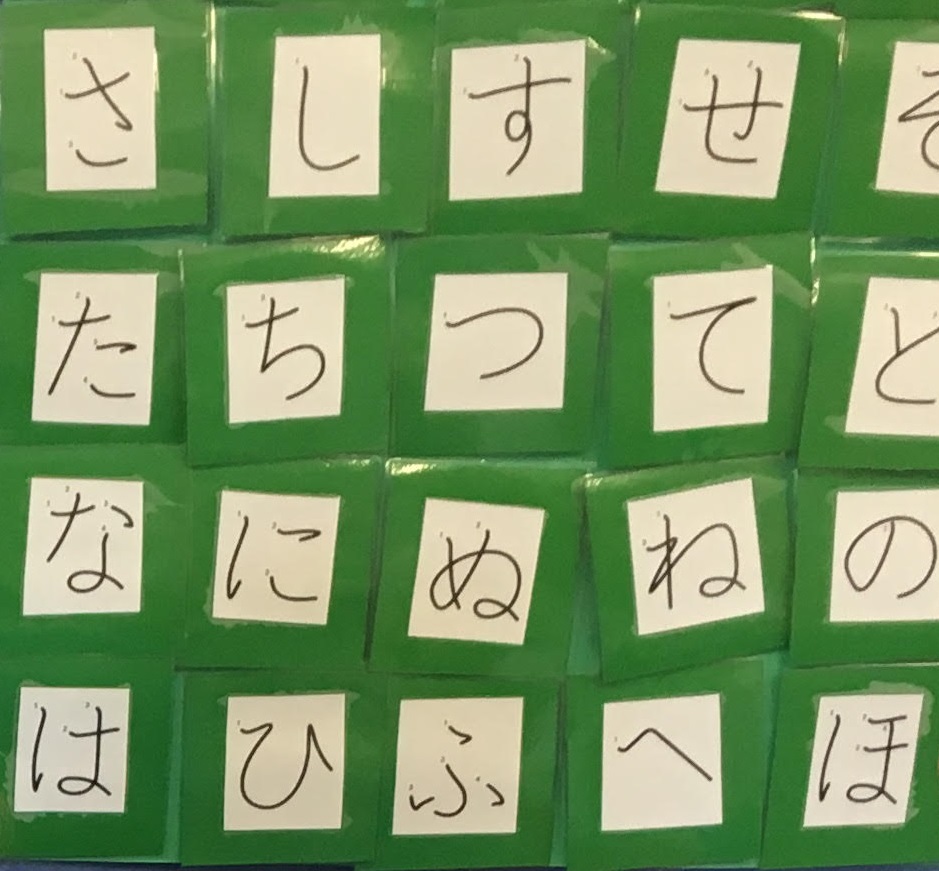
You need a piece of cardboard that you rule up into a table with 5 columns. These columns will house hiragana cards going left to right eg ka, ki, ku, ke ko. I make cards to fit these columns that are about 10cm by 10cm. Write a hiragana on each one and laminate if you like. I then use Velcro dots to stick the hiragana cards to the table. This means you can easily take the cards off to reveal what is behind each card during the game. It also makes packing up quick at the end.

On your cardboard table you can now write in pencil random points. I usually use a mixture of 5, 10, 20 and 50 points. I also hide one or two 100 points and 5 hearts and 5 crosses. I write these in pencil so that I can change the location in the future. Your students will quickly rote learn the location of the higher points otherwise!
Step 2: Question generating

Put students into table teams and name them after a colour in Japanese eg aka, midori. It doesn’t matter if you haven’t studied colours yet. They only need to remember it as their team name.

Give them scrap paper and 5-10 minutes in teams to write down as many questions with a sample answer as they can about anything they remember studying about last year in Japanese. It can include vocabulary, grammar, or cultural knowledge. They must write their team colour on every strip of paper. This is very important. Gather all the team questions, mix together then place in a bag.

Step 3: Playing the game

On the board draw a basic table with each team colour listed in a column. Give each team 20 points to start. You then ask the first team to pick a hiragana letter from the board. You then randomly pick out a question from the bag. Read out the question. That team will attempt to answer and if they get it correct, remove the hiragana card from the board to reveal their points eg 5, 10, 100 points. Add those points to the score chart on the board. If they get a heart though, it doubles their current score. If they get a cross, it halves their current score. If they get the question wrong, nothing happens. Do not reveal what is behind the hiragana card if they get it wrong.

When reading out the question, check which team wrote it and give them 5 bonus marks. This means that the team who writes lots of questions has an advantage so make sure you explain this to the students before they start writing questions. This really motivates them. You can also reject a question if you don’t like it. If the students who wrote the question have a good question, but a wrong sample answer you can still use it and give them points. This helps you understand their misconceptions. Just explain the correct answer to the class when you award the points.

The beauty of this game is you can make it as long or short as you need to and don’t need to prepare any questions in advance. The board can be re-used and you can change the hiragana cards for katakana cards for older students. If your students don’t know hiragana, I used it in primary by giving them access to a hiragana chart and they were fine.

As always, if you have any questions, please feel free to email me directly at jblog1help@gmail.com .

All the best for a fabulous 2020!

Filed Under: Professional development, Student Engagement, Teaching and Learning

2020 – The year of the metal rat!

November 26, 2019 by Manten Resources

According to very official sources on the internet, 2020 is going to be “a strong, prosperous, and lucky year” for all signs of the juunishi, and “everyone will show determination regarding their goals, and aspirations”. It is “a great year for founding and evolving”. So, what are you waiting for? Time to get excited about 2020 and sign up for our Noosa workshop. Sadly, there won’t be any fortune telling at the workshop, but we will be sharing future directions in Japanese education including:

  • Hansei habits for teachers and students – how can we help students prepare for success in language learning? How can we prescribe tools for change for individual students?
  • Task based learning – programming learning beyond the linear. What is the place of explicit grammatical instruction in contemporary language courses? How can we keep track of what students are learning?
  • Embedding Aboriginal and Torres Strait Islander perspectives in the primary and secondary context
  • Exploring soft CLIL through cross-curricular activities and play based learning
  • Multimodal texts – what are they? Beyond the metalanguage to classroom application
  • Surviving and thriving in the language teaching space – finding ways to align system goals with your personal values and strengths

The workshop is held Saturday July 11th which falls in the holidays for all the states, so we hope you can slot in a day with us. This year we are focusing on lots of take-away ideas and hands-on activities for primary and secondary teachers of Japanese.

This is the 3rd workshop Junko Nichols and I have run at Noosa and we would like to thank all those enthusiastic participants who keep encouraging us to come back. It is going to be a HUGE day of learning, escaping the winter cold at the beautiful Pepper’s Resort, Noosa. The range of ideas is sure to raise your motivation levels during the mid-winter slump.

Early bird offers apply to the end of Term 1 only and places are strictly limited as this is designed as an intimate workshop.

To book your place, click here or email me at jblog1help@gmail.com to discuss any aspects of the day. We hope to see you there!

Juunishi reference: Retrieved from https://www.thechinesezodiac.org/horoscope-2020/

Filed Under: Aboriginal and Torres Strait Islander perspectives, Professional development, Student Engagement, Teacher Wellbeing, Teaching and Learning

Investing in you

July 22, 2019 by Manten Resources

Every time you take a flight you receive some excellent advice on life that most of us not only ignore, we fail to even acknowledge at the time. I am referring to the safety demonstration. The wisdom in the words “secure your own oxygen mask before helping others” is applicable to all aspects of our lives. Yet as we roll into term 3 how many of us have spent the first half of the year helping our students, our staff and the school community often at the expense of our own time, relationships and personal needs.

One area I feel we are particularly poor at is prioritizing our own learning needs. I was fortunate to visit Japan these holidays and I was reminded of how the culture of learning permeates everything in Japanese society. It is not only students studying for exams, but adults taking proficiency tests and courses in everything from foreign language classes to needlework and tai chi. Stationery stores had special diaries to help people use their time more wisely and focus on daily goals. Even I became enthused by their slogan 「大切な一日を無駄にしない」.

So, I did what every Japanese teacher does and stocked up on resources – but this time for me. I purchased study guides for the Japanese Language Proficiency exam at levels suitable for the teachers I work with and me. I realised that the best way to model a growth mindset to my students, is to demonstrate how I continue to prioritize learning in my own life. Year after year, we let our own language proficiency decline as we teach to junior classes. We become used to only using the kanji that is listed on the syllabus. It was so exciting to be immersed in “non-syllabus” kanji again in Japan. It was like eating out with adults after weeks of sharing simple meals designed to suit your toddlers.

I know we are time poor but if you committed to 5 minutes a day 6 days a week you will be spending the same amount of time on Japanese that many of our primary students receive! It doesn’t have to be quality time either – 5 minutes on the commute, in the carpark before you drive home, at breakfast before anyone gets up or in the bath at night. My son loaded a fitness app on my phone recently that has a fabulous robot voice that offers no room to procrastinate. She loudly announces prior to each new set “Do the exercise.” There is no enthusiasm in her voice, she is not trying to convince me this will be fun, she simply wants me to get on with it.

Invest in you this term and start “securing your own oxygen mask before helping others”.

If you need some motivation to get started the JLTAV are running a language maintenance immersion weekend in October https://forms.gle/9mQHZStFNSsCbf1EA and the Japan Foundation run monthly speaking nights and courses specifically for teachers.

Filed Under: Growth mindset, Professional development, Teacher Wellbeing

Time to freshen up

January 7, 2019 by Manten Resources

Welcome back to January everyone. It is my favourite time of year as the weather is great, time has slowed down a little and my to-do list is at its most achievable point. As we know, teachers rarely stop though and these holidays I have been working on the new programs for Year 10 in NSW. This process includes going through the workbook materials and checking that the youtube links still work. Occasionally one will have died and I will be sucked into the void that is the internet as I search for a new replacement. Although this is annoying when you have a task based on the clip, it does force you to freshen up your resources, which is never a bad thing.

(On a side note, if you are using the Manten workbook resources and you find a link that doesn’t work anymore, please email me at jblog1help@gmail.com. Although I check these links intermittently, they can cease to work at any point in time so the best way to keep our resources up to date is to keep in contact and collaborate together. Once contacted, I am always happy to find you a replacement and create new questions where needed.)

During this process, I came across the following youtube clip which I think is a fantastic example of how two cultures can look at the same situation with completely different perspectives. It is a discussion between a British and Japanese citizen debating the service and hospitality of ryokan tradition in Japan. The discussion is in English but has great Japanese subtitles for extending your prior learning or background students.

I think it taps into the following outcomes quite nicely:

NSW – LJA5-9U : A student explains and reflects on the interrelationship between language, culture and identity

ACARA –  ACLJAU036: Recognise and explain how the Japanese language carries embedded cultural information, such as the prioritising of collective well-being, respect and harmony.

As you begin planning your 2019, don’t forget that the early bird price for our Noosa 2019 workshop is only available in Term 1. Please feel free to email me about this workshop if you have questions.

https://www.trybooking.com/book/event?eid=412564&

2019年 も みんな にとって すばらしい 年 に なりますように

Filed Under: Professional development, Teaching and Learning

EARLY BIRD SALE – NOOSA WORKSHOP 2019

November 27, 2018 by Manten Resources

As we slide into the end of the year, many of us may be lacking the energy to feel inspired about 2019. Luckily, Junko Nichols and I have been working on some new ideas and activities to re-energise you next year at Noosa. The workshop is held July 13th which falls in the holidays for all the states, so we hope you can slot in a day with us. This year we are focusing on lots of take-away ideas and hands-on activities for primary and secondary teachers of Japanese.

We will be covering the following:

·       How to take a topical issue like “gender” and make the language accessible to students

·       How to use a newspaper article in English to develop speaking, reading and writing skills in Japanese

·       How to analyse stereotypes in the media using simple language and cover Learning Across the Curriculum content

·       Developing peer feedback skills in speaking tasks – your chance to sample our new Speaking stations resource

·       Effective ways to communicate with parents and increase school support at the primary level

·       Strategies to enable your students to contribute to the local community through language and charity work

·       Battling your nemesis subject at secondary schools – how to fight back and drive up those elective numbers

·       Incorporating soft-CLIL into primary art lessons

·       Simple print-making techniques inspired by Hokusai

·       Developing an appreciation of art and nature in students

·       Dabbling in Comprehensible Input theory – beginner strategies for circling questions and mini-grammar sub-lessons

·       Task-based learning – sample assessment task ideas

·       Embedding Aboriginal and Torres Strait Islander perspectives in your programs – actual resources and activities to get you started

It is going to be a HUGE day of learning, escaping the winter cold at the beautiful Pepper’s Resort, Noosa. The range of ideas is sure to raise your motivation levels during the mid-winter slump.

Early bird prices apply to the end of Term 1 only and places are strictly limited as this is designed as an intimate workshop.

To book your place, click here or email me at jblog1help@gmail.com  to discuss any aspects of the day. We hope to see you there!

Filed Under: Advocacy, Assessment, Australian Curriculum, Professional development, Teaching and Learning

Teachers as growth mindset role models

April 25, 2018 by Manten Resources

One of the most powerful aspects of teaching is the potential to influence students. Although many teachers may feel powerless personally in the larger educational system, they can be extremely influential on a student’s development.

Last week I presented in Melbourne on growth mindset research. We discussed the impact our individual position on the growth and fixed mindset continuum can have on our perspective of ourselves and of our students. We noted that a growth mindset means we believe that anyone can improve with focus and practice, including ourselves and the students in our classes. If we have a fixed mindset, we may focus on the “best” students and discourage others from continuing due to their lack of “natural talent”. Dweck’s research showed that students who had a strong growth mindset had greater learning gains over time than those with a fixed mindset – even when the fixed mindset was a belief that they were clever or natural at something.

Recently I have developed a passion for formative assessment research (or Assessment for Learning as it is also known as). One of the key findings is that students around the world (including research in Japan, Hong Kong, Norway and Sweden) appreciate and learn well from task samples. This means if you are setting a self-introduction letter as a task, they want to look at other sample letters and have the opportunity to learn from those exemplars. They need opportunities to calibrate their understanding and expectations of themselves against the samples, and to reflect on the reactions of others towards those samples.

So how does this relate to us as teachers? Dweck’s research demonstrated that we vary in our degree of fixed or growth mindset according to the context, and that we all have the potential to change our mindset. So we may have a growth mindset about learning language but a fixed mindset about technology. The key is to develop our metacognitive (thinking) skills to help us consciously transfer some of our growth mindset skills in one area, to other areas where we may be a little more fixed.

The best way to do improve the growth mindset of your students is to act as a growth mindset role model yourself. Show them how you face your own insecurities about a field (eg technology) and push yourself to have a go. Try a new website/activity/app with them and talk them through your thinking skills. Admit this is the first time to try it and that there may be some issues. Ask for feedback about what went well (or not so well), and more importantly how you could improve it next time. Commit together to trying it again. They will learn from your bravery and begin to see that feedback can be used as a tool for learning. It does not need to be a weapon of judgement in a summative context.

My personal challenge this month is Nearpod. I attended the talented Shingo Gibson-Suzuki’s workshop at the JLTAV conference on this topic. Shingo is very good at technology – but I recognise that his expertise is not only due to a natural talent in the field, but a honed skill developed through years of being curious about new applications and experimenting with them. Just watching Shingo doesn’t make me proficient in Nearpod. I need to use it myself and learn from the obstacles that arise. So this week I have made two Nearpod lessons. The first I loaded on my Facebook page to keep myself honest. I learned from that attempt. If I am honest with myself, the first attempt found me trying to do what I usually do in a new medium.

The second attempt I will share via the link below. In this version, I tried to take more on board the essence of Nearpod – that it is there to collect feedback and formative information from the students. This activity is linked to a unit on Okinawa which is chapter 4 of Jblog textbook 3.

https://share.nearpod.com/WtYQSIkJoM

If you find this lesson useful, you can email me (jblog1help@gmail.com) for an editable copy that you can use in your own classes. I also have a PDF with sample answers.

My challenge to you this month is to stretch yourself in an area of development. Choose one thing you have wanted to try and give it a go. Maybe it is an activity from some recent Professional Learning or just an idea you have been putting off due to other commitments. Prioritize your own learning and growth and model to your students your effort, bravery and commitment.

You may find your students will learn just as much from the experience as you do.

Reference : Dweck, C.S. (2006). Mindset: the new psychology of success. Random House.

Further reading:

You may also be interested in our post on growth mindset at https://www.mantenresources.com.au/teachers/blog/growth-mindset-more-than-just-a-poster-on-the-wall/


Filed Under: Growth mindset, Professional development, Teaching and Learning

  • Page 1
  • Page 2
  • Go to Next Page »

Primary Sidebar

Copyright © 2026 · Manten Resources - All Rights Reserved