• Skip to primary navigation
  • Skip to main content
  • Skip to primary sidebar

Manten Resources

Supporting your Japanese language program

  • Manten Resources
  • About
  • Teachers
    • Stage 6 Beginners
    • Jblog Textbooks
      • Jblog 1
      • Jblog 2
      • Jblog 3
      • Programming
    • Base Camp
    • Student Workbooks
    • Amazing Races
    • Assessment
      • Manten Exams
      • Assessment Inspiration
      • Script Resources
    • Blog Spot
  • Parents
  • Contact

Growth mindset

Learning from Assessments

October 6, 2021 by Manten Resources

Being a student is difficult. Many of us may have forgotten what it feels like now we spend our days on the other side of the desk. Learning makes us vulnerable and most of us are not sufficiently comfortable with the inevitable errors and failures that accompany progress.

High school students are even more vulnerable. They are in the midst of a physical and emotional transformation that make it difficult to hear and take on advice – particularly from adults. They are incredibly judgemental of themselves and are surrounded by a world where anyone can “comment” on virtually anything. No wonder they are paranoid about making mistakes in class.

Some take the self-sabotaging highway to avoid the vulnerability. Student A yesterday informed me they had spent all weekend playing computer games and were tired today as a result – today being the first day of their 2-week exam period. The fact that they chose to tell me this was not meant as an insult but rather a justification to themselves as to why they were about to perform poorly. They know the behaviour is not going to lead them to success but in their minds, it does have the benefit of shielding them from the anxiety of putting your best out there for judgement.

Student B in my class is the complete opposite. They have developed a thicker skin against the pain of feedback by putting themselves out there in every single class task. They never skip a task even if it is optional or challenging and they apply my feedback to subsequent tasks.

Teaching Student A and Student B reminds me of what it is like to be a parent. You can have two children raised by the same parents in the same emotional and economic environment, but the children may end up very different. As teachers, all our students may not experience the same level of success in our courses despite our best efforts.

Students cannot control what will be in the assessment or the grade they will receive. They cannot even control their mindset on the day, the level of anxiety they feel or what may be happening at home in the lead-up to the task. What they can control though is what they choose to learn from the experience, and this is where we can help them the most.

Share how to prepare

Many students genuinely have a limited idea of how to prepare for a test. Marie Kondo talks about how parents assume children know how to clean-up their room and as a result no one explicitly teaches them how to do it efficiently and effectively. The same could be said for study.

For speaking exams, writing sample answers is a good start because if they have never created those sentences before, they are unlikely to spontaneously come up with fabulous answers during the test. Although the exam requires the ability to answer unseen questions, in the early days providing set questions to build upon is a great start.

The next step is detailed feedback about what they did well and where they can improve. This needs to be explicit though eg Great use of connectives and conjunctions to link ideas such as the te form, でも、そして、それから、てから. I like to use the single point rubric feedback scale to do this.

A vital final step is then what you have the students do with that feedback. For example, you could make them select 5 questions they could have answered better, draft new responses to those questions and after feedback from you on the written redraft, record in pairs the 5 questions. This has the benefit of helping the student who is simply asking the questions, be exposed to how others are responding and the type of vocabulary and grammar they are favouring.

For more passive sections such as listening and reading, you can focus the post-assessment task on reflection. These ideas are then collated by the teacher into checklists lists under the headings what I planned to do, what I did, what I think will be a successful strategy next time. The teacher should go through with the class these strategies explicitly and elicit from students the pros and cons of each strategy.

And finally, don’t forget to learn from the experience as well. What does the performance of each student in the assessment tell you about their learning? How can you embed further regular review and practice in class for these weaker areas? One benefit of online learning has been the ability to use breakout rooms to specifically pair students to work on differentiated tasks and jump between the rooms as needed. The students will help you if the technology is an issue – another opportunity to demonstrate a growth mindset to them!


Jblog 4 Year 12 Resources including workbook tasks, sound files and google forms are now available. Email jblog1help@gmail.com to order these or the sample Year 12 assessment tasks.

Filed Under: Assessment, Differentiation, Growth mindset, Teaching and Learning

New support resources for Stage 6 Beginners

October 19, 2020 by Manten Resources

By now many of you have sampled the new Jblog 4 Express textbook specifically designed to support the teaching of the NSW Stage 6 Beginners course. Even if you are teaching the Stage 6 Continuers course you may like to have a copy as a teacher’s reference material. Last week I was working with a group of Continuers students and found it handy to share just a few pages on topics they needed further review in such as directions and note writing. We all know you can never have enough sample texts!

Some very organised teachers have contacted me already about the support resources for the Beginners course in 2021 and have even pre-ordered these now to spread the cost over the 2020 and 2021 budgets. If you also need to be invoiced prior to your budget cut-off date in 2020 do not hesitate to email me at jblog1help@gmail.com to discuss.

So, what is in store for the Beginners course?

Those of you who have used Manten resources for your junior classes will be familiar with our unique student workbook system. We don’t sell individual student workbooks but rather use a one-off payment pack that you can use with as many students as you like forever. We use this system for Jblog 1,2,3 and are creating a similar package for Jblog 4. We try to accommodate everyone’s budget limitations though, so we are offering a few options for Jblog 4 as listed below.

We will be releasing the Year 11 support options in the following forms:

  • The deluxe pack – all programmes, student workbook pdfs, teacher marking guidelines, sound files, google forms. Basically, your unit is ready to go. $100 per unit or $600 for the full year 11 course.
  • The budget pack – Program and teacher marking guidelines only – $50 each unit or $300  for the full year 11 course. You can see all the suggested activities and sample answers for the workbook tasks.
  • The overview pack –  teacher marking guidelines only -$150 for the set of Year 11 course of teacher marking guidelines.

We aim to release the Year 11 resources as they are completed over the remainder of this year. We will release similar content for Year 12 in 2021. The Jblog 4 Express student workbooks will be released to you as PDFs and as a word document so you can edit it as you like. You can delete tasks you don’t like and add in your favourite current worksheets easily.

What other resources do you have for Beginners?

If you are teaching the Stage 6 Beginners course, you may find the following resources relevant for your school setting:

  • Teaching script – hiragana, katakana and kanji

Hiragana and katakana patch

The Beginners Patch for Kanji (Set A and B)

  • Year 11 Assessment task ideas

Listening and writing skills

Reading and speaking skills

  • Introduction to general language learning skills and motivational ideas

Base Camp

As always, if there is a resource you would love us to make, or you have an issue unique to your school that you would like some assistance with, please don’t hesitate to contact me at jblog1help@gmail.com . Nothing makes me happier than being able to help make your job a little easier.


Filed Under: Assessment, Growth mindset, Student Engagement, Teaching and Learning

NSW Stage 6 Beginners Upgrade

July 16, 2020 by Manten Resources

It has been a long time coming but this year we plan on injecting some fresh resources into the Stage 6 Beginners course. The new Jblog 4 Express textbook is should be back in about 2 months from printing! In the interim our first support resource is now out in the form of a Beginners Kanji Patch. Hopefully you are familiar with our Patch system and many of you probably use it already for Hiragana and Katakana. You can read more about the system that encourages a student-centred growth mindset approach to script mastery on our website.

https://www.mantenresources.com.au/teachers/resources-teaching-scripts/

We are now launching a similar system for the Beginners Kanji list. We have divided the kanji into 12 levels for Patch A and 12 levels for Patch B. These are in order of the new Jblog 4 Express textbook but students could still use the resource if they are using alternative materials. Each pack includes all the regular features such as a student workbook, flashcards, quizzes, teacher marking guidelines and progress certificates. What is new is that we are also including the excel spreadsheet list of terms so you can import them into your preferred review website such as quizizz, quizlet, quia etc. The lists are already set up for you in Education Perfect though under Manten resources.

Another great trick I have discovered after our Covid isolation period is how to use these quizzes without paper. I personally like the printed level test but some schools have asked in the past about a paperless version. This is now available if you use an application such as Classkick. You can simply import the quiz from the PDF version and it becomes a live task. You can have students take the quiz simultaneously on their devices and watch their progress in real time.

To order the Beginners Kanji Patch A and Patch B, simply email me at jblog1help@gmail.com. Patch A covers approximately the year 11 kanji covered in the textbook and Patch B focuses on the Year 12 content. Each Patch is a one-off payment of $50 ($100 for both sets) that can be used with as many students as you like for life. Bargain!

Good luck with the start of term 3 and keep you eye on our Facebook feeds for more details about the textbook and other resources.

Filed Under: Assessment, Growth mindset, Teaching and Learning

Online learning options

March 30, 2020 by Manten Resources

During this new period of self-isolation and restricted movement, I have discovered a new level of mindfulness in my daily life. Even road signs begin to take on new meaning when so many of our daily distractions, both good and bad, have been removed. This week’s roadside prophecy was “Use other path”. This is the reality for many teachers now coming to terms with online learning.

Today I want to focus on what a lesson might look like in two common platforms – Canvas and Google classroom. The key point to remember is that you do not need to be perfect. Have a growth mindset and allow yourself the space to improve gradually. In this post I will show you how to use your Jblog google forms as they are in a google platform and how to adapt them to the Canvas platform. If you click on the images contained in this post you will be able to see them more clearly.

The Google platform

If you are using Google classroom it is relatively straightforward to add your google form task to your classwork stream.

You can create an assignment and just add the link to the google form. You can then add instructions and a title, and you are done.

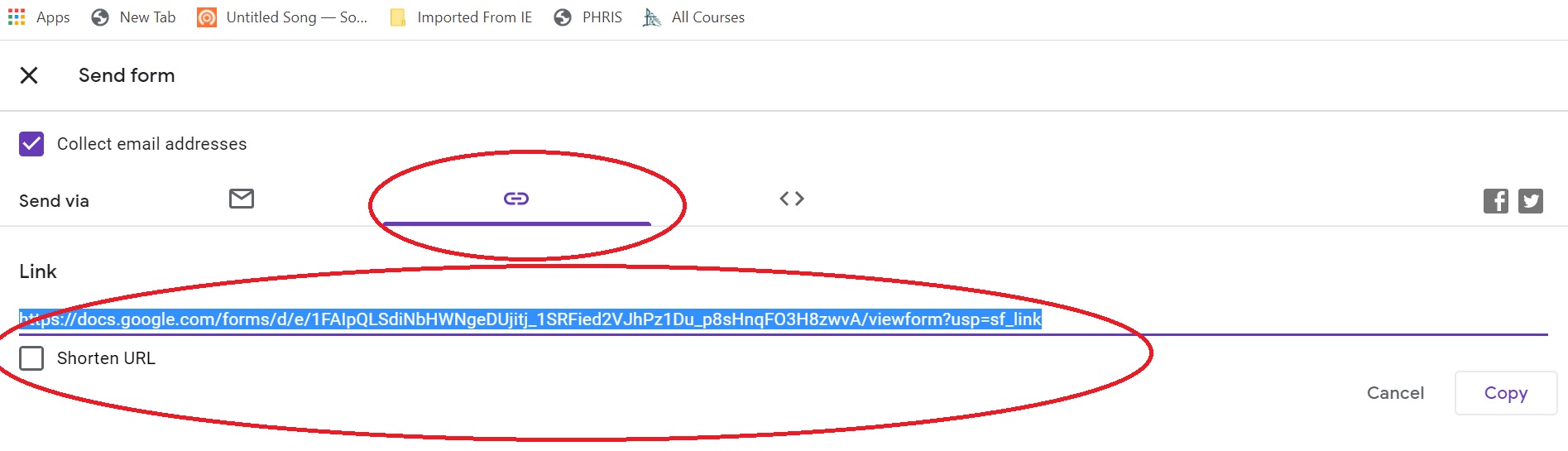
You can get the link to the google form by going to your copy of the form on google drive. Click on the send button and then select the link tab. This will provide you with the link you need.

The Canvas platform

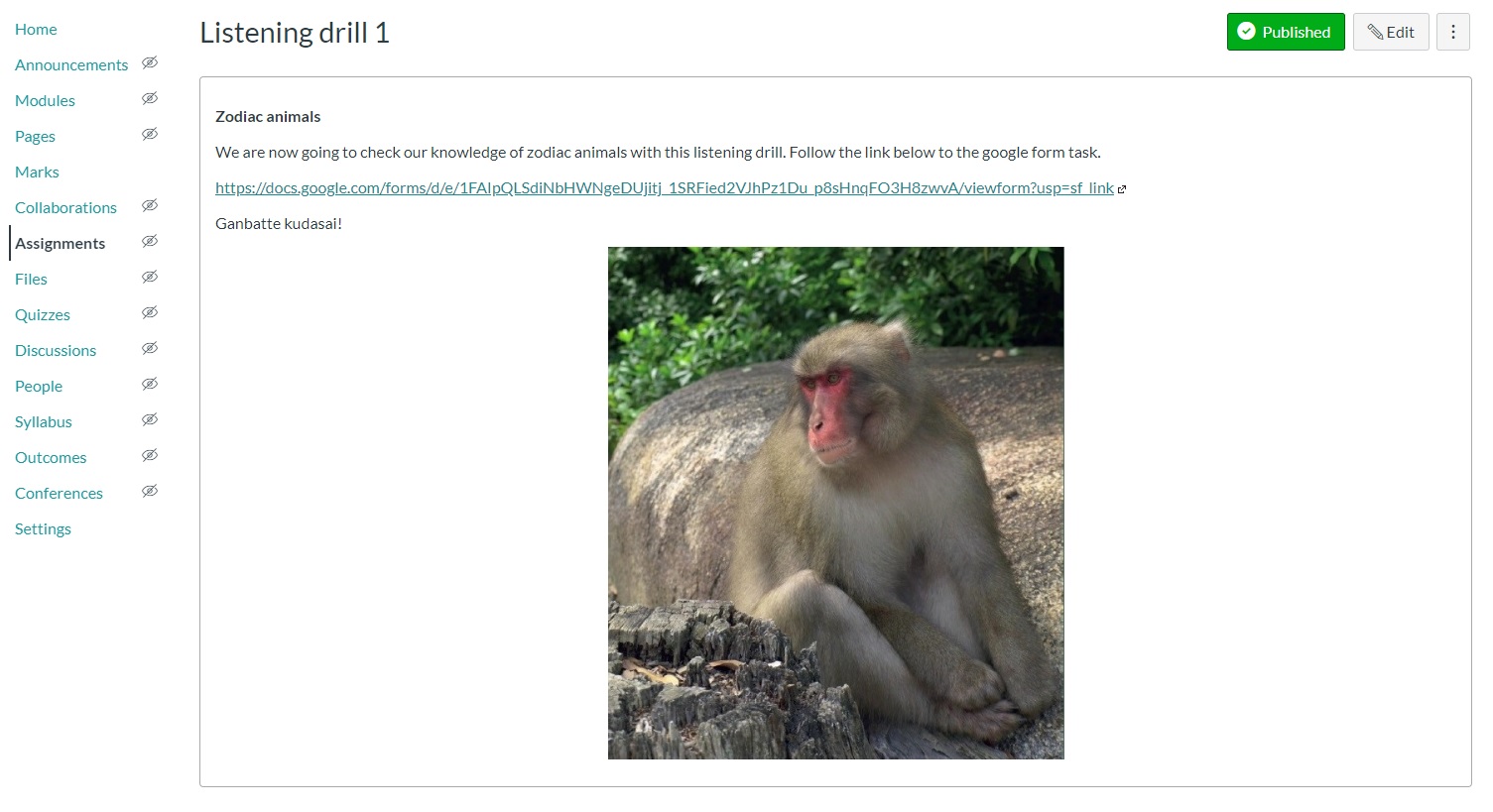
You can achieve the same thing in Canvas by adding the link to the google form and directing students out of Canvas to complete the form. (See above regarding how to get the link to your google form.) I added this to my module as an assignment page. If you want to keep the marks all in Canvas, you can manually add the score to Canvas if you add the points to the Canvas assignment set up.

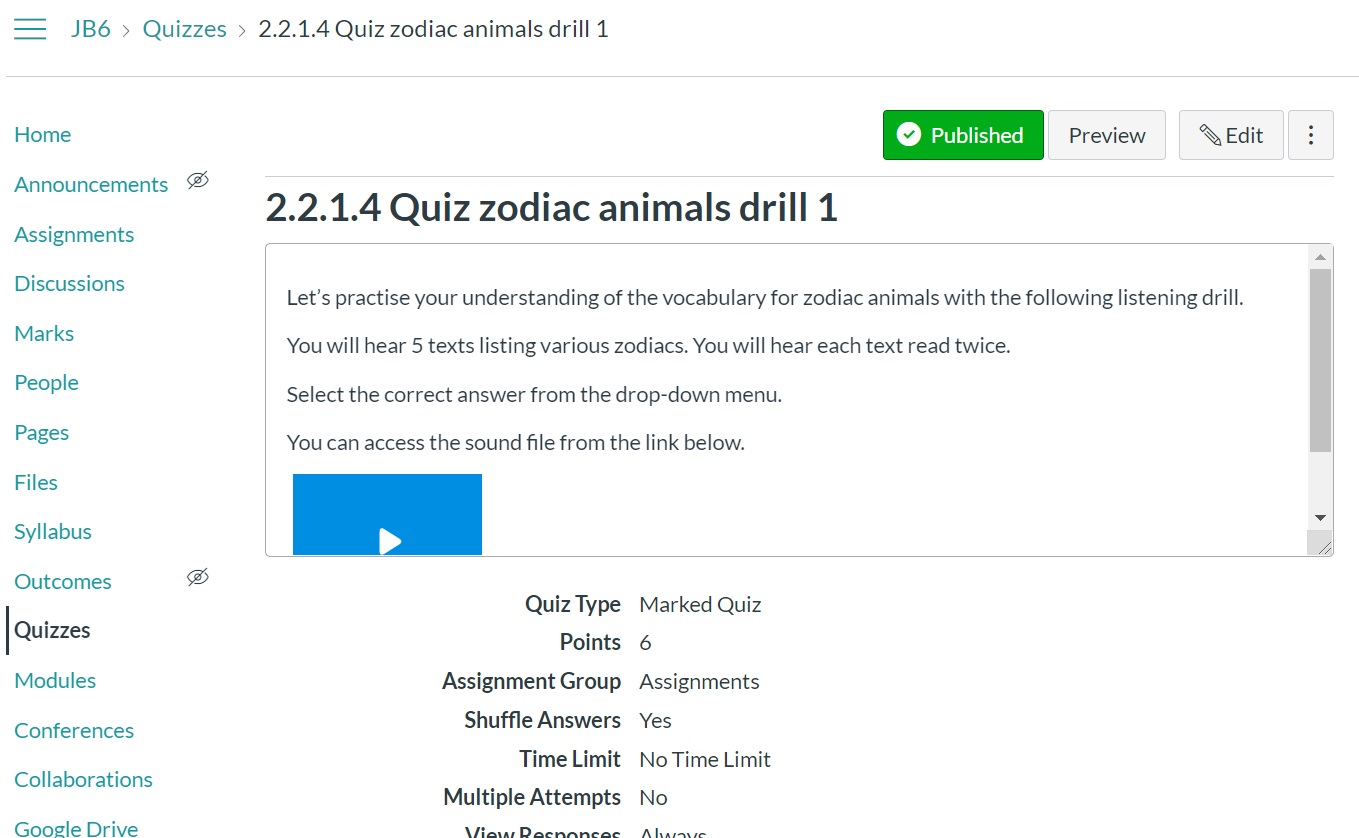
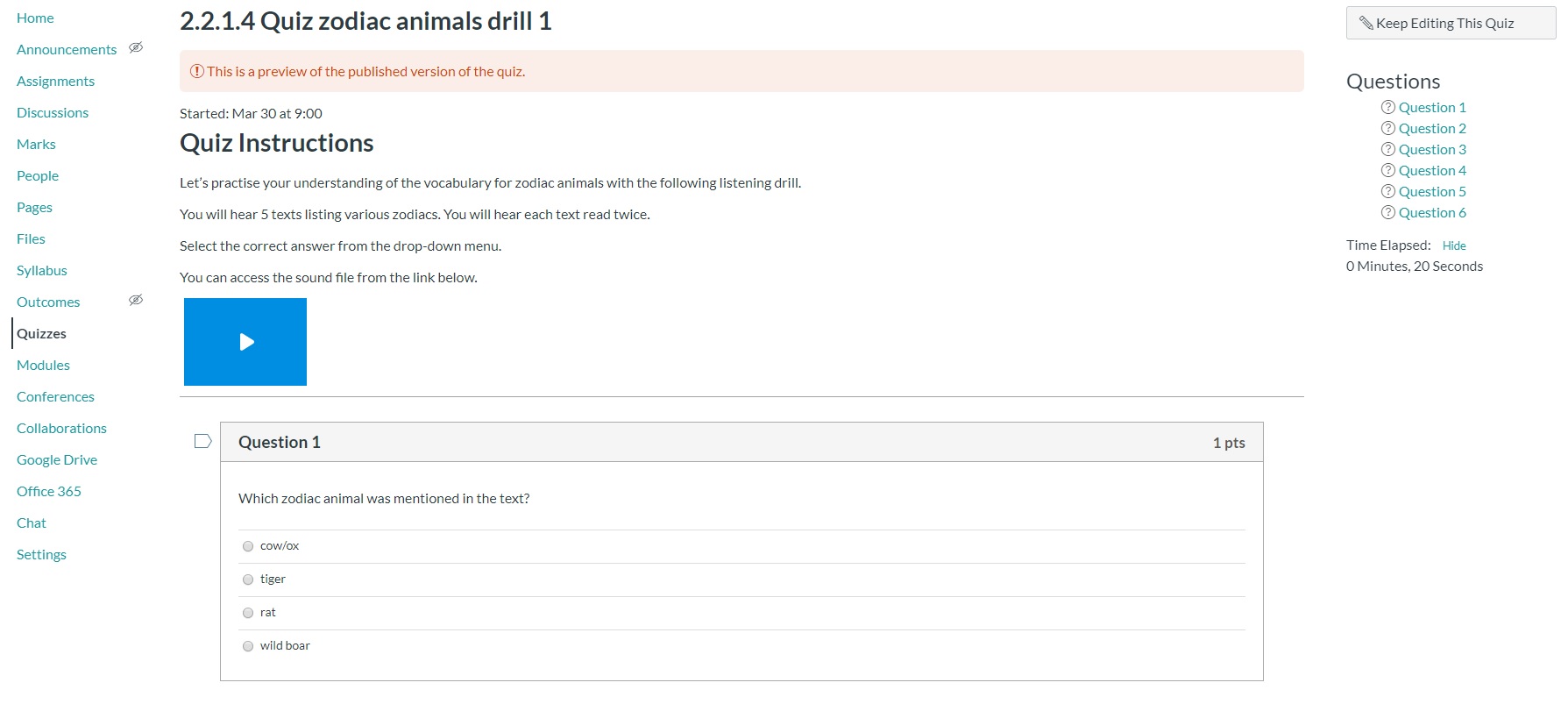
When you have more time, you may want to start moving the content into Canvas as a Canvas quiz and keep everything within the one program. You can do this by setting up a normal Canvas quiz page and adding the sound file for the quiz from your Jblog google folder.

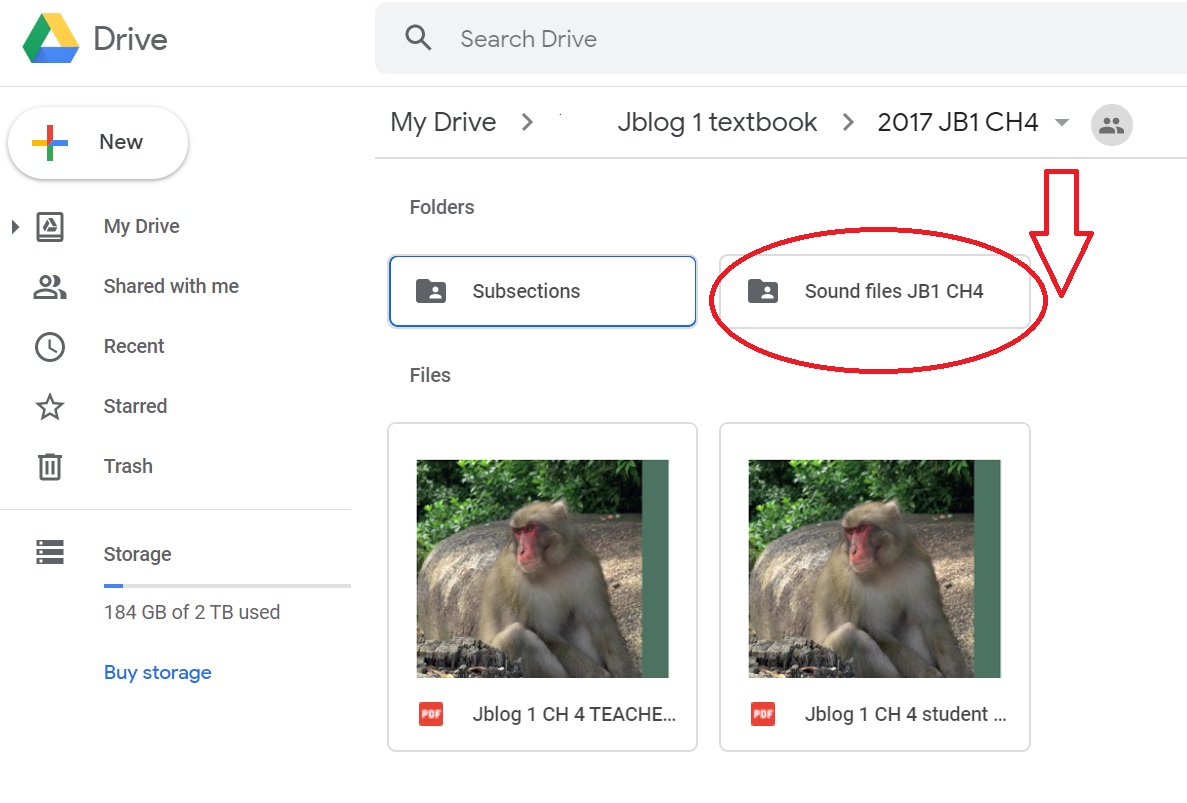
You can find the sound files in your google folder in the Sound files folder for the relevant chapter. Upload that sound file to Canvas by selecting the record/upload media button, then select the Upload media tab and Select audio file tab. I find this works better than inserting a link to a file as that tends to require a download and is less seamless.

You can then copy and paste the questions and answers into your new Canvas quiz from your old google quiz.

Good luck everybody. If you have questions or you get stuck, please feel free to contact me at  jblog1help@gmail.com .

We are all learning together and if I can help if some way, please let me.

Stay well.

Filed Under: Growth mindset, ICT, Teacher Wellbeing, Teaching and Learning, Uncategorized

Temptation bundling

October 18, 2019 by Manten Resources

Sometimes in life our actions have unexpected and even undesirable repercussions. I have a 12 year old son. He is an only child and has grown up in a somewhat nerdy household where we read a lot, believe learning another a language is normal and avoid a lot of mainstream media. His generation though are largely connected by the internet. When he started at a new school, we met some of his friends via video conference before we met in them or their parents in “real life”. We had encouraged him to be calm and quiet at home, but combined with his generation’s propensity for screen time, this had unexpected repercussions. We purchased him an exercise tracking device and realised that on a school day he would be lucky to reach 5000 steps – half the daily recommendation. We realised though that he had been merely doing what he was told. His teachers wanted him to sit still and listen – so he did. We drove him to school each day as it there are no buses from our suburb. When he came home, he wanted to read or go online. When was he supposed to be clocking up the 10 000 steps in this kind of lifestyle that we had created for him?

Around this time, I became aware of a concept called “temptation bundling”. This concept is a motivational strategy whereby you bundle an action you want to do with an action you need to do. For example, I had committed to a weekly task that I really wasn’t enjoying. I was beginning to dislike Thursdays because of this weekly commitment, even though the task was only a small part of the day. By contrast, something that I do enjoy is writing in the morning at a café that overlooks a marina. It is my special time to have a latte and look out at the boats as I play around with new ideas for resources or workshops. So, I combined the two in a temptation bundle. I allowed myself to only visit the café on Thursday mornings before I had to attend to the weekly commitment. In this way, I began to associate the commitment with my reward of writing time. The action I needed to do was the Thursday commitment, and the action I wanted to do was the café writing session.

We solved the problem of my son’s inactivity in the same way. The action he needed to do was move more for his long-term health. (I would like to emphasize that we were not concerned about diet or losing weight here, but rather the research into poor health associated with prolonged sitting for adults and children alike.) The action my son needed to do was exercise more, preferably outside in nature, to counteract his largely indoor school lifestyle. The action he wanted to do was purchase a mobile phone. We had told him he could have one when he started high school the following year. We also wanted him to appreciate the cost of such a device and to be responsible with such an expensive accessory. So, we developed a temptation bundle where he earned $5 for each day he walked 10 000 steps. We paid him in cash each week and then he banked it in a mobile phone account. We began by going for a walk after school to make up the shortfall. Soon though he came up with strategies like earning 2000 on the playground before school, and 2000 at recess and lunch. We had a bonus scheme where he earned an additional $5 if he made 15 000 or if he beat my score for the day. As his earnings grew, he came up with other ideas like joining me some days before school on my 6am walk. Exercise became a natural part of his identity as it fitted with his already present identity of someone who loves technology. His exercise was linked to his desire for technology. It has taken him months to earn the money and the habits of daily movement are now ingrained in his life.

So how does this relate to your teaching?

My latest project is called The Platform. This is a formative assessment tool pitched at Year 9 and 10 students. What do most students of this age want to do? In my experience, the answer is while away hours watching Youtube clips and drifting through social media posts. How can we make better use of this natural inclination to achieve learning gains in language study?

The Platform aims to create a temptation bundle where students become a member of a small group (2-4 students) to share videos that have interested them. They must write a minimum of 30 characters about each video and other members of the group have to respond to at least one post per learning cycle. I have created scaffolds to help them with this. Unlike regular tasks though, the students are rewarded for the quantity of writing they do, rather than the quality. We want them to experiment with language here, to focus on communicating with others for a real purpose and to practice vocabulary, grammar and script recognition on a regular basis. The teacher can then set group achievement goals such as a reward when all members of the group have written 100 ji each. Each post or comment is numbered and fortnightly reward draws could be held eg comment 21 wins a Japanese lolly or gets to sit in the tatami space or choose who to sit next to for that week. The more posts and comments you make the more chances you have of both improving your overall grade and winning the reward draw. There are two versions of this task included in the resource pack called Version 1 and Version 2.

This formative assessment tool could be used for writing in lieu of a formal task or it could be used as a tool to improve the learning culture and growth mindset of your cohort. You can read more about this task on our website at https://www.mantenresources.com.au/teachers/assessment/assessment-inspiration/ or email me at jblog1help@gmail.com .)

Good luck with your temptation bundling!

Filed Under: Assessment, Growth mindset, Student Engagement, Teaching and Learning

Is pedagogy essential to language teaching?

September 26, 2019 by Manten Resources

Pedagogy is defined as the “method and practice of teaching”. Pedagogy is where we learn the how of teaching. Most of us would agree it is as essential to a teacher as our content knowledge. It is just as difficult to be a Japanese teacher if you don’t know Japanese, as it is to teach Japanese as a native speaker if you don’t understand methodology.

So, let us agree on this point, teaching involves having something to teach and having the skills to share that knowledge with others.

But what about learning? What does it take to learn a language? Could we say that learning involves having someone or something to learn from and the skills to access that learning? Can we say with confidence that are language students are coming to us with those requisite skills?

Perhaps, the very first concepts we should be teaching in our language courses, is the how of learning. The success of all our subsequent lessons will be improved if students have fundamental knowledge of learning habits, study skills and motivation techniques. The poor continuation rates in languages suggest amongst other things, that students are not finding it an easy choice.

I have come to the conclusion, that explicit teaching of skills to access learning in language is the essential first step in the language journey. To this end, I have developed two short introductory courses for secondary students called Base Camp level 1 and level 2.

The first course is pitched at Year 7/8 students who may be beginning a language course for the first time. It covers five key concepts to develop student skills in learning and motivation. These include concepts such as implementation intentions, habit stacking and the two-minute rule.

The second course is pitched at Year 9/10 and 11/12 students who may have continued into elective courses. This sequence looks more closely at specific learning strategies to support independent learners. It suggests ways to revise and extend one’s knowledge in the macroskills using accessible resources from the students’ world. This includes various strategies to harness teenager obsession with social media for positive learning gains in language.

Although there are two levels, I would suggest that students who have not worked with the level 1 materials would benefit from working through those before attempting the level 2 materials. The Base Camp level 1 and 2 resource is sold as a set for $50 and can be purchased by emailing jblog1help@gmail.com .

I consider this resource a prerequisite bridging course for all language students. Don’t start 2020 without it!

Filed Under: Growth mindset, Student Engagement, Teaching and Learning

  • Page 1
  • Page 2
  • Page 3
  • Go to Next Page »

Primary Sidebar

Copyright © 2026 · Manten Resources - All Rights Reserved