• Skip to primary navigation
  • Skip to main content
  • Skip to primary sidebar

Manten Resources

Supporting your Japanese language program

  • Manten Resources
  • About
  • Teachers
    • Stage 6 Beginners
    • Jblog Textbooks
      • Jblog 1
      • Jblog 2
      • Jblog 3
      • Programming
    • Base Camp
    • Student Workbooks
    • Amazing Races
    • Assessment
      • Manten Exams
      • Assessment Inspiration
      • Script Resources
    • Blog Spot
  • Parents
  • Contact

Australian Curriculum

The new differentiation

May 11, 2019 by Manten Resources

Are you struggling with elective class enrolments? Feel like you are constantly fighting for support from the executive? Your problem may lie in differentiation – although not from the traditional perspective.

Differentiation is how we shape our teaching and learning activities to support the needs and interests of the students. Traditionally we focus on making materials accessible to students who are at different levels of understanding and ability at a given point in time. For example, the NSW syllabus groups content appropriate to mainstream, prior-learning and background student levels. In the Jblog textbook series, we differentiate questions at the green, blue and black level based on ski runs.

But what if we looked at differentiation from a different perspective?

I was recently inspired by Seth Godin’s book “This is Marketing.” In it, he writes:

It doesn’t make sense to make a key and then run around and looking for a lock to open. The only productive solution is to find a lock and then fashion a key. Its easier to make products and services for the customers you seek to serve than it is to find customers for your products and services. (pages 5-6)

How many of us are trying to sell a language program rather than creating a languages product that meets the needs of our key stakeholders? Do you even know what the needs and desires of your stakeholders are?

When I refer to stakeholders, I am considering the students, their parents, the school executive and the larger community. These stakeholder groups will influence to different degrees how relevant my languages product will be perceived. Some of you may argue that we shouldn’t have to do this, and that simply stating the many benefits of language learning should be enough. Seth Godin argues though, that “The status quo doesn’t shift because you’ re right. It shifts because the culture changes”. (page 122)

It is a mighty task to change the dominant culture of your stakeholders to align with a languages’ viewpoint. But it is less difficult to align your course with the dominant culture. How about differentiating your languages course to meet the needs and interests of those stakeholders? Can you differentiate to better reflect their values, rather than swim against the tide? One of our schools has a dominant culture that exults commerce and business. So we embraced that with a unit titled “The Intercultural marketing business case study”. Students learned about how marketing to a Japanese audience differs to an Australian audience. They learned how customer expectations of customer service are deeply embedded in the language and culture that we identify with. Those of you in NSW currently reprogramming for the new syllabus may like to embrace this shift in mindset as you develop new task-based programs.

We will be discussing this topic in more detail at our Noosa workshop July 13th. The extended workshop will give us time to look at examples of assessment tasks that align with different stakeholder values and dominant cultures. You can book online using Trybooking or email me at jblog1help@gmail.com to request an invoice for your school. We look forward to escaping the winter chill with you then.

Good luck with your programming!

Filed Under: Advocacy, Assessment, Australian Curriculum, Differentiation, Student Engagement

EARLY BIRD SALE – NOOSA WORKSHOP 2019

November 27, 2018 by Manten Resources

As we slide into the end of the year, many of us may be lacking the energy to feel inspired about 2019. Luckily, Junko Nichols and I have been working on some new ideas and activities to re-energise you next year at Noosa. The workshop is held July 13th which falls in the holidays for all the states, so we hope you can slot in a day with us. This year we are focusing on lots of take-away ideas and hands-on activities for primary and secondary teachers of Japanese.

We will be covering the following:

·       How to take a topical issue like “gender” and make the language accessible to students

·       How to use a newspaper article in English to develop speaking, reading and writing skills in Japanese

·       How to analyse stereotypes in the media using simple language and cover Learning Across the Curriculum content

·       Developing peer feedback skills in speaking tasks – your chance to sample our new Speaking stations resource

·       Effective ways to communicate with parents and increase school support at the primary level

·       Strategies to enable your students to contribute to the local community through language and charity work

·       Battling your nemesis subject at secondary schools – how to fight back and drive up those elective numbers

·       Incorporating soft-CLIL into primary art lessons

·       Simple print-making techniques inspired by Hokusai

·       Developing an appreciation of art and nature in students

·       Dabbling in Comprehensible Input theory – beginner strategies for circling questions and mini-grammar sub-lessons

·       Task-based learning – sample assessment task ideas

·       Embedding Aboriginal and Torres Strait Islander perspectives in your programs – actual resources and activities to get you started

It is going to be a HUGE day of learning, escaping the winter cold at the beautiful Pepper’s Resort, Noosa. The range of ideas is sure to raise your motivation levels during the mid-winter slump.

Early bird prices apply to the end of Term 1 only and places are strictly limited as this is designed as an intimate workshop.

To book your place, click here or email me at jblog1help@gmail.com  to discuss any aspects of the day. We hope to see you there!

Filed Under: Advocacy, Assessment, Australian Curriculum, Professional development, Teaching and Learning

SPEAKING STATIONS

November 12, 2018 by Manten Resources

When programming for the new syllabus, I noticed that I needed to create more opportunities for the students to meet the outcome LJA4-1C, in particular the following content point: “engage in collaborative activities that involve planning and making arrangements for example participating in class activities using set phrases in Japanese” (ACLJAC002).

Although we played games in my classes, I wanted to embed more target language use into the games and the way the students played together.

The result is the Speaking Stations Pack. The first of these packs to be released is aimed at Stage 4 (year 7/8). This version develops a student’s skills in the language content covered in Jblog textbook 1.

How to play

Students in pairs or small groups have a map of Mt Fuji that has 15 speaking stations. Student A throws a dice and moves along the path the number of places on the dice. Student B uses the question card to ask Student A the matching question for that station eg 「何才ですか」. Student A refers to their stimulus card which provides information in Japanese to help them answer the question. If Student A answers correctly, they can stay on the station. If they answer incorrectly, they must go back to the start. Student B is responsible for telling Student A if they are correct or not. Student B has the answers written on the question card. Students take turns rolling the dice and answering the question.

This game can be differentiated in two ways.

Firstly, each game has a script version (hiragana and basic kanji) and a romaji version (with romaji above the Japanese script). Students or teachers can select which is more appropriate for individual students.

Secondly, students can use the same question card or different question cards. For example, student A could be using the Dialogue Review Profile A card and student B could be using the Dialogue Review Profile D card.

click on image to view enlarged version

What topics are covered?

This Year 7/8 version covers the following topics:

Game 1 – Aisatsu

This game revises common aisatsu and has questions in English such as You arrive home to your homestay apartment. Greet your host family. The student would be expected to say “ただいま”.

Game 2 – Dialogue Review CH1-5

This game revises common self-introduction content such as name, age, birthday, number of people in your family etc. Students must refer to the profile they receive of a Japanese person to answer each question. The profile is provided in Japanese in a table format. The students use the stimulus to create an appropriate full sentence to respond. There are 3 versions of game 2 that use different Japanese profiles.

Game 3 – School life

This game revises common school life content such as if they like or dislike a subject, what period or day of the week they study a subject, what their favourite subject is etc. Students must refer to the profile they receive of a Japanese person to answer each question. The profile is provided in Japanese in a table format. The students use the stimulus to create an appropriate full sentence to respond. There are 3 versions of game 3 that use different Japanese profiles.

Game 4 – Shopping at the Bunkasai

This game revises content related to shopping, prices and classroom objects. The setting is purchasing classroom objects from a stall at the bunkasai. Students will be required to use Japanese language to ask what an item is, how much it costs, to pass items and to say thank you etc. There are 3 versions of game 4 that use different stimulus information.

click on image to view enlarged version

Composing option

Teachers may also like to follow this speaking task with a composing option. There are blank tables provided, that students could use to create their own versions of the game by composing the profiles/stimulus cards and sample answer cards. This activity would address the composing outcome LJA4-4C, in particular the content point, “Compose informative and imaginative texts in spoken, written and multimodal forms for a variety of purposes and audiences, using stimulus materials and modelled language (ACLJAC007).”

How much does it cost? What do I receive in the pack?

The pack costs $50 and includes:

  • A Mt Fuji game sheet with 15 stations
  • Game 1 – Aisatsu
  • Game 2 – Dialogue Review with 3 different profile versions
  • Game 3 – School Life with 3 different profile versions
  • Game 4 – Shopping at the Bunkasai with 3 different stimulus cards
  • All games include a scripted version and a romaji version
  • Student game explanation with suggested language to use when playing the game such as はい、どうぞ。(When passing the dice to each other.);さいころはどこですか。Where is the dice?; わたしのばん It is my turn.
  • Scaffolds to support the composing option of the game
  • Teacher guide


Teachers will receive all these items as PDFS or word documents. It is recommended that you laminate the game sheet. Teachers will need to supply their own dice and markers for the game.

To order, email jblog1help@gmail.com

Filed Under: Australian Curriculum, Differentiation, Student Engagement, Teaching and Learning

NEW SYLLABUS PROGRAMMING RESOURCE

September 4, 2018 by Manten Resources

2019 is the implementation year for the new syllabus in NSW for years 7 & 9. If you are feeling overwhelmed by the prospect of reprogramming for the new syllabus, then you may be interested in this resource.

The teacher guide to programming for Year 9 includes:

·       8 Sample programs – PDF versions

·       8 Sample programs in word (to enable you to edit as suits you)

·       An outcome and content mapping grid

·       A teacher guideline

This resource maps all the content and activities available in the Jblog 2 textbook, workbook, amazing races and sound files. Even if you are not using Jblog as your main textbook, you may find the suggested learning tasks adaptable to your current program.  It provides programming details such as suggested discussion questions and differentiation strategies for the 3 student pathways of the new syllabus (regular entry, students with prior learning and/or experience and background students). It also includes our regular differentiated content at the green, blue and black levels.

There are a lot of options in these programs so we suggest you just cut and paste the learning sequences that best suit your teaching group.

This resource is $100 and you can order by emailing jblog1help@gmail.com.

We hope it can help reduce some of the stress that can arise in an implementation year.

Click on the images below to access an enlarged view.


Filed Under: Australian Curriculum, Differentiation

Ideas for incorporating Sustainability in your program

March 7, 2018 by Manten Resources

Sustainability is one of the key cross-curriculum priorities of the Australian Curriculum. The environment is an obvious context for this content. Some teachers may be concerned that this topic  is too challenging for their students but it doesn’t have to be. Here are some ideas modelling how to differentiate an environmental unit.

This task is based on the content in chapter 7 of Jblog textbook 3. This unit introduces students to key environmental issues in Japan such as cleaning up Mt Fuji, the Fukushima nuclear power plant disaster and solar panel farm controversy. Students are then directed to consider their own impact on the environment. The following task from the student workbook could be used as the driving question for the unit.

Learning task : In pairs or small groups, choose an environmental issue in your community. What action could you take to help with this issue? Design promotional materials using Japanese (eg poster, flier, videoclip) to promote positive action for your cause.

Extension task: Research how other Japanese communities are grappling with your issue (or similar) in the Japanese context. (Students with prior learning and/or experience, background or who are working at a GT level should be encouraged to use realia in Japanese as part of this research.)

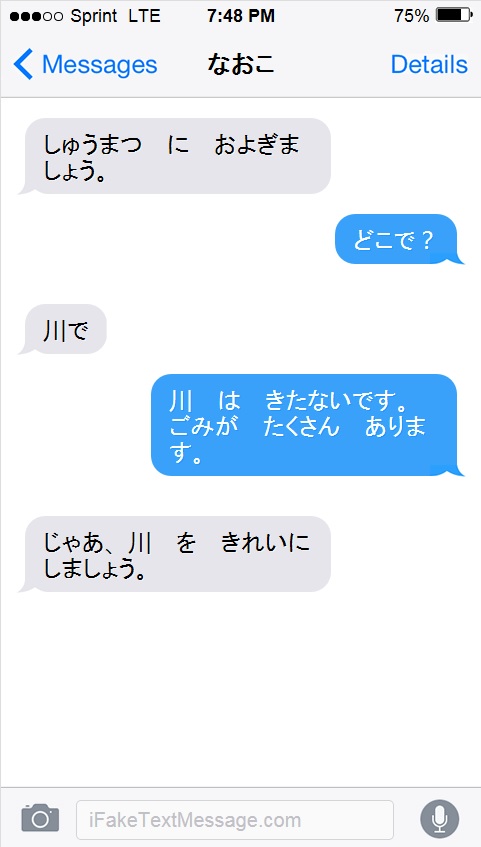
For students who are working at a lower level or who find composing in Japanese intimidating, using a Fake text app may make this more palatable. For example students could use the stimulus on page 86 of the textbook that advertises a river clean-up day. They could then write a series of text messages between two friends planning to attend the event.

 (Click on image to view as a larger image)

There are various applications out that can help you create fake text messages. I found this one was the easiest to use for me personally:  https://ifaketextmessage.com.

There are several more examples of how to create and use fake text messages in our March newsletter. If you missed it, please email me and I can send you through a back issue. You can sign up for our newsletter on the website homepage – just scroll to the bottom of the screen for the sign-up form.

Further reading:

You may also be interested in our post about the Australian Curriculum

Filed Under: Australian Curriculum, Differentiation, ICT

New Growth mindset formative assessment resource

January 4, 2018 by Manten Resources

Are you feeling motivated to freshen up your teaching and assessment task schedule? If you are looking for a way to embed growth mindset ideals in a formative assessment context, then this is the resource you have been looking for. The Stage 5 Formative Assessment Writing Resource is professional development for your department and a student assessment task all rolled into one. This resource provides you with everything you need to run the task plus a summary of the evidence based research that contributed to its design. You will learn how to facilitate the task and why each step is relevant to the learning process.

This task develops writing skills in Japanese. It is pitched at Stage 5 Year 9 students but could be modified to suit other grades.

This task will suit teachers who:

  • Are striving to develop peer feedback and self-analysis skills in their students
  • Are committed to growth mindset principles and the long term benefits for their students
  • Want to see their students learn from and use the feedback they receive in subsequent tasks
  • Want to increase the quality and quantity of feedback received by their students within a sustainable workload structure
  • Are looking for a fresh take on assessment, based on evidence based research


What is included in the Stage 5 Formative Assessment Writing Resource pack?

Each pack includes:

  • A student workbook to guide students through the stages of the task
  • A teacher support pack that explains each step, provides suggested outcomes, success criteria, an annotated student work sample of what constitutes effective and not so effective feedback, teacher marking comment bank, professional readings summaries
  • Peer feedback prompts worksheet
  • Self-analysis prompts worksheet
  • Student Pre-test google form
  • Growth mindset teacher marking comment bank
  • Student feedback sheet

How can I order a copy?

The total coast for the pack is $70. You can order simply by emailing jblog1help@gmail.com. Please provide us with the email address you would like the resource sent to and any billing requirements (eg bill to a school or as an individual, provide a quote only etc). The copyright allows you to print off the resources or edit them as you wish amongst the staff within your school campus. They cannot be shared with others outside your school campus.

This resource would work well with the Hiragana Patch and Katakana Patch resources. For more information on these visit : https://www.mantenresources.com.au/resources-teaching-scripts/


Filed Under: Assessment, Australian Curriculum, Growth mindset

  • Page 1
  • Page 2
  • Go to Next Page »

Primary Sidebar

Copyright © 2026 · Manten Resources - All Rights Reserved