• Skip to primary navigation
  • Skip to main content
  • Skip to primary sidebar

Manten Resources

Supporting your Japanese language program

  • Manten Resources
  • About
  • Teachers
    • Stage 6 Beginners
    • Jblog Textbooks
      • Jblog 1
      • Jblog 2
      • Jblog 3
      • Programming
    • Base Camp
    • Student Workbooks
    • Amazing Races
    • Assessment
      • Manten Exams
      • Assessment Inspiration
      • Script Resources
    • Blog Spot
  • Parents
  • Contact

Manten Resources

EARLY BIRD SALE – NOOSA WORKSHOP 2019

November 27, 2018 by Manten Resources

As we slide into the end of the year, many of us may be lacking the energy to feel inspired about 2019. Luckily, Junko Nichols and I have been working on some new ideas and activities to re-energise you next year at Noosa. The workshop is held July 13th which falls in the holidays for all the states, so we hope you can slot in a day with us. This year we are focusing on lots of take-away ideas and hands-on activities for primary and secondary teachers of Japanese.

We will be covering the following:

·       How to take a topical issue like “gender” and make the language accessible to students

·       How to use a newspaper article in English to develop speaking, reading and writing skills in Japanese

·       How to analyse stereotypes in the media using simple language and cover Learning Across the Curriculum content

·       Developing peer feedback skills in speaking tasks – your chance to sample our new Speaking stations resource

·       Effective ways to communicate with parents and increase school support at the primary level

·       Strategies to enable your students to contribute to the local community through language and charity work

·       Battling your nemesis subject at secondary schools – how to fight back and drive up those elective numbers

·       Incorporating soft-CLIL into primary art lessons

·       Simple print-making techniques inspired by Hokusai

·       Developing an appreciation of art and nature in students

·       Dabbling in Comprehensible Input theory – beginner strategies for circling questions and mini-grammar sub-lessons

·       Task-based learning – sample assessment task ideas

·       Embedding Aboriginal and Torres Strait Islander perspectives in your programs – actual resources and activities to get you started
It is going to be a HUGE day of learning, escaping the winter cold at the beautiful Pepper’s Resort, Noosa. The range of ideas is sure to raise your motivation levels during the mid-winter slump.

Early bird prices apply to the end of Term 1 only and places are strictly limited as this is designed as an intimate workshop.

To book your place, click here or email me at jblog1help@gmail.com  to discuss any aspects of the day. We hope to see you there!
Filed Under: Advocacy, Assessment, Australian Curriculum, Professional development, Teaching and Learning

SPEAKING STATIONS

November 12, 2018 by Manten Resources

When programming for the new syllabus, I noticed that I needed to create more opportunities for the students to meet the outcome LJA4-1C, in particular the following content point: “engage in collaborative activities that involve planning and making arrangements for example participating in class activities using set phrases in Japanese” (ACLJAC002).

Although we played games in my classes, I wanted to embed more target language use into the games and the way the students played together.

The result is the Speaking Stations Pack. The first of these packs to be released is aimed at Stage 4 (year 7/8). This version develops a student’s skills in the language content covered in Jblog textbook 1.

How to play

Students in pairs or small groups have a map of Mt Fuji that has 15 speaking stations. Student A throws a dice and moves along the path the number of places on the dice. Student B uses the question card to ask Student A the matching question for that station eg 「何才ですか」. Student A refers to their stimulus card which provides information in Japanese to help them answer the question. If Student A answers correctly, they can stay on the station. If they answer incorrectly, they must go back to the start. Student B is responsible for telling Student A if they are correct or not. Student B has the answers written on the question card. Students take turns rolling the dice and answering the question.

This game can be differentiated in two ways.

Firstly, each game has a script version (hiragana and basic kanji) and a romaji version (with romaji above the Japanese script). Students or teachers can select which is more appropriate for individual students.

Secondly, students can use the same question card or different question cards. For example, student A could be using the Dialogue Review Profile A card and student B could be using the Dialogue Review Profile D card.

click on image to view enlarged version
What topics are covered?

This Year 7/8 version covers the following topics:

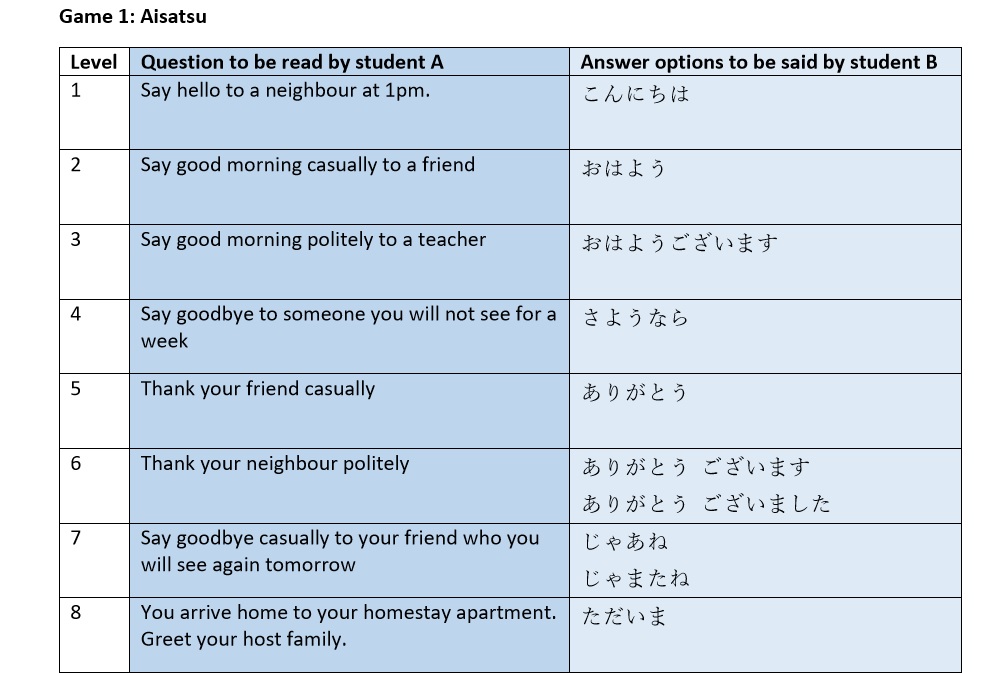
Game 1 – Aisatsu

This game revises common aisatsu and has questions in English such as You arrive home to your homestay apartment. Greet your host family. The student would be expected to say “ただいま”.

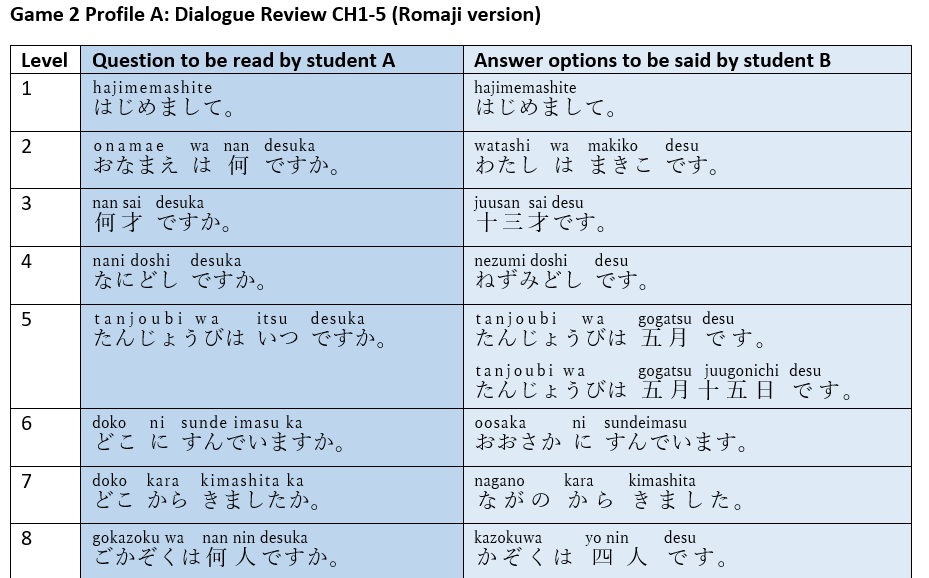
Game 2 – Dialogue Review CH1-5

This game revises common self-introduction content such as name, age, birthday, number of people in your family etc. Students must refer to the profile they receive of a Japanese person to answer each question. The profile is provided in Japanese in a table format. The students use the stimulus to create an appropriate full sentence to respond. There are 3 versions of game 2 that use different Japanese profiles.

Game 3 – School life

This game revises common school life content such as if they like or dislike a subject, what period or day of the week they study a subject, what their favourite subject is etc. Students must refer to the profile they receive of a Japanese person to answer each question. The profile is provided in Japanese in a table format. The students use the stimulus to create an appropriate full sentence to respond. There are 3 versions of game 3 that use different Japanese profiles.

Game 4 – Shopping at the Bunkasai

This game revises content related to shopping, prices and classroom objects. The setting is purchasing classroom objects from a stall at the bunkasai. Students will be required to use Japanese language to ask what an item is, how much it costs, to pass items and to say thank you etc. There are 3 versions of game 4 that use different stimulus information.

click on image to view enlarged version
Composing option

Teachers may also like to follow this speaking task with a composing option. There are blank tables provided, that students could use to create their own versions of the game by composing the profiles/stimulus cards and sample answer cards. This activity would address the composing outcome LJA4-4C, in particular the content point, “Compose informative and imaginative texts in spoken, written and multimodal forms for a variety of purposes and audiences, using stimulus materials and modelled language (ACLJAC007).”

How much does it cost? What do I receive in the pack?

The pack costs $50 and includes:

  • A Mt Fuji game sheet with 15 stations
  • Game 1 – Aisatsu
  • Game 2 – Dialogue Review with 3 different profile versions
  • Game 3 – School Life with 3 different profile versions
  • Game 4 – Shopping at the Bunkasai with 3 different stimulus cards
  • All games include a scripted version and a romaji version
  • Student game explanation with suggested language to use when playing the game such as はい、どうぞ。(When passing the dice to each other.);さいころはどこですか。Where is the dice?; わたしのばん It is my turn.
  • Scaffolds to support the composing option of the game
  • Teacher guide


Teachers will receive all these items as PDFS or word documents. It is recommended that you laminate the game sheet. Teachers will need to supply their own dice and markers for the game.

To order, email jblog1help@gmail.com

Filed Under: Australian Curriculum, Differentiation, Student Engagement, Teaching and Learning

NEW SYLLABUS PROGRAMMING RESOURCE

September 4, 2018 by Manten Resources

2019 is the implementation year for the new syllabus in NSW for years 7 & 9. If you are feeling overwhelmed by the prospect of reprogramming for the new syllabus, then you may be interested in this resource.

The teacher guide to programming for Year 9 includes:

·       8 Sample programs – PDF versions

·       8 Sample programs in word (to enable you to edit as suits you)

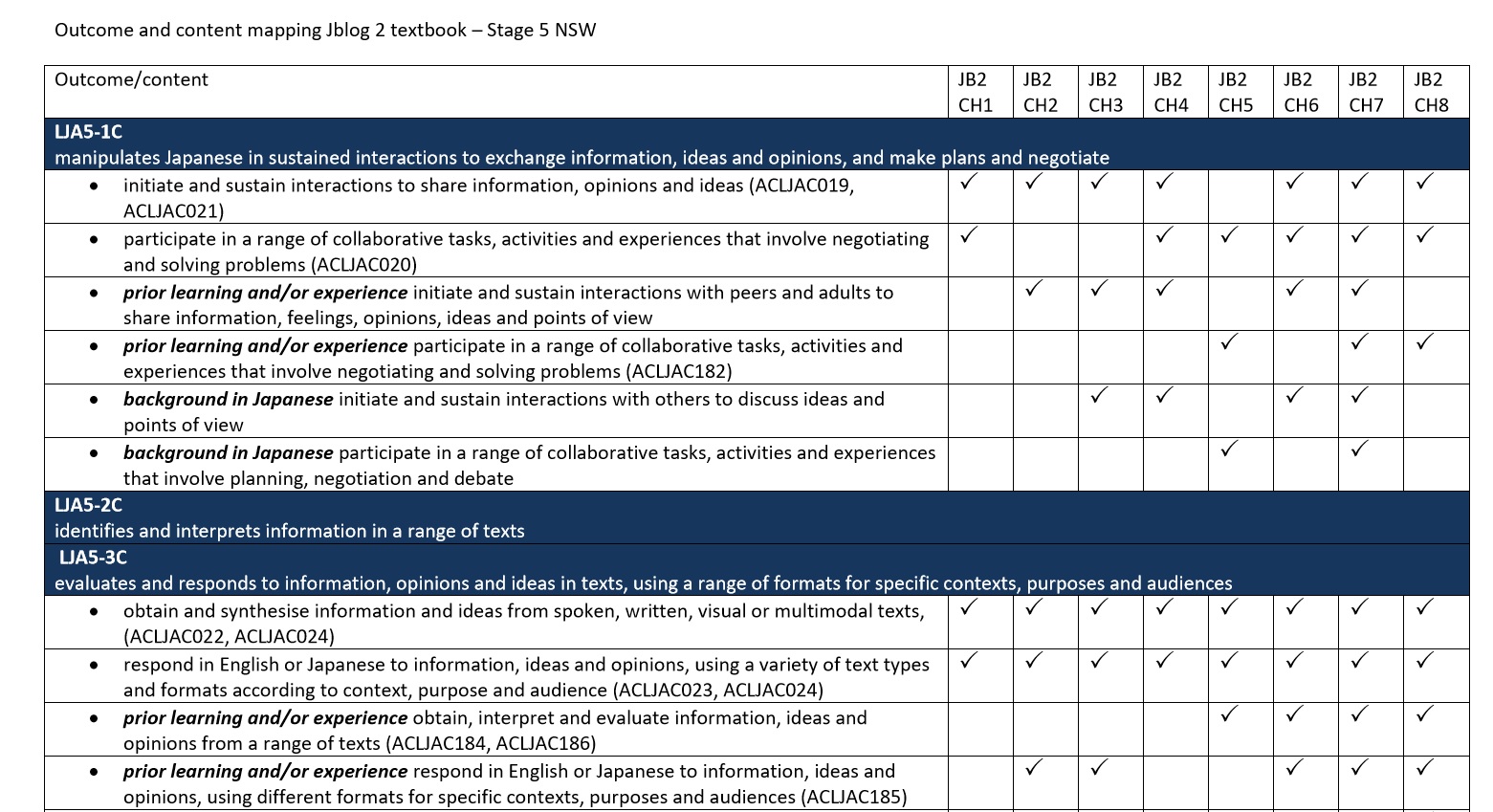
·       An outcome and content mapping grid

·       A teacher guideline

This resource maps all the content and activities available in the Jblog 2 textbook, workbook, amazing races and sound files. Even if you are not using Jblog as your main textbook, you may find the suggested learning tasks adaptable to your current program.  It provides programming details such as suggested discussion questions and differentiation strategies for the 3 student pathways of the new syllabus (regular entry, students with prior learning and/or experience and background students). It also includes our regular differentiated content at the green, blue and black levels.

There are a lot of options in these programs so we suggest you just cut and paste the learning sequences that best suit your teaching group.

This resource is $100 and you can order by emailing jblog1help@gmail.com.

We hope it can help reduce some of the stress that can arise in an implementation year.

Click on the images below to access an enlarged view.


Filed Under: Australian Curriculum, Differentiation

Ideas for Japanese visits to your school

July 21, 2018 by Manten Resources

Term 3 is a popular time for Japanese students to visit your school. Having students visit your class and interact with your students is great fun but it can be nerve-wracking planning enough activities to keep everyone engaged. Here are 3 of my favourite ideas that get your students interacting.

1.Paired Kahoot

These kahoots are bilingual with questions in one language and answer options in another. This encourages the Australian and Japanese students to talk together to work out each answer. Lots of gestures and laughs to be had. Below are links to two different versions. If you can’t gain access via the link search kahoot for games made by Manten resources or jblog textbooks and should find these. Feel free to make a copy and edit them to better suit your students.

Japanese group quiz re Australia

Japanese visitor quiz 

2.Bilingual Amazing Race

Again, this activity is bilingual requiring collaboration between the Japanese and Australian students. There is a free download of an entire game including worksheets, answers, game cards and sound file. The instructions can also be found on our site via the link below.

https://www.mantenresources.com.au/teachers/our-resources/amazing-races/

3.Use your visitors to help with speaking assessments

We run our Year 8 assessment task during the annual school visit from Japan. Our students plan 3 questions to ask the visitors in Japanese and they must answer one question in Japanese. This is all filmed on their mobile phones or devices and submitted. Our students are so excited that their Japanese actually “works” and are often keen to show their parents when they get home.

For our Year 9 students, we ran a joint speaking contest where the students are buddied up for an interview style contest. They worked together in the previous term prior to the visit online, to draft sample answers. When the visitors arrive, they have one lesson to practice face to face and then we run the speech contest in real time. We award a joint trophy and have a pizza and sushi lunch together. 

Check out our Facebook page August 4 2017 for more details.You will need to scroll down to that date to find it, sorry!) https://www.facebook.com/mantenresources/ 


Filed Under: Advocacy, Student Engagement, Teaching and Learning

Choose your weapons wisely

May 11, 2018 by Manten Resources

This week I had an interesting conversation with a dedicated Japanese teacher. She mentioned casually that she felt “guilty” about purchasing some of our resources. I found this comment to be a real insight into our practice. It is also not a sentiment shared by many other industries or even other subjects. For some reason, as language teachers we are made to feel that not only do we need to know our subject well, our students well and have a good range of pedagogical strategies to draw upon, but that we also need to create every resource from scratch. Can you imagine a plumber rushing off to design his own pipes or a doctor being expected to manufacture his own medicines? Nobody has such expectations for other industries so please shrug off this unnecessary yoke of teaching.

In this month’s newsletter I am writing in more detail about some of the technological applications available to us to support formative assessment. Here are a few ideas we all need to consider when making decisions about ICT in general.

1. Choose the teacher strategy and content first

It is so tempting to jump on a bandwagon and start using technology because other people are doing it. This may have short-term benefits by grabbing the attention of the students due to the novelty factor. You may also become more enthusiastic as a teacher as you are excited about the new direction. These are both legitimate short-term benefits, but you also need to consider the longer term. Eventually the newness will wear off for both you and the students, so you need to ensure that there are other benefits from this technological choice. Is it more efficient? Is it saving you time because you can easily reuse or modify it for future lessons? Does it provide you with insights into the students’ progress and/or perspective/experience of the lesson?

2. Be mindful

Sometimes you may find a great youtube clip that you just want to use to settle the class or as a transition activity, rather than as a main source of content. That is fine, as long as you are mindful of what you are doing. Question each resource and activity before and after each lesson. Are you doing that task because you did it last year or because you feel it will suit this year’s cohort as well? What information is allowing you to make that decision?

3. What is your learning intention?

The term “fit for purpose” is often used when considering types of assessment. It suggests that formative assessment is preferable for certain purposes, and summative for others. Similarly, your technology and use of it, needs to match the purpose of your lesson. If you are promoting a growth mindset, you may want to question why you have grades/marks on your google form, or why the students do not have the option of editing the form? How you use the tools is just as important as how you select them.

Three Resources that will save you time and don’t cost the earth

  1. Manten Exams. Choose from our content library to create your own exams. Listening tasks rendered to your personal selection without an embargo date! https://www.mantenresources.com.au/teachers/assessment/manten-exams/
  2. Hiragana Patch and the Katakana and Kanji equivalents. Script resources that emphasise growth mindset and a formative approach to script mastery. https://www.mantenresources.com.au/teachers/resources-teaching-scripts/
  3. Amazing Race sets. Collaborative tasks covering all skills and mapped to Australian Curriculum outcomes and cross-curriculum content such as literacy and Aboriginal and Torres Strait Islander perspectives. https://www.mantenresources.com.au/teachers/our-resources/amazing-races/

Yes, we know you are capable, of creating everything from scratch, because language teachers are creative and talented people. But is this the best use of your precious time? You do deserve a weekend too!

Filed Under: Assessment, Growth mindset, Teacher Wellbeing, Teaching and Learning

Teachers as growth mindset role models

April 25, 2018 by Manten Resources

One of the most powerful aspects of teaching is the potential to influence students. Although many teachers may feel powerless personally in the larger educational system, they can be extremely influential on a student’s development.

Last week I presented in Melbourne on growth mindset research. We discussed the impact our individual position on the growth and fixed mindset continuum can have on our perspective of ourselves and of our students. We noted that a growth mindset means we believe that anyone can improve with focus and practice, including ourselves and the students in our classes. If we have a fixed mindset, we may focus on the “best” students and discourage others from continuing due to their lack of “natural talent”. Dweck’s research showed that students who had a strong growth mindset had greater learning gains over time than those with a fixed mindset – even when the fixed mindset was a belief that they were clever or natural at something.

Recently I have developed a passion for formative assessment research (or Assessment for Learning as it is also known as). One of the key findings is that students around the world (including research in Japan, Hong Kong, Norway and Sweden) appreciate and learn well from task samples. This means if you are setting a self-introduction letter as a task, they want to look at other sample letters and have the opportunity to learn from those exemplars. They need opportunities to calibrate their understanding and expectations of themselves against the samples, and to reflect on the reactions of others towards those samples.

So how does this relate to us as teachers? Dweck’s research demonstrated that we vary in our degree of fixed or growth mindset according to the context, and that we all have the potential to change our mindset. So we may have a growth mindset about learning language but a fixed mindset about technology. The key is to develop our metacognitive (thinking) skills to help us consciously transfer some of our growth mindset skills in one area, to other areas where we may be a little more fixed.

The best way to do improve the growth mindset of your students is to act as a growth mindset role model yourself. Show them how you face your own insecurities about a field (eg technology) and push yourself to have a go. Try a new website/activity/app with them and talk them through your thinking skills. Admit this is the first time to try it and that there may be some issues. Ask for feedback about what went well (or not so well), and more importantly how you could improve it next time. Commit together to trying it again. They will learn from your bravery and begin to see that feedback can be used as a tool for learning. It does not need to be a weapon of judgement in a summative context.

My personal challenge this month is Nearpod. I attended the talented Shingo Gibson-Suzuki’s workshop at the JLTAV conference on this topic. Shingo is very good at technology – but I recognise that his expertise is not only due to a natural talent in the field, but a honed skill developed through years of being curious about new applications and experimenting with them. Just watching Shingo doesn’t make me proficient in Nearpod. I need to use it myself and learn from the obstacles that arise. So this week I have made two Nearpod lessons. The first I loaded on my Facebook page to keep myself honest. I learned from that attempt. If I am honest with myself, the first attempt found me trying to do what I usually do in a new medium.

The second attempt I will share via the link below. In this version, I tried to take more on board the essence of Nearpod – that it is there to collect feedback and formative information from the students. This activity is linked to a unit on Okinawa which is chapter 4 of Jblog textbook 3.

https://share.nearpod.com/WtYQSIkJoM

If you find this lesson useful, you can email me (jblog1help@gmail.com) for an editable copy that you can use in your own classes. I also have a PDF with sample answers.

My challenge to you this month is to stretch yourself in an area of development. Choose one thing you have wanted to try and give it a go. Maybe it is an activity from some recent Professional Learning or just an idea you have been putting off due to other commitments. Prioritize your own learning and growth and model to your students your effort, bravery and commitment.

You may find your students will learn just as much from the experience as you do.

Reference : Dweck, C.S. (2006). Mindset: the new psychology of success. Random House.

Further reading:

You may also be interested in our post on growth mindset at https://www.mantenresources.com.au/teachers/blog/growth-mindset-more-than-just-a-poster-on-the-wall/


Filed Under: Growth mindset, Professional development, Teaching and Learning

  • « Go to Previous Page
  • Page 1
  • Interim pages omitted …
  • Page 6
  • Page 7
  • Page 8
  • Page 9
  • Page 10
  • Page 11
  • Go to Next Page »

Primary Sidebar

Copyright © 2026 · Manten Resources - All Rights Reserved