• Skip to primary navigation
  • Skip to main content
  • Skip to primary sidebar

Manten Resources

Supporting your Japanese language program

  • Manten Resources
  • About
  • Teachers
    • Stage 6 Beginners
    • Jblog Textbooks
      • Jblog 1
      • Jblog 2
      • Jblog 3
      • Programming
    • Base Camp
    • Student Workbooks
    • Amazing Races
    • Assessment
      • Manten Exams
      • Assessment Inspiration
      • Script Resources
    • Blog Spot
  • Parents
  • Contact

Manten Resources

The wait is over!

November 24, 2020 by Manten Resources

The new support resources for Jblog 4 are now ready including your new programs, student workbook tasks, teacher marking guidelines, sound files and google forms. Take the stress out of the final week of term and buy yourself some time with this useful pack. Your entire year 11 lesson prep is done for $600. This set supports Jblog 4 the new Stage 6 Beginners course.

Haven’t ordered your copies yet? $70 plus postage for the textbook that covers both Year 11 and 12.

Teaching continuers but looking for additional reading texts – then you need a copy too! Includes current topics such as COVID-19 and veganism.

To order any of our resources just email me at jblog1help@gmail.com and request a quote or invoice.
Filed Under: Teacher Wellbeing, Teaching and Learning

New support resources for Stage 6 Beginners

October 19, 2020 by Manten Resources

By now many of you have sampled the new Jblog 4 Express textbook specifically designed to support the teaching of the NSW Stage 6 Beginners course. Even if you are teaching the Stage 6 Continuers course you may like to have a copy as a teacher’s reference material. Last week I was working with a group of Continuers students and found it handy to share just a few pages on topics they needed further review in such as directions and note writing. We all know you can never have enough sample texts!

Some very organised teachers have contacted me already about the support resources for the Beginners course in 2021 and have even pre-ordered these now to spread the cost over the 2020 and 2021 budgets. If you also need to be invoiced prior to your budget cut-off date in 2020 do not hesitate to email me at jblog1help@gmail.com to discuss.

So, what is in store for the Beginners course?

Those of you who have used Manten resources for your junior classes will be familiar with our unique student workbook system. We don’t sell individual student workbooks but rather use a one-off payment pack that you can use with as many students as you like forever. We use this system for Jblog 1,2,3 and are creating a similar package for Jblog 4. We try to accommodate everyone’s budget limitations though, so we are offering a few options for Jblog 4 as listed below.

We will be releasing the Year 11 support options in the following forms:

  • The deluxe pack – all programmes, student workbook pdfs, teacher marking guidelines, sound files, google forms. Basically, your unit is ready to go. $100 per unit or $600 for the full year 11 course.
  • The budget pack – Program and teacher marking guidelines only – $50 each unit or $300  for the full year 11 course. You can see all the suggested activities and sample answers for the workbook tasks.
  • The overview pack –  teacher marking guidelines only -$150 for the set of Year 11 course of teacher marking guidelines.

We aim to release the Year 11 resources as they are completed over the remainder of this year. We will release similar content for Year 12 in 2021. The Jblog 4 Express student workbooks will be released to you as PDFs and as a word document so you can edit it as you like. You can delete tasks you don’t like and add in your favourite current worksheets easily.

What other resources do you have for Beginners?

If you are teaching the Stage 6 Beginners course, you may find the following resources relevant for your school setting:

  • Teaching script – hiragana, katakana and kanji

Hiragana and katakana patch

The Beginners Patch for Kanji (Set A and B)

  • Year 11 Assessment task ideas

Listening and writing skills

Reading and speaking skills

  • Introduction to general language learning skills and motivational ideas

Base Camp

As always, if there is a resource you would love us to make, or you have an issue unique to your school that you would like some assistance with, please don’t hesitate to contact me at jblog1help@gmail.com . Nothing makes me happier than being able to help make your job a little easier.


Filed Under: Assessment, Growth mindset, Student Engagement, Teaching and Learning

Finding time for the 4 skills in the new syllabus

October 14, 2020 by Manten Resources

The new syllabus directions encourage us as teachers to help students develop knowledge across all the specific skills in a more fluid manner than we did in the past. Previously we may have planned our lessons around single skill-based tasks such as a listening drill, a speaking task, a reading comprehension and a writing task. The new syllabus goes as far as grouping skills such as reading and listening under terms such as Accessing and responding. In order to better prepare students to develop such a fluid mindset I have been reflecting on how we can structure activities in class to develop such skills simultaneously. Here are 3 ideas I have been enjoying this week.

1.The question word warm-up

Due to the structure of our exam system in Year 11 and 12, students tend to focus their language learning on being able to answer questions, rather than ask them of each other. As such, I find many of their speaking errors are actually due to not focusing on the specific question word used. They tend to predict rather than consider what is being ask of them. For example, a common error if you ask what grade are you in (何年生ですか。) is to tell me their age confusing the two common questions (何才ですか。). I know that they know the answers to both of these questions so the error is not an issue of ability but rather an issue of  unfocused listening.

This warm-up activity begins by having students brainstorm all known question words in Japanese such as いつ、なに、どこ. I then selected the question they had remembered least well and had them jot down, if they could, 3 questions using this word. Each student then had to tell me one of their questions and I wrote it on the board helping them correct any errors that may have been in their original question. Once the questions were on the board, the students had to choose one, read out the question and respond to it. This allowed for natural differentiation as students self-selected the question they felt confident answering.

If you have a large class, you can have them do the task in pairs or threes, generating the initial questions and generating the answers together.

2.The uso/maji game.

I have a son in Year 7  so I know personally how hard it can be for teenagers to listen to others and process what the other person is actually saying! This game works on improving this weakness.

Students are asked to write 4 statements about themselves in Japanese. This could be as simple as 4 statements using すき・きらい or as sophisticated as describing experiences they may or may not have had using たことがあります. Three of the statements are true and one is false (or you could do the opposite.)

The rest of the class then listens to the student read out their statements and they have to decide which is the うそ(lie). They write down in their books the statement in the following way : うそは「へびが好きです」。The teacher calls on 3 people to read their guesses and the student who wrote the statements answers with either 「はい、うそです。」or 「いいえ、まじです。」. I found the students loved to use the slang まじ (for real)  and it gave the game more a more “edgy feel”.

Again, in larger classes, you can do the task in pairs or small groups. For younger students you may want to focus on particular scaffolds for grammar structures you are studying. For older students I would correct on the spot if they had any errors and write the changed sentence on the board if needed.

3.The writing stimulus

For Senior students encouraging them to write more frequently is always a challenge. I find boys in particular struggle in writing tasks because they try to stick to the truth, rather than write well within the confines of their vocabulary and grammatical knowledge. This task works on improving the students ability to be imaginative and flexible when answering in the writing task space.

We began this task by looking at 4 stimulus questions from their textbook which happened to be about travel in the future tense. The questions focused on where the person was going, by what mode of transport, how long it would take and what they would do there. I then paired the students up and had them answer those question in the past tense reflecting on the recent school holidays. The answers could be as bland as “I went to the local shops by train and went shopping.” Student A then took that information and had to write a recount of Student B’s day. They were allowed to be imaginative within appropriate boundaries. I found by writing about another, based on very scant details they were better able to move beyond the truth and tap into a creative response within the confines of their language ability. We did the speaking aspect of the task during class and the writing task at home.


All three tasks aim to move from one skill to another fluidly, combining listening and speaking with reading and writing as much as possible.

Other posts you may like:

SPEAKING STATIONS

Enabling student success in languages

Improving productive skills via contemporary issues

Filed Under: Differentiation, Student Engagement, Teaching and Learning

The Grammar Patch Enrichment program

September 23, 2020 by Manten Resources

Today I am excited to release a new resource to help address differentiation needs in our students. 2020 has been a very challenging year to say the least, and our students have coped with the changes and challenges in different ways. Unfortunately, this means that the learning gaps that occur naturally are more pronounced this year. The Grammar Patch Enrichment program aims to help “patch” up missed learning for those who need it, and extend others who are ready for more. It is also useful post-assessment as part of the feedback cycle.

The purpose of the grammar patch series

We know that teaching vibrant language lessons in a real context is current best practice. In this method, we teach students how to achieve a task, and the language and grammar they need to do this is embedded into the unit organically. Our programs are task-based and Manten Resources whole-heartedly embraces this direction in Languages education.

This resource is not designed as a lesson plan or programming tool. Instead I envisaged this tool being used in the following ways.

1.Post-task feedback

Sometimes when we have students complete a task, we notice that they have gaps in their understanding. They may have achieved the task, for example, of writing a diary about a visit to Japan. They successfully observed features of the text type, correctly used hiragana, katakana and kanji scripts and expressed their ideas in a logically structured manner. Your feedback to them may instead be around a misunderstanding in grammar. They may be consistently making errors in tenses or just not understanding how to inflect verbs into the て form. In this case, you may find this resource useful because you can prescribe to them some additional practice and follow-up on these weaker areas. This is explicit teaching for current misunderstandings. Often teacher comments fall into the trap of vague suggestions such as “You need to work on your tenses.” Or “Take care with the て form.”  Unless we give the students explicit practice as part of their learning, feedback and reflection cycle, the opportunity to demonstrate growth and new understanding may be missed.

Just as a tennis coach knows practising volleys is not playing tennis, there is a place for drills when a specific skill needs to be strengthened.

2.Progress indicator

Sarah Pavy’s research indicated that one of the reasons students struggle with motivation in language learning is the lack of obvious progress indicators. From a business perspective, you also hear the phrase “You manage what you measure”. Many students enjoy the sense of progress that comes from moving forward along a known pathway. Unfortunately, sometimes students feel this is hidden in language courses and that the teacher controls the pace, time on task and content of the program. This resource is useful for such students. They can be working on the task-based content of the class program but also work their own way through the grammar patterns that can be applied to the tasks they do in class.

3.Extension tool or catch-up program

In a perfect teaching world, all the students arrive in your class on day 1 of the course, turn up to your class every day and stay until the end of their schooling. The reality of teaching is very different, as we know. We regularly have students join the course midway, transfer from another subject or school, or miss chunks of schooling due to sporting competitions or family vacations. This resource can be used to extend students who have already mastered the content you are teaching or to help others catch-up on missed learning. Some students just love grammar and will find pleasure in working their way through the booklets, treating them like a giant to-do list for Japanese. I was one of these people as a student, and loved working my way through grammar dictionaries and trying out the new structures with my friends.

4.Verb vocabulary extender

Growth mindset research has taught us that students with a fixed mindset tend to play it safe and avoid taking risks in their learning for fear of making a mistake. This often results in students using the same familiar verbs, over and over again in their spoken and written texts.

The grammar patch aims to extend student confidence with a wide range of verbs by focusing on different verbs in each grammar level. There are flashcards with these verbs inflected for students to practice with, allowing them to develop both their knowledge of the structure and the meaning of these new verbs simultaneously. Students with a fixed mindset will feel comfortable though as the list is determined, allowing them to extend their knowledge in what they see as a “safe environment”.

How can I purchase it and what do I get in the package?

There are currently 4 Grammar Patches available for $50 each or $200 for all four sets. You can order these separately although we recommend having the series so you can prescribe as needed. We know teachers like to adjust things to suit their cohort so each resource includes the word document version and the PDF so that you can adjust things if you wish. The lists are supported on Education Perfect so your students can practice digitally as well. We also supply an Excel spreadsheet with the lists though so you can import the  lists into your preferred on-line tool such as Quizlet or Quizizz.

Each set includes:

  • A student workbook
  • Teacher marking guidelines
  • 4 quizzes per level and teacher marking guidelines
  • Flashcards
  • Certificates for students who pass several levels
  • An Excel spreadsheet with the terms listed and Education Perfect supported lists

The grammar covered in each book currently includes:

  • Book 1: Polite form of verbs in all tenses; Polite form of adjectives in all tenses; たい form; inflecting the たい form in all tenses and noticing the correlation to い adjectives
  • Book 2: the てform; てください、ています、てもいい、てはだめ、てみます、くて・で
  • Book 3:ましょう、Masu base +にいきます(たべにいきます)、ながら、ませんか、たいとおもいます、いちばん + adjectives in relative clause statements, Adjectives + になる・くなる
  • Book 4: Plain form of verbs in all tenses; Plain form of adjectives in all tenses; たあとで、たりたり;たことがあります

If you have questions regarding the task or how to implement it, please do not hesitate to contact me via my email at jblog1help@gmail.com.

As always to place an order just email me directly at jblog1help@gmail.com. This resource is suitable for both Junior and Senior high school students.

Filed Under: Assessment, Differentiation, Teaching and Learning

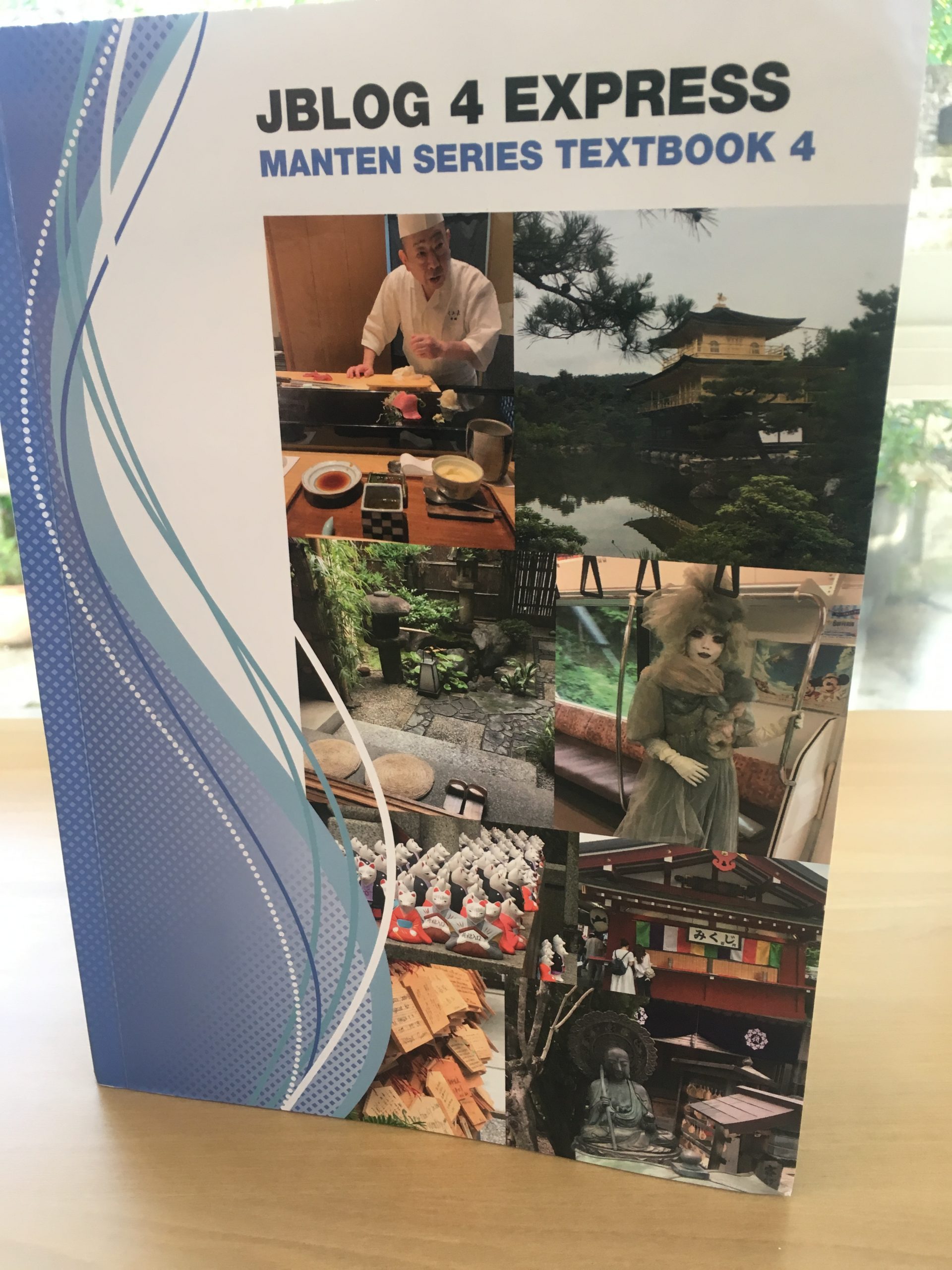
What’s in Jblog 4?

August 22, 2020 by Manten Resources

This 300 page full-colour textbook is designed to meet the needs of the Stage 6 Beginners course syllabus in NSW. It is also suitable for schools teaching Year 7 to 10 who are looking to progress student learning at a faster level such as selective school cohorts or those with students with prior learning.

If you have used Jblog 1 to 3, you will recognise some of the content as we have selected the best of the previous books and updated it to specifically meet the needs of the Beginners syllabus. The kanji and grammatical structures for example have been modified to meet the needs of this different pathway.

We have kept popular features such as the Dear Senpai column that explains misunderstandings of language and culture. The blog pages are there too introducing the cultural background of each chapter.

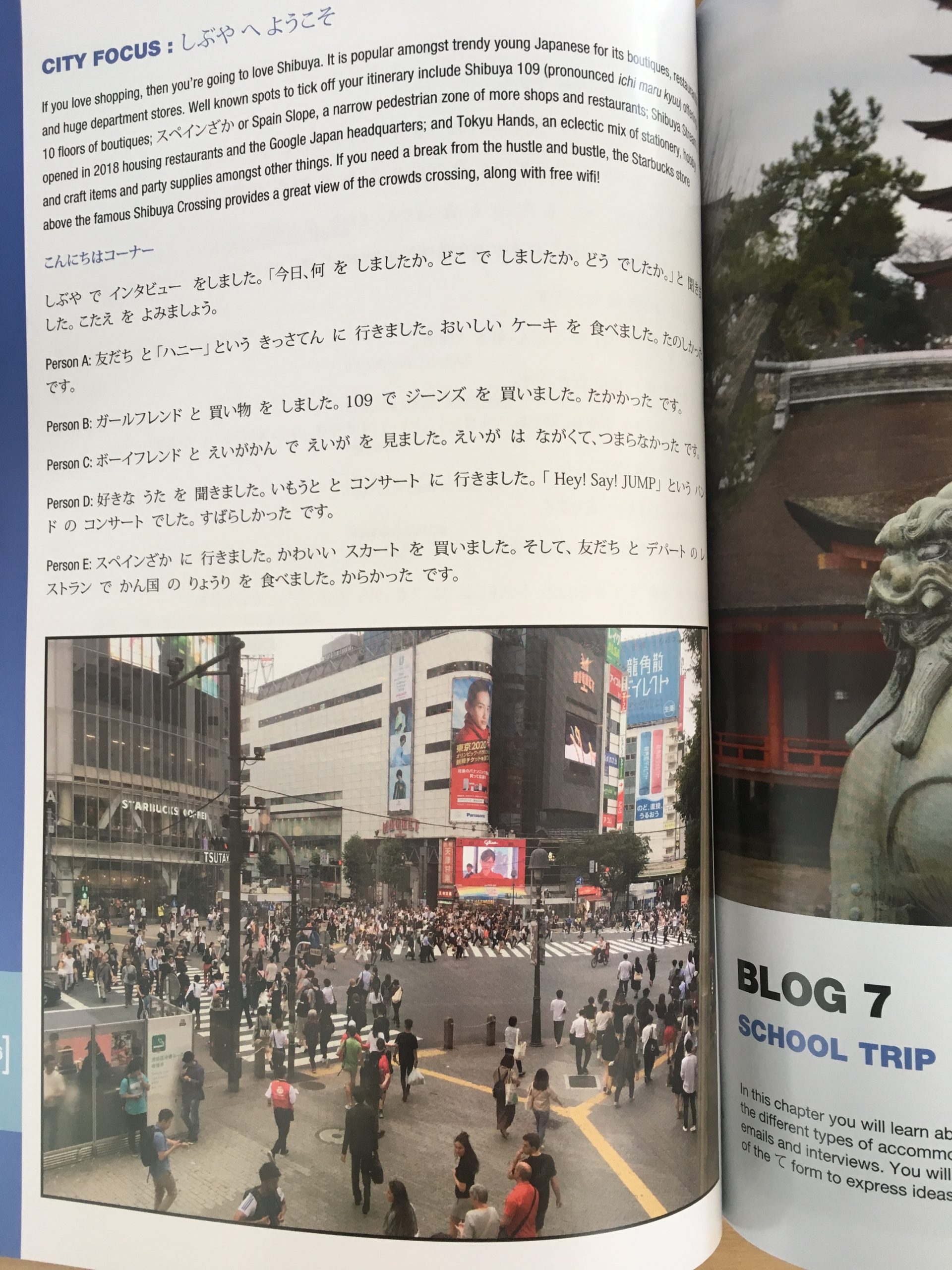
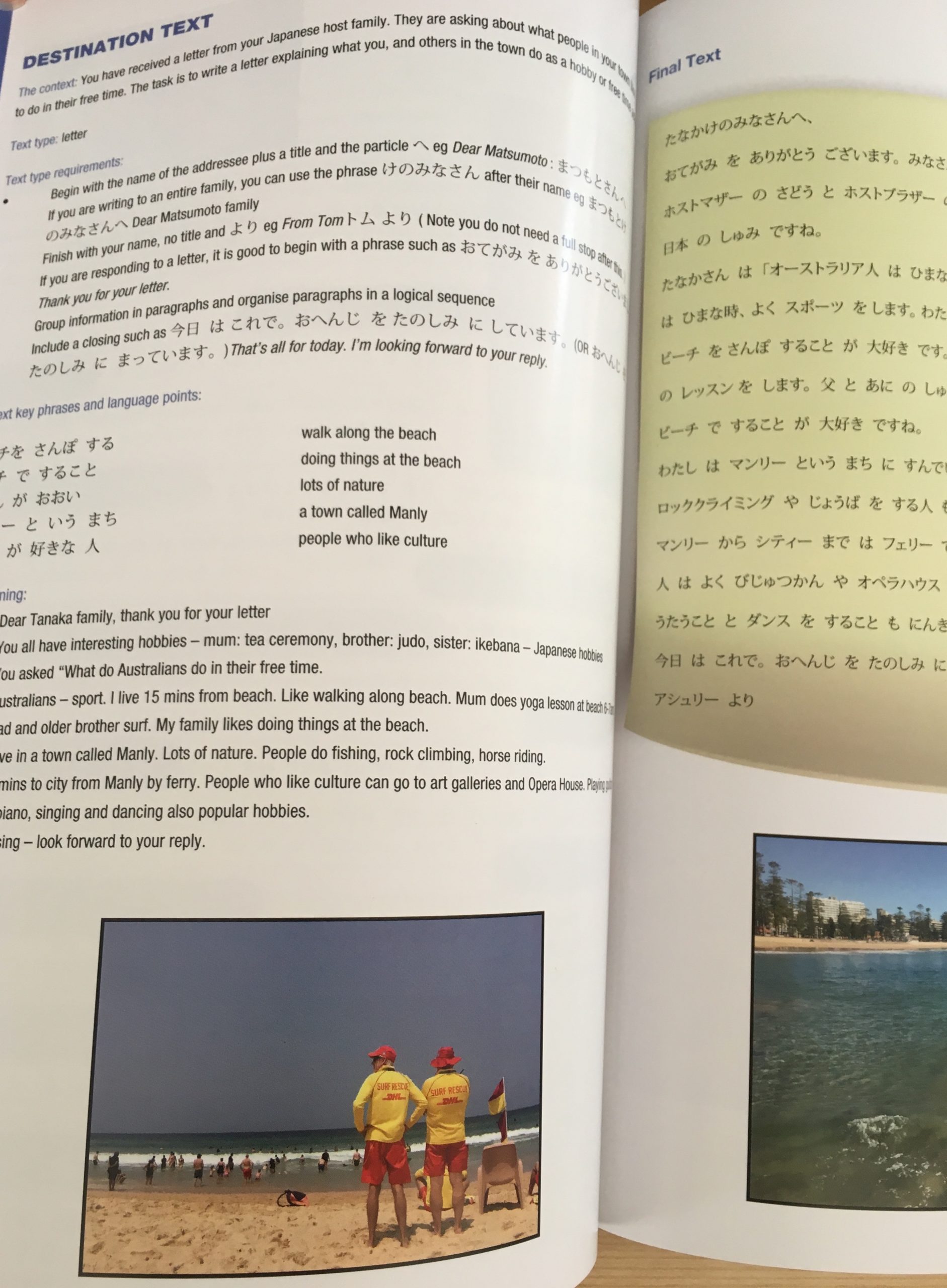
New features include a city focus in each chapter that provides an introduction to the city in English, and an interview in Japanese on location in that city. We have also added a Destination text each chapter that unpacks how to plan and write different text types such as letters, emails and diaries.

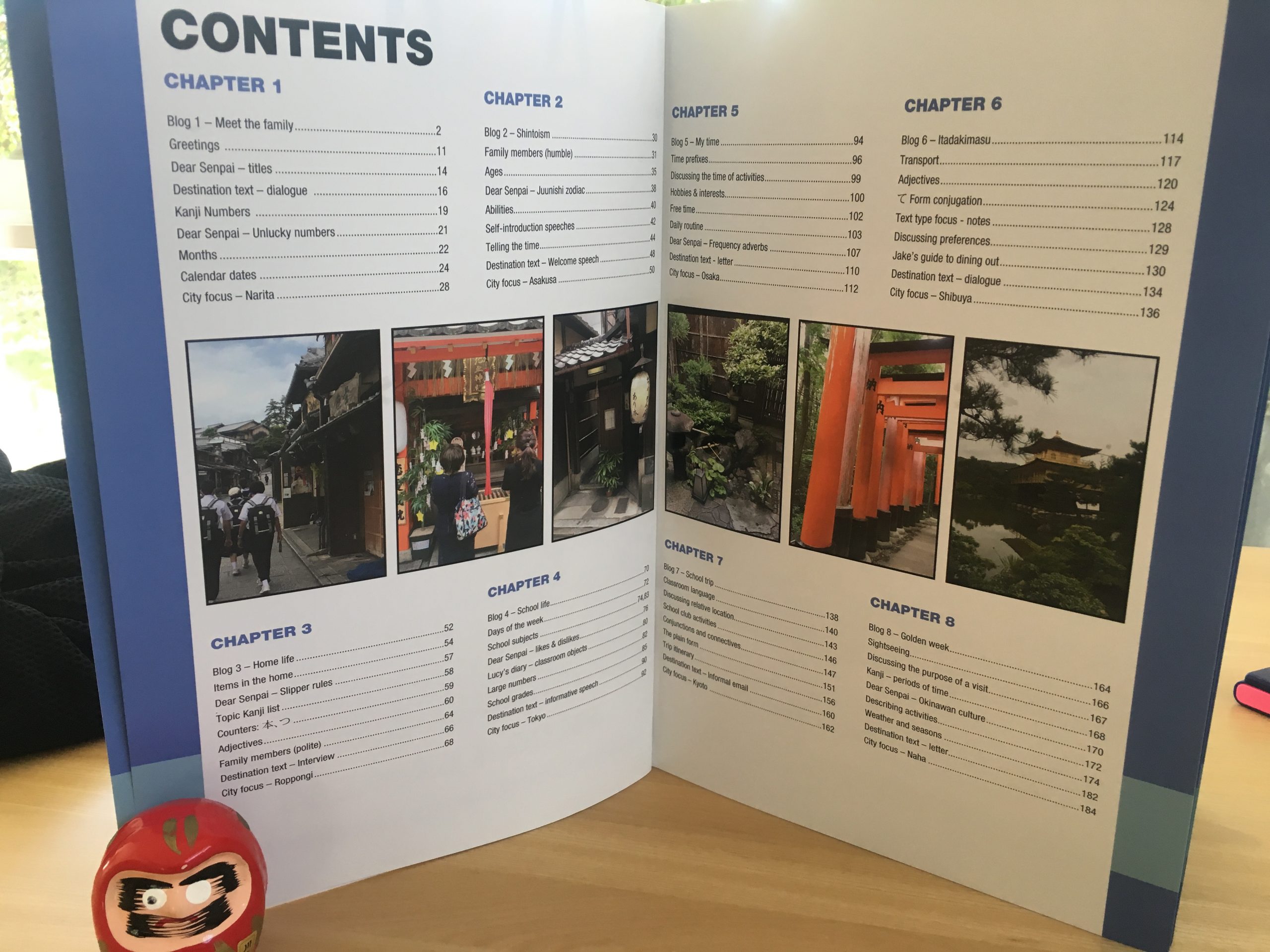
Script support is provided by the inclusion of furigana for all script in chapter 1 and 2, then dropping the furigana on hiragana from chapter 3, dropping the furigana from katakana from chapter 5 and removing spaces between words from chapter 10. There are 13 chapters in total with the expectation that most stage 6 classes will work through approximately 2 chapters per term.

As with all Jblog textbooks, it is our desire to present a contemporary view of Japan beyond the well-known stereotypes. We challenge the concept of a purely monocultural society by looking at regional differences in language, culture and history in Okinawa, Kansai, Tohoku and Hokkaido. Cross-curriculum links are made between the Ainu culture and Australian Aboriginal and Torres strait Islander culture.

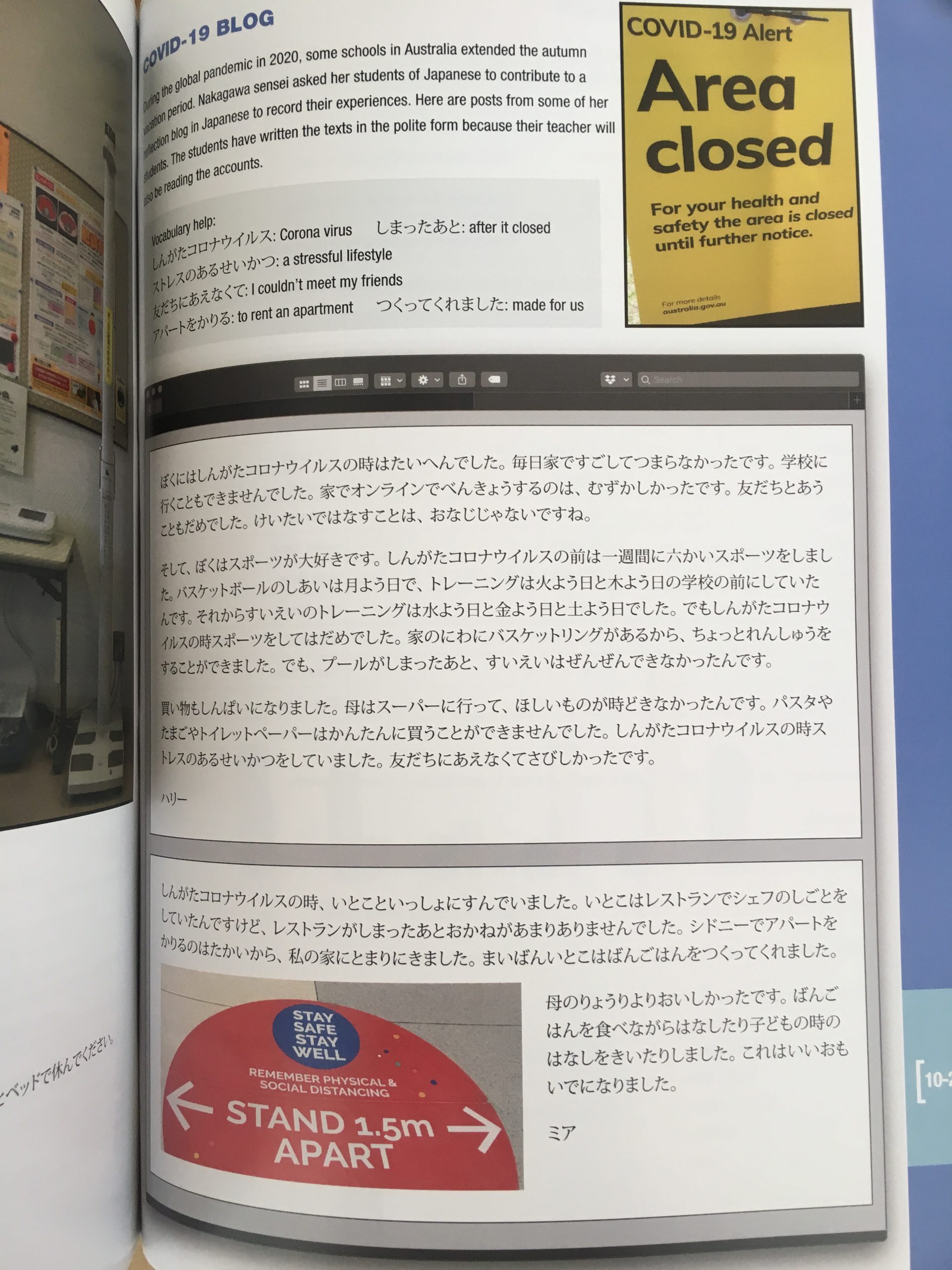
We have endeavoured to keep the content fresh and relevant including topics such as the impact of COVID-19 on student lives and the changes in society such as veganism and employment opportunities. Efforts have been made to explicitly teach good study habits and elements of behaviour design such as implementation intentions and mnemonic strategies.

Many wonderful people have contributed knowledge, experiences, stories and photographs to help produce this book for you. It has been years since a new resource has been created for the Stage 6 Beginners course so I hope you find it useful. Thank you to those kind souls who have emailed me beautiful words of encouragement already. Writing is a vulnerable and lonely task at times, so I really appreciate those who took the time to show support.

本当にありがとうございました。

The first shipment is due back September 28th and we have been taking pre-orders this week. Numbers are limited (due to my garage capacity!) so email me at jblog1help@gmail.com to secure your copy. Jblog 4 is retailing at $70 plus postage.

Filed Under: Teaching and Learning

NSW Stage 6 Beginners Upgrade

July 16, 2020 by Manten Resources

It has been a long time coming but this year we plan on injecting some fresh resources into the Stage 6 Beginners course. The new Jblog 4 Express textbook is should be back in about 2 months from printing! In the interim our first support resource is now out in the form of a Beginners Kanji Patch. Hopefully you are familiar with our Patch system and many of you probably use it already for Hiragana and Katakana. You can read more about the system that encourages a student-centred growth mindset approach to script mastery on our website.

https://www.mantenresources.com.au/teachers/resources-teaching-scripts/

We are now launching a similar system for the Beginners Kanji list. We have divided the kanji into 12 levels for Patch A and 12 levels for Patch B. These are in order of the new Jblog 4 Express textbook but students could still use the resource if they are using alternative materials. Each pack includes all the regular features such as a student workbook, flashcards, quizzes, teacher marking guidelines and progress certificates. What is new is that we are also including the excel spreadsheet list of terms so you can import them into your preferred review website such as quizizz, quizlet, quia etc. The lists are already set up for you in Education Perfect though under Manten resources.

Another great trick I have discovered after our Covid isolation period is how to use these quizzes without paper. I personally like the printed level test but some schools have asked in the past about a paperless version. This is now available if you use an application such as Classkick. You can simply import the quiz from the PDF version and it becomes a live task. You can have students take the quiz simultaneously on their devices and watch their progress in real time.

To order the Beginners Kanji Patch A and Patch B, simply email me at jblog1help@gmail.com. Patch A covers approximately the year 11 kanji covered in the textbook and Patch B focuses on the Year 12 content. Each Patch is a one-off payment of $50 ($100 for both sets) that can be used with as many students as you like for life. Bargain!

Good luck with the start of term 3 and keep you eye on our Facebook feeds for more details about the textbook and other resources.

Filed Under: Assessment, Growth mindset, Teaching and Learning

  • « Go to Previous Page
  • Page 1
  • Page 2
  • Page 3
  • Page 4
  • Page 5
  • Interim pages omitted …
  • Page 11
  • Go to Next Page »

Primary Sidebar

Copyright © 2026 · Manten Resources - All Rights Reserved