• Skip to primary navigation
  • Skip to main content
  • Skip to primary sidebar

Manten Resources

Supporting your Japanese language program

  • Manten Resources
  • About
  • Teachers
    • Stage 6 Beginners
    • Jblog Textbooks
      • Jblog 1
      • Jblog 2
      • Jblog 3
      • Programming
    • Base Camp
    • Student Workbooks
    • Amazing Races
    • Assessment
      • Manten Exams
      • Assessment Inspiration
      • Script Resources
    • Blog Spot
  • Parents
  • Contact

Teaching and Learning

Choose your weapons wisely

May 11, 2018 by Manten Resources

This week I had an interesting conversation with a dedicated Japanese teacher. She mentioned casually that she felt “guilty” about purchasing some of our resources. I found this comment to be a real insight into our practice. It is also not a sentiment shared by many other industries or even other subjects. For some reason, as language teachers we are made to feel that not only do we need to know our subject well, our students well and have a good range of pedagogical strategies to draw upon, but that we also need to create every resource from scratch. Can you imagine a plumber rushing off to design his own pipes or a doctor being expected to manufacture his own medicines? Nobody has such expectations for other industries so please shrug off this unnecessary yoke of teaching.

In this month’s newsletter I am writing in more detail about some of the technological applications available to us to support formative assessment. Here are a few ideas we all need to consider when making decisions about ICT in general.

1. Choose the teacher strategy and content first

It is so tempting to jump on a bandwagon and start using technology because other people are doing it. This may have short-term benefits by grabbing the attention of the students due to the novelty factor. You may also become more enthusiastic as a teacher as you are excited about the new direction. These are both legitimate short-term benefits, but you also need to consider the longer term. Eventually the newness will wear off for both you and the students, so you need to ensure that there are other benefits from this technological choice. Is it more efficient? Is it saving you time because you can easily reuse or modify it for future lessons? Does it provide you with insights into the students’ progress and/or perspective/experience of the lesson?

2. Be mindful

Sometimes you may find a great youtube clip that you just want to use to settle the class or as a transition activity, rather than as a main source of content. That is fine, as long as you are mindful of what you are doing. Question each resource and activity before and after each lesson. Are you doing that task because you did it last year or because you feel it will suit this year’s cohort as well? What information is allowing you to make that decision?

3. What is your learning intention?

The term “fit for purpose” is often used when considering types of assessment. It suggests that formative assessment is preferable for certain purposes, and summative for others. Similarly, your technology and use of it, needs to match the purpose of your lesson. If you are promoting a growth mindset, you may want to question why you have grades/marks on your google form, or why the students do not have the option of editing the form? How you use the tools is just as important as how you select them.

Three Resources that will save you time and don’t cost the earth

  1. Manten Exams. Choose from our content library to create your own exams. Listening tasks rendered to your personal selection without an embargo date! https://www.mantenresources.com.au/teachers/assessment/manten-exams/
  2. Hiragana Patch and the Katakana and Kanji equivalents. Script resources that emphasise growth mindset and a formative approach to script mastery. https://www.mantenresources.com.au/teachers/resources-teaching-scripts/
  3. Amazing Race sets. Collaborative tasks covering all skills and mapped to Australian Curriculum outcomes and cross-curriculum content such as literacy and Aboriginal and Torres Strait Islander perspectives. https://www.mantenresources.com.au/teachers/our-resources/amazing-races/

Yes, we know you are capable, of creating everything from scratch, because language teachers are creative and talented people. But is this the best use of your precious time? You do deserve a weekend too!

Filed Under: Assessment, Growth mindset, Teacher Wellbeing, Teaching and Learning

Teachers as growth mindset role models

April 25, 2018 by Manten Resources

One of the most powerful aspects of teaching is the potential to influence students. Although many teachers may feel powerless personally in the larger educational system, they can be extremely influential on a student’s development.

Last week I presented in Melbourne on growth mindset research. We discussed the impact our individual position on the growth and fixed mindset continuum can have on our perspective of ourselves and of our students. We noted that a growth mindset means we believe that anyone can improve with focus and practice, including ourselves and the students in our classes. If we have a fixed mindset, we may focus on the “best” students and discourage others from continuing due to their lack of “natural talent”. Dweck’s research showed that students who had a strong growth mindset had greater learning gains over time than those with a fixed mindset – even when the fixed mindset was a belief that they were clever or natural at something.

Recently I have developed a passion for formative assessment research (or Assessment for Learning as it is also known as). One of the key findings is that students around the world (including research in Japan, Hong Kong, Norway and Sweden) appreciate and learn well from task samples. This means if you are setting a self-introduction letter as a task, they want to look at other sample letters and have the opportunity to learn from those exemplars. They need opportunities to calibrate their understanding and expectations of themselves against the samples, and to reflect on the reactions of others towards those samples.

So how does this relate to us as teachers? Dweck’s research demonstrated that we vary in our degree of fixed or growth mindset according to the context, and that we all have the potential to change our mindset. So we may have a growth mindset about learning language but a fixed mindset about technology. The key is to develop our metacognitive (thinking) skills to help us consciously transfer some of our growth mindset skills in one area, to other areas where we may be a little more fixed.

The best way to do improve the growth mindset of your students is to act as a growth mindset role model yourself. Show them how you face your own insecurities about a field (eg technology) and push yourself to have a go. Try a new website/activity/app with them and talk them through your thinking skills. Admit this is the first time to try it and that there may be some issues. Ask for feedback about what went well (or not so well), and more importantly how you could improve it next time. Commit together to trying it again. They will learn from your bravery and begin to see that feedback can be used as a tool for learning. It does not need to be a weapon of judgement in a summative context.

My personal challenge this month is Nearpod. I attended the talented Shingo Gibson-Suzuki’s workshop at the JLTAV conference on this topic. Shingo is very good at technology – but I recognise that his expertise is not only due to a natural talent in the field, but a honed skill developed through years of being curious about new applications and experimenting with them. Just watching Shingo doesn’t make me proficient in Nearpod. I need to use it myself and learn from the obstacles that arise. So this week I have made two Nearpod lessons. The first I loaded on my Facebook page to keep myself honest. I learned from that attempt. If I am honest with myself, the first attempt found me trying to do what I usually do in a new medium.

The second attempt I will share via the link below. In this version, I tried to take more on board the essence of Nearpod – that it is there to collect feedback and formative information from the students. This activity is linked to a unit on Okinawa which is chapter 4 of Jblog textbook 3.

https://share.nearpod.com/WtYQSIkJoM

If you find this lesson useful, you can email me (jblog1help@gmail.com) for an editable copy that you can use in your own classes. I also have a PDF with sample answers.

My challenge to you this month is to stretch yourself in an area of development. Choose one thing you have wanted to try and give it a go. Maybe it is an activity from some recent Professional Learning or just an idea you have been putting off due to other commitments. Prioritize your own learning and growth and model to your students your effort, bravery and commitment.

You may find your students will learn just as much from the experience as you do.

Reference : Dweck, C.S. (2006). Mindset: the new psychology of success. Random House.

Further reading:

You may also be interested in our post on growth mindset at https://www.mantenresources.com.au/teachers/blog/growth-mindset-more-than-just-a-poster-on-the-wall/


Filed Under: Growth mindset, Professional development, Teaching and Learning

Stage 6 Assessment tasks – are you ready?

March 28, 2018 by Manten Resources

This term the hot topic in NSW amongst secondary teachers is the recent change to the Stage 6 assessment task schedule. Even if you are not in NSW, the topic will resonate with you – how can you assess your students at a school level without succumbing to just practising for the test? The dilemma for NSW teachers is that they can only have 3 tasks and only 1 of these can be an exam style task. The non-exam tasks also need to be conducted in one sitting each – so no portfolios or ongoing work; and they need to assess multiple skills in order to cover the outcomes.

So what to do?

One idea is to film a native speaker talking about an object or photograph. The students could then answer questions in English about the speech (listening skills) in Part A of the task. Part B could require them to summarise the text as the script of a conversation between the student and the native speaker (writing skills). They could be encouraged to not only ask questions relating to the content but also to provide details about themselves.

For example if the speaker (B) introduced their school club the dialogue could develop into a text as follows:

A:ぶかつどうは何をしていますか。

B:ぶかつどうはバスケットボールをしています。十三才の時からしています。

A:そうですか。じつは私もバスケットボールのチームに入っています。でも、私のチームは強くないです。

B:好きなプロのせんしゅはいますか。

A: とくにいませんが、きょ年クラスのえんそくでプロのしあいを見に行きました。シドニーキングズというチームがかちました。とても楽しいけいけんでした。

The marking criteria would need to outline the expectations clearly such as:

Write the script of a conversation between you and the speaker from the listening text.

An excellent response will:

  • direct the conversation with questions that allow you to include information provided by the text
  • extend the conversation beyond the information provided to include relevant details about your own experience relevant to the conversation
  • demonstrate a range of grammatical structures and vocabulary
  • demonstrate accurate use of script, vocabulary and grammatical structures
  • demonstrate an understanding of aizuchi and other intercultural skills such as modesty when discussing ability etc

I hope that gives you a starting point for combining skills in a single task without replicating just an exam format.

Further reading:

You may also be interested in our post on feedback at https://www.mantenresources.com.au/teachers/blog/5-steps-to-better-feedback/

Filed Under: Assessment, Teaching and Learning

How to have fun with questions

February 26, 2018 by Manten Resources

If you are looking for a exciting way to have students practice making questions then look no further than “the question game”. It is free and fun but also ticks the boxes of differentiation and developing growth mindset and teamwork skills.

How to play

This is a great game to play when you have a practicum student or a Japanese assistant. You will need to know a little about the person to make the worksheet. The worksheet can be 3 by 3 squares or larger depending on how long you want the game to take. In each box, write in Japanese a word or phrase. The students will need to look at the words or statements on the sheet and think of a question or statement or action that will make you say that word or phrase. As such, pitch the stimulus phrases to their current ability level.

The idea is that the students are seated in groups at tables with a copy of the worksheet each, plus one team copy that they will use to get signed by the teachers.

When they have thought of a question they call, either you or the assistant over by name, using phrases such as “Campbell せんせい、きてください”. This is good for less confident speakers as they have to say it many times and get quite good at it.

When you come they will ask you the question but the fun part is their question may be grammatically correct but needs to be asked to the other teacher. Eg our assistant liked basketball so asking me 「好きなスポーツは何ですか。」 wouldn’t work. They love it when this happens and are frantic to ask the question again to the right person.

The more they have to think, the more fun they have. For eg I put in the example below the grade my son is in in primary school. They had to think about me and what they knew about my family to generate a good question. (Click on the image to see it in more detail)

The best stimulus phrase though is 「ありがとう」. This can lead to a wide range of responses from compliments about how much they love you to offering you a seat. One time when we played this, a particular group became stuck on this question. The quick thinking Japanese assistant, seeing their dilemma, dropped his pencil intentionally. The boys picked it up for him and said 「どうぞ」 eliciting the 「ありがとう」 they had been searching for.

Why this game works

I love this game because it naturally differentiates and enables all students to utilise higher order thinking skills regardless of their Japanese ability. Students develop teamwork skills as they work together to translate the stimulus word or phrase, consider options that may elicit the correct response considering their knowledge of the person and/or Japanese culture, and translate these questions into correct Japanese. It develops growth mindset skills as students ask the wrong questions and consider new possibilities. It acknowledges social constructivism theory as it encourages students of varying abilities to work together, learn from each other and consider other ways of arriving at an answer. It is also very flexible and the same question sheet could be used by various classes with only the questions changing.

How to mix it up

Idea 1 : You can make it specific to a grammatical structure you want to practice by including more specific phrases such as「はい、行ったことがあります。」when you want to practice questions like 「日本に行ったことがありますか。」. If you want to keep it more general, use instead a phrase like 「はい、あります。」as your stimulus. This could lead to other options such as 「自分の部屋にテレビがありますか」.

Idea 2 : You could test cultural knowledge using the target language via this game. For example your stimulus could be a date eg 「三月三日」which would elicit questions like 「ホワイトデーはいつですか」. Or it could be a specific cultural term eg 「ちゃんこなべ」which would elicit questions like「すもうさんは何を食べますか。」.

Further reading:

You may also be interested in our post on growth mindset at https://www.mantenresources.com.au/teachers/blog/growth-mindset-more-than-just-a-poster-on-the-wall/

Filed Under: Differentiation, Growth mindset, Student Engagement, Teaching and Learning

5 steps to better feedback

February 9, 2018 by Manten Resources

Feedback is not perceived as exciting to the same extent as many other aspects of teaching (such as organizing an excursion or designing an assessment task). In formal assessment tasks, teachers often dislike writing it, and students frequently fail to read it properly. It seems as if everyone is focused only on the mark or grade, their ranking against others. This is a disappointing state though as feedback has been ranked as one of the top ten influences on student achievement (Hattie 2009). It is also one of the most variable influences suggesting that all feedback is not equal. Why isn’t there more consistency produced by feedback? Why aren’t we doing it well?

Luckily for us there has been some interesting research conducted in this area in recent years. Unfortunately most teachers and schools are just too busy to read it though! If you haven’t had time to finish last term’s cup of coffee then this list is for you. It is a summary of how to save your feedback from failure.

Step 1 : Provide explanation feedback not correctional feedback

For example if correcting a written text of a student who had forgotten to indent at the beginning of a paragraph; “You didn’t indent one box.” , would be an example of correctional feedback. “You needed to indent one box as that would indicate to the reader that it is the start of a new paragraph.”, would be an example of explanation feedback. The student may not make the connection between the correction and the fact it is needed as it is the start of a new paragraph without such detail, and hence may not be able to repeat the indent in future contexts.

Step 2 : Tell them what they did well, not just what they did wrong

Many teachers give excellent explicit feedback about what is incorrect but gloss over or leave out what was well done. For example “great use of punctuation” tells them very little. “I was impressed to see that you remembered that the full stop shares the box with the letter if it appears at the end of a row. Well done.”, is far more explicit and useful to the student.

Step 3 : Avoid negative phrase like “you should” and “wrong”

“You have written the dash in シドニー the wrong way. You should write the dash horizontally when writing a text horizontally.”, is an example of feedback that is unlikely to motivate a student. Instead try phrases like :

“I was really impressed to see you stretch yourself to include the new kanji from chapter 2 of Jblog 2. Take a look at the kanji index on page 125 of Jblog 2 and see if you can find the reason I have highlighted this kanji.”

Step 4 : Provide objective feedback not subjective feedback

Students don’t need to hear “You are awesome at kanji”. That encourages a fixed mindset and will ultimately lead to them playing it safe to avoid making a mistake and disappointing you. Instead try honest but subjective phrases about their effort and persistence, and explain why it was impressive. Eg “You used some great conjunctions in your letter to link ideas and actions such as でも、ですから and そして. This makes your text more interesting for the reader.”

Step 5 : Stop the teacher monopoly on feedback                      

Feedback is not supposed to be about you justifying the grade you gave a student. It is an important opportunity for the student to improve and learn. Try to embed more peer feedback and self-analysis components in your next assessment.

The examples in this text are taken from The Stage 5 Formative Assessment Writing Resource. This resource is available for purchase for $70 from Manten resources and includes professional development readings and a ready-made assessment task to get you started. More information is available at this link : https://www.mantenresources.com.au/teachers/blog/new-growth-mindset-formative-assessment-resource/ 

Further reading:

You may also be interested in our post on growth mindset at https://www.mantenresources.com.au/teachers/blog/growth-mindset-more-than-just-a-poster-on-the-wall/

Reference :

Hattie, J., & Ebooks Corporation. (2009). Visible learning : A synthesis of over 800 meta-analyses relating to achievement / John A.C. Hattie. London ; New York: Routledge.

Filed Under: Assessment, Teaching and Learning

5 REASONS TO LOVE GOOGLE FORMS

February 3, 2018 by Manten Resources

Are you a novice to google forms or bored of them already? Here are 5 reasons why I love this tool and how you can benefit more from your own usage. (Click on the images to view the detail.)

1. Easy to differentiate

I love to do my listening drills using a google form. I embed the sound file as a linked youtube clip and differentiate the questions in the form. This means that the whole class can be listening to the same sound file but working at the pace and level that suits them. They can pause the sound file to look up a word or repeat the text until they can hear the detail they need. They can choose to work at different levels of difficulty for every question. Sometimes when a topic is familiar or of particular interest to them they can stretch to a harder level of question. The forms allow them to choose as they go and have the time to think about this.

2. Can be used to improve literacy skills and catch misconceptions

When I am having students complete a form that is predominately English based (eg when checking comprehension of aspects of culture) I direct the students to complete the forms individually. Then without marking them, I bring the responses up in “summary” mode. We then talk through as a class which answers are better than others and why. For example in this image, the first response is superior because it is a full sentence and they used a capital letter for Tokyo. After we discuss the answers and ensure we are clear on the original misconceptions, I allow students to then go back into their form and edit their work. I only mark the forms after they have had time to apply the feedback their peers and myself have given them in this general discussion.

3. Time saving

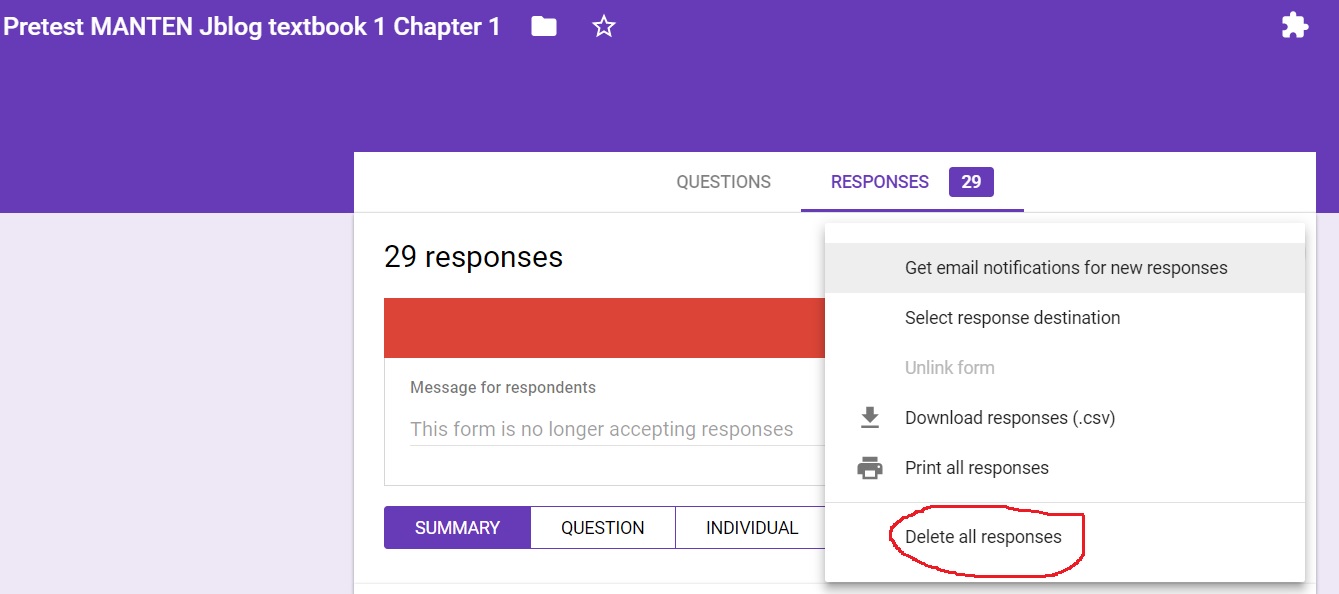
I love the fact that you can export your student responses from the google form to an excel file spreadsheet. This means you can then clear the form to reuse again next year. No more reinventing the wheel.

4. You can personalize shared forms

You can modify the shared resources of others to suit your unique class. Simply make a copy of the original and then edit away! Not sure where to start – there are 288 forms available for the Jblog series already made. We encourage our users to edit their copy to add in their own favourite links or images etc. (These are available as part of the student workbook resources pack – see our website for more details: https://www.mantenresources.com.au/teachers/our-resources/jblog-textbooks/student-workbooks/)

5. You can personalise the feedback

When I create my google forms, I embed the generic feedback in the form. I also have the option of adding to that with specific individual feedback. In this example, all students received the top line of correctional feedback but the other 2 lines are specific to that student only. This saves you time as the basic answer is already there in the feedback and you only need to personalise it.

Technology is there to help us but it needs to serve a pedagogical purpose. Hopefully you can see some new uses for google forms now. A free example of one of our google forms is available as part of the following post on the Australian Curriculum. The sample form is on the topic of Okinawa.

Australian Curriculum – NSW Begins the Journey

Filed Under: Differentiation, Student Engagement, Teaching and Learning

  • « Go to Previous Page
  • Page 1
  • Interim pages omitted …
  • Page 6
  • Page 7
  • Page 8
  • Page 9
  • Go to Next Page »

Primary Sidebar

Copyright © 2026 · Manten Resources - All Rights Reserved