• Skip to primary navigation
  • Skip to main content
  • Skip to primary sidebar

Manten Resources

Supporting your Japanese language program

  • Manten Resources
  • About
  • Teachers
    • Stage 6 Beginners
    • Jblog Textbooks
      • Jblog 1
      • Jblog 2
      • Jblog 3
      • Programming
    • Base Camp
    • Student Workbooks
    • Amazing Races
    • Assessment
      • Manten Exams
      • Assessment Inspiration
      • Script Resources
    • Blog Spot
  • Parents
  • Contact

Student Engagement

“Surprise, surprise! Students enjoy learning from traditional books.”

April 6, 2019 by Manten Resources

“Surprise, surprise! Students enjoy learning from traditional books.”

So begins Richard Glover’s article in today’s Sydney Morning Herald (Spectrum, April 6-7 2019, p3).

I found this interesting as when we first wrote the Jblog textbook series we also looked into creating an ebook version. We were told then in confidence by one of the graphic designers who also makes ebooks that students don’t like learning from them. I surveyed our students and found them of the same opinion, so we backed away from the ebook trend. My family, including my 11 year old son, are all avid readers of the hard copy variety and for me there is nothing nicer than the smell of a new book. Books don’t need charging and encourage the reader to browse through the material when attention spans wane. (When the attention span of a student on a computer wanes, they immediately flick to a game.)

Richard Glover’s article continues to describe how some schools such as Reddam House, have reversed their decision to use ebooks much to the enthusiasm of the students. It also states that “Educational experts have discovered that children retain more information when they read things using a hard-copy book, when compared to a digital device.” As a teacher, one only needs to consider how much easier it is to program using the hard copy version of the new syllabus than the on-line version. I prefer to flick back between the hard-copy sections and then copy and paste from the digital version once I have located the page. Students were also quoted as preferring the “ease of navigation” of a book.

I love using technology in the classroom but only if it serves a purpose. I personally prefer to learn from the book and then create using a computer. That way, students can refer to their textbook when they are talking to the visiting Japanese students, listening to sound files or creating their own presentation. Flicking between six screens just doesn’t calm me in the same way as book with post-it notes.

Enjoy your weekend everyone!

Filed Under: Student Engagement, Teaching and Learning

SPEAKING STATIONS

November 12, 2018 by Manten Resources

When programming for the new syllabus, I noticed that I needed to create more opportunities for the students to meet the outcome LJA4-1C, in particular the following content point: “engage in collaborative activities that involve planning and making arrangements for example participating in class activities using set phrases in Japanese” (ACLJAC002).

Although we played games in my classes, I wanted to embed more target language use into the games and the way the students played together.

The result is the Speaking Stations Pack. The first of these packs to be released is aimed at Stage 4 (year 7/8). This version develops a student’s skills in the language content covered in Jblog textbook 1.

How to play

Students in pairs or small groups have a map of Mt Fuji that has 15 speaking stations. Student A throws a dice and moves along the path the number of places on the dice. Student B uses the question card to ask Student A the matching question for that station eg 「何才ですか」. Student A refers to their stimulus card which provides information in Japanese to help them answer the question. If Student A answers correctly, they can stay on the station. If they answer incorrectly, they must go back to the start. Student B is responsible for telling Student A if they are correct or not. Student B has the answers written on the question card. Students take turns rolling the dice and answering the question.

This game can be differentiated in two ways.

Firstly, each game has a script version (hiragana and basic kanji) and a romaji version (with romaji above the Japanese script). Students or teachers can select which is more appropriate for individual students.

Secondly, students can use the same question card or different question cards. For example, student A could be using the Dialogue Review Profile A card and student B could be using the Dialogue Review Profile D card.

click on image to view enlarged version

What topics are covered?

This Year 7/8 version covers the following topics:

Game 1 – Aisatsu

This game revises common aisatsu and has questions in English such as You arrive home to your homestay apartment. Greet your host family. The student would be expected to say “ただいま”.

Game 2 – Dialogue Review CH1-5

This game revises common self-introduction content such as name, age, birthday, number of people in your family etc. Students must refer to the profile they receive of a Japanese person to answer each question. The profile is provided in Japanese in a table format. The students use the stimulus to create an appropriate full sentence to respond. There are 3 versions of game 2 that use different Japanese profiles.

Game 3 – School life

This game revises common school life content such as if they like or dislike a subject, what period or day of the week they study a subject, what their favourite subject is etc. Students must refer to the profile they receive of a Japanese person to answer each question. The profile is provided in Japanese in a table format. The students use the stimulus to create an appropriate full sentence to respond. There are 3 versions of game 3 that use different Japanese profiles.

Game 4 – Shopping at the Bunkasai

This game revises content related to shopping, prices and classroom objects. The setting is purchasing classroom objects from a stall at the bunkasai. Students will be required to use Japanese language to ask what an item is, how much it costs, to pass items and to say thank you etc. There are 3 versions of game 4 that use different stimulus information.

click on image to view enlarged version

Composing option

Teachers may also like to follow this speaking task with a composing option. There are blank tables provided, that students could use to create their own versions of the game by composing the profiles/stimulus cards and sample answer cards. This activity would address the composing outcome LJA4-4C, in particular the content point, “Compose informative and imaginative texts in spoken, written and multimodal forms for a variety of purposes and audiences, using stimulus materials and modelled language (ACLJAC007).”

How much does it cost? What do I receive in the pack?

The pack costs $50 and includes:

  • A Mt Fuji game sheet with 15 stations
  • Game 1 – Aisatsu
  • Game 2 – Dialogue Review with 3 different profile versions
  • Game 3 – School Life with 3 different profile versions
  • Game 4 – Shopping at the Bunkasai with 3 different stimulus cards
  • All games include a scripted version and a romaji version
  • Student game explanation with suggested language to use when playing the game such as はい、どうぞ。(When passing the dice to each other.);さいころはどこですか。Where is the dice?; わたしのばん It is my turn.
  • Scaffolds to support the composing option of the game
  • Teacher guide


Teachers will receive all these items as PDFS or word documents. It is recommended that you laminate the game sheet. Teachers will need to supply their own dice and markers for the game.

To order, email jblog1help@gmail.com

Filed Under: Australian Curriculum, Differentiation, Student Engagement, Teaching and Learning

Ideas for Japanese visits to your school

July 21, 2018 by Manten Resources

Term 3 is a popular time for Japanese students to visit your school. Having students visit your class and interact with your students is great fun but it can be nerve-wracking planning enough activities to keep everyone engaged. Here are 3 of my favourite ideas that get your students interacting.

1.Paired Kahoot

These kahoots are bilingual with questions in one language and answer options in another. This encourages the Australian and Japanese students to talk together to work out each answer. Lots of gestures and laughs to be had. Below are links to two different versions. If you can’t gain access via the link search kahoot for games made by Manten resources or jblog textbooks and should find these. Feel free to make a copy and edit them to better suit your students.

Japanese group quiz re Australia

Japanese visitor quiz 

2.Bilingual Amazing Race

Again, this activity is bilingual requiring collaboration between the Japanese and Australian students. There is a free download of an entire game including worksheets, answers, game cards and sound file. The instructions can also be found on our site via the link below.

https://www.mantenresources.com.au/teachers/our-resources/amazing-races/

3.Use your visitors to help with speaking assessments

We run our Year 8 assessment task during the annual school visit from Japan. Our students plan 3 questions to ask the visitors in Japanese and they must answer one question in Japanese. This is all filmed on their mobile phones or devices and submitted. Our students are so excited that their Japanese actually “works” and are often keen to show their parents when they get home.

For our Year 9 students, we ran a joint speaking contest where the students are buddied up for an interview style contest. They worked together in the previous term prior to the visit online, to draft sample answers. When the visitors arrive, they have one lesson to practice face to face and then we run the speech contest in real time. We award a joint trophy and have a pizza and sushi lunch together. 

Check out our Facebook page August 4 2017 for more details.You will need to scroll down to that date to find it, sorry!) https://www.facebook.com/mantenresources/ 


Filed Under: Advocacy, Student Engagement, Teaching and Learning

How to have fun with questions

February 26, 2018 by Manten Resources

If you are looking for a exciting way to have students practice making questions then look no further than “the question game”. It is free and fun but also ticks the boxes of differentiation and developing growth mindset and teamwork skills.

How to play

This is a great game to play when you have a practicum student or a Japanese assistant. You will need to know a little about the person to make the worksheet. The worksheet can be 3 by 3 squares or larger depending on how long you want the game to take. In each box, write in Japanese a word or phrase. The students will need to look at the words or statements on the sheet and think of a question or statement or action that will make you say that word or phrase. As such, pitch the stimulus phrases to their current ability level.

The idea is that the students are seated in groups at tables with a copy of the worksheet each, plus one team copy that they will use to get signed by the teachers.

When they have thought of a question they call, either you or the assistant over by name, using phrases such as “Campbell せんせい、きてください”. This is good for less confident speakers as they have to say it many times and get quite good at it.

When you come they will ask you the question but the fun part is their question may be grammatically correct but needs to be asked to the other teacher. Eg our assistant liked basketball so asking me 「好きなスポーツは何ですか。」 wouldn’t work. They love it when this happens and are frantic to ask the question again to the right person.

The more they have to think, the more fun they have. For eg I put in the example below the grade my son is in in primary school. They had to think about me and what they knew about my family to generate a good question. (Click on the image to see it in more detail)

The best stimulus phrase though is 「ありがとう」. This can lead to a wide range of responses from compliments about how much they love you to offering you a seat. One time when we played this, a particular group became stuck on this question. The quick thinking Japanese assistant, seeing their dilemma, dropped his pencil intentionally. The boys picked it up for him and said 「どうぞ」 eliciting the 「ありがとう」 they had been searching for.

Why this game works

I love this game because it naturally differentiates and enables all students to utilise higher order thinking skills regardless of their Japanese ability. Students develop teamwork skills as they work together to translate the stimulus word or phrase, consider options that may elicit the correct response considering their knowledge of the person and/or Japanese culture, and translate these questions into correct Japanese. It develops growth mindset skills as students ask the wrong questions and consider new possibilities. It acknowledges social constructivism theory as it encourages students of varying abilities to work together, learn from each other and consider other ways of arriving at an answer. It is also very flexible and the same question sheet could be used by various classes with only the questions changing.

How to mix it up

Idea 1 : You can make it specific to a grammatical structure you want to practice by including more specific phrases such as「はい、行ったことがあります。」when you want to practice questions like 「日本に行ったことがありますか。」. If you want to keep it more general, use instead a phrase like 「はい、あります。」as your stimulus. This could lead to other options such as 「自分の部屋にテレビがありますか」.

Idea 2 : You could test cultural knowledge using the target language via this game. For example your stimulus could be a date eg 「三月三日」which would elicit questions like 「ホワイトデーはいつですか」. Or it could be a specific cultural term eg 「ちゃんこなべ」which would elicit questions like「すもうさんは何を食べますか。」.

Further reading:

You may also be interested in our post on growth mindset at https://www.mantenresources.com.au/teachers/blog/growth-mindset-more-than-just-a-poster-on-the-wall/

Filed Under: Differentiation, Growth mindset, Student Engagement, Teaching and Learning

5 REASONS TO LOVE GOOGLE FORMS

February 3, 2018 by Manten Resources

Are you a novice to google forms or bored of them already? Here are 5 reasons why I love this tool and how you can benefit more from your own usage. (Click on the images to view the detail.)

1. Easy to differentiate

I love to do my listening drills using a google form. I embed the sound file as a linked youtube clip and differentiate the questions in the form. This means that the whole class can be listening to the same sound file but working at the pace and level that suits them. They can pause the sound file to look up a word or repeat the text until they can hear the detail they need. They can choose to work at different levels of difficulty for every question. Sometimes when a topic is familiar or of particular interest to them they can stretch to a harder level of question. The forms allow them to choose as they go and have the time to think about this.

2. Can be used to improve literacy skills and catch misconceptions

When I am having students complete a form that is predominately English based (eg when checking comprehension of aspects of culture) I direct the students to complete the forms individually. Then without marking them, I bring the responses up in “summary” mode. We then talk through as a class which answers are better than others and why. For example in this image, the first response is superior because it is a full sentence and they used a capital letter for Tokyo. After we discuss the answers and ensure we are clear on the original misconceptions, I allow students to then go back into their form and edit their work. I only mark the forms after they have had time to apply the feedback their peers and myself have given them in this general discussion.

3. Time saving

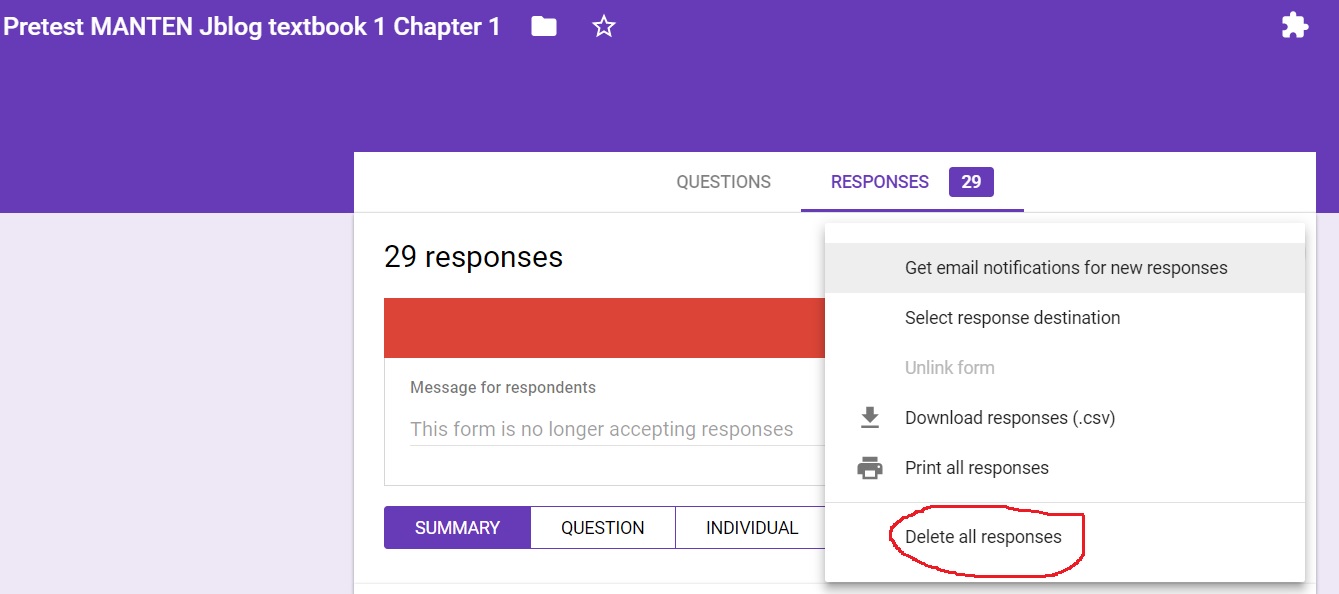
I love the fact that you can export your student responses from the google form to an excel file spreadsheet. This means you can then clear the form to reuse again next year. No more reinventing the wheel.

4. You can personalize shared forms

You can modify the shared resources of others to suit your unique class. Simply make a copy of the original and then edit away! Not sure where to start – there are 288 forms available for the Jblog series already made. We encourage our users to edit their copy to add in their own favourite links or images etc. (These are available as part of the student workbook resources pack – see our website for more details: https://www.mantenresources.com.au/teachers/our-resources/jblog-textbooks/student-workbooks/)

5. You can personalise the feedback

When I create my google forms, I embed the generic feedback in the form. I also have the option of adding to that with specific individual feedback. In this example, all students received the top line of correctional feedback but the other 2 lines are specific to that student only. This saves you time as the basic answer is already there in the feedback and you only need to personalise it.

Technology is there to help us but it needs to serve a pedagogical purpose. Hopefully you can see some new uses for google forms now. A free example of one of our google forms is available as part of the following post on the Australian Curriculum. The sample form is on the topic of Okinawa.

Australian Curriculum – NSW Begins the Journey

Filed Under: Differentiation, Student Engagement, Teaching and Learning

Using Data to Increase Enrolments

September 5, 2017 by Manten Resources

Term 4 can be a traumatic time of year for language teachers. Teachers of compulsory subjects have little understanding of the pressure that teachers of elective subjects are under. Nobody enjoys the wait to hear whether their subject will run as an elective in the coming year.

The goal of many teachers is to lure approximately 20-25% of a Year 8 cohort into the year 9 elective course, in order to guarantee a class. Some states are lucky and have guaranteed classes until Year 9 or 10, but inevitably the elective challenge arises at some point.

Regardless of whether you managed to get an elective class or not, term 4 is the most important time of year as it is the perfect time to plan for next year’s direction. So what do you need to do now to ensure long term success and growth?

  1. Befriend the administrative assistant who enters the students’ elective choices and ask to see how many students picked your subject prior to the final lines being established. This will let you know how successful you were attracting students prior to other factors tainting the results (such as line clashes, students leaving the school etc).
  2. Keep a record of how your department is going regarding electives across several years, and annotate factors that may have impacted your numbers both positively (eg changing textbooks or purchasing new resources) and negatively (eg teachers on leave, new subject being offered in competition etc). You are aiming for a steady increase.
  3. Now get access to what students picked for their other electives. What are the most popular subjects in your school? This is valuable information as it can provide you with an overview of trends in your school community. You then need to consider what aspects of these popular subjects you can tap into, to enhance your course. For example if PASS (a sport based subject) is popular, they you may like to include sport based incursions such as kendo or karate lessons into your Stage 5 program. When “MasterChef fever” was as its peak, we introduced a pop-up restaurant assessment task in the schedule.
  4. Start planning your assessment and incursion/excursion activities for next year with this data in mind. Often it is just a matter of tweaking what you already do to better market your course. We know what we do is awesome but unfortunately many parents and students don’t realise this until it is too late.
  5. Don’t let it wear you down. What you do is incredible. You just need to ensure more people realise this through reflective practice, use of data and strategic planning. Good luck!

Filed Under: Student Engagement, Teacher Wellbeing, Teaching and Learning

  • « Go to Previous Page
  • Page 1
  • Page 2
  • Page 3
  • Page 4
  • Page 5
  • Go to Next Page »

Primary Sidebar

Copyright © 2026 · Manten Resources - All Rights Reserved