• Skip to primary navigation
  • Skip to main content
  • Skip to primary sidebar

Manten Resources

Supporting your Japanese language program

  • Manten Resources
  • About
  • Teachers
    • Stage 6 Beginners
    • Jblog Textbooks
      • Jblog 1
      • Jblog 2
      • Jblog 3
      • Programming
    • Base Camp
    • Student Workbooks
    • Amazing Races
    • Assessment
      • Manten Exams
      • Assessment Inspiration
      • Script Resources
    • Blog Spot
  • Parents
  • Contact

Student Engagement

Teaching under COVID-19: our time for Kensho

March 17, 2020 by Manten Resources

This year has been a challenging one. We’ve had terrible bushfires, followed by storm damage and now a pandemic – and we’re still in term 1! Times like these can be stressful for both students and teachers. I am hopeful though, that this slow-down of our lives will help us experience a moment of kensho. Kensho is defined by Vishen Lakhiani as “Growth from temporary pain”. It can shock us into hansei, (reflection), with regards to how lucky we have been to have had so much choice in the past; but also a mental edit that perhaps some of the things we were cramming into our lives in the past are not missed now that they are gone.

This week I was saddened when our conferences and workshops had to be cancelled or postponed until next year. I was due to run a primary network meeting tomorrow but due to the enthusiasm of the group we have decided to run it virtually. This event is forcing me to upskill my knowledge of videoconferencing – a task that had been on my to-do list for months. I need to be an expert by tomorrow – and will subsequently need to adopt a growth mindset when I realize I am not.

Many of us are preparing to live and teach with less face to face contact. Teaching, as we know, is heavily influenced by the relationship that exists between the teacher and the students, and between the students themselves. As we prepare to run courses on-line, we need to ensure that we strive to maintain that connection. Here are some tips to do so.

  1. Use a narrative or the first person when creating resources. The students need you now more than ever so where possible share voiceovers or videos of yourself welcoming the students to the work each week and verbally talking them through the tasks you lined up for them.
  2. Consider including a task like The Platform. This formative task encourages students from year 9 to 12, to share their interests and use language to comment on each other’s findings. Working in smaller pods of students enable them to feel less social anxiety about sharing and can develop a sense of connection with the teacher in a virtual space.
  3. Manage your own mental health by using resources and websites that are ready made for some tasks. Your energy is better spent on providing feedback to the student on their efforts than in spending hours creating the perfect on-line task.

We know that some of us who use class sets of textbooks may be worried about what to do when the teaching goes on-line. To help with this, we have made flipbooks of Jblog 1 and Jblog 2 textbooks that are available to teachers for a one-off fee of $100 during this COVID-19 period. This cost allows use to load the text to your school’s preferred online platform to enable access for your students. This offer is only available to school’s who have purchased a class set in the past. Email me at jblog1help@gmail.com for details.

Good luck everyone during this time of change and challenge. Keep looking for those moments of kensho!
Filed Under: Student Engagement, Teacher Wellbeing, Teaching and Learning

Enabling student success in languages

January 31, 2020 by Manten Resources

New Year, New cohort. But are your students equipped to learn a language?

As a Language teacher in Australia, I often describe myself as a naive optimist. I almost consider this mindset to be an essential trait of my job. The odds are stacked against us in many ways, yet we continually strive to bring fresh energy and enthusiasm to our lessons each year.

Last year, I realised though, that perhaps we were missing a key step. Although we made huge efforts to teach languages well to our students, perhaps we didn’t always check first if the students were ready for the journey. It’s like taking a group hiking without checking what they have in their backpack. Do they have water and food? Appropriate clothing and shoes? How is their current fitness levels?

Some may argue that they do a quick survey at the start of the year to check if the students have had experience with language learning. This is a good first move but it doesn’t provide us with much real data on how equipped our students are to learn a language with us, now, as high school students.

I have come to the conclusion, that explicit teaching of skills to access learning in language is the essential first step in the language journey. To this end, I have developed two short introductory courses for secondary students called Base Camp level 1 and level 2. 

The first course is pitched at Year 7/8 students who may be beginning a language course for the first time. It covers five key concepts to develop student skills in learning and motivation. These include concepts such as implementation intentions, habit stacking and the two-minute rule.

The second course is pitched at Year 9/10 and 11/12 students who may have continued into elective courses. This sequence looks more closely at specific learning strategies to support independent learners. It suggests ways to revise and extend one’s knowledge in the macro skills using accessible resources from the students’ world. This includes various strategies to harness teenager obsession with social media for positive learning gains in language.

Both of these resources outline how to harness research into the psychology of motivation to help students find time and motivation for their language learning and provide an infrastructure for successful learning to occur.

Although there are two levels, I would suggest that students, who have not worked with the level 1 materials, would benefit from working through those, before attempting the level 2 materials. The Base Camp level 1 and 2 resource is sold as a set for $50 and can be purchased by emailing jblog1help@gmail.com .

If you are interested in learning more about this topic, you may be interested in attending our Noosa Workshop in July. Details and booking information is available via this link.

Good luck with your new classes in 2020!

Filed Under: Differentiation, Student Engagement, Teaching and Learning

What’s new in 2020?

January 22, 2020 by Manten Resources

Welcome to the new year! Here’s a quick update of what’s happening in 2020 and a game to get you started with those new classes.

1.The new Jblog 4 Express launch

This textbook is designed specifically for the Stage 6 Beginners Japanese course mainly taught in NSW. It will share a similar feel to the other Jblog textbooks but will include new features like a city focus and destination text in each chapter.

2.Stage 6 Beginners Japanese Kanji Patch

A Kanji Patch specifically for the Stage 6 course is on its way. Students can move smoothly through the Hiragana, Katakana and now, Kanji Patches.

3.Digital versions of Jblog textbook 1 and 2

Digital versions of Jblog 1 and 2 are now available in the form of flipbooks. Whilst we still believe the research that shows hard copy textbooks are both preferred by students and have greater learning gains, we understand that it can be useful to have a hard copy at school and a digital copy at home for homework. That option is now available.

4.Noosa Workshop 2020

Our Noosa Workshop for teachers from all states and levels is running again Saturday, July 11th  2020. You can read more about it and book a spot using this link. We may take a break in 2021 due to family commitments so don’t miss this year’s workshop.

Keep an eye on our facebook page for the exact dates each of these and other new resources go live.

Don’t forget that we launched several new resources at the end of last year including Base Camp, The Platform and The Year 7/8 Investment Expo Assessment task. These may also help kick start your new academic year in a fresh way.

Open-ended review game

When you start the year, often you are taking on a class of students that you didn’t teach in the previous year. This game is a great way to ascertain what they remember after the long summer break. It doesn’t need any IT or internet either!

This is a version of the hearts and crosses game.

Step 1: Board preparation

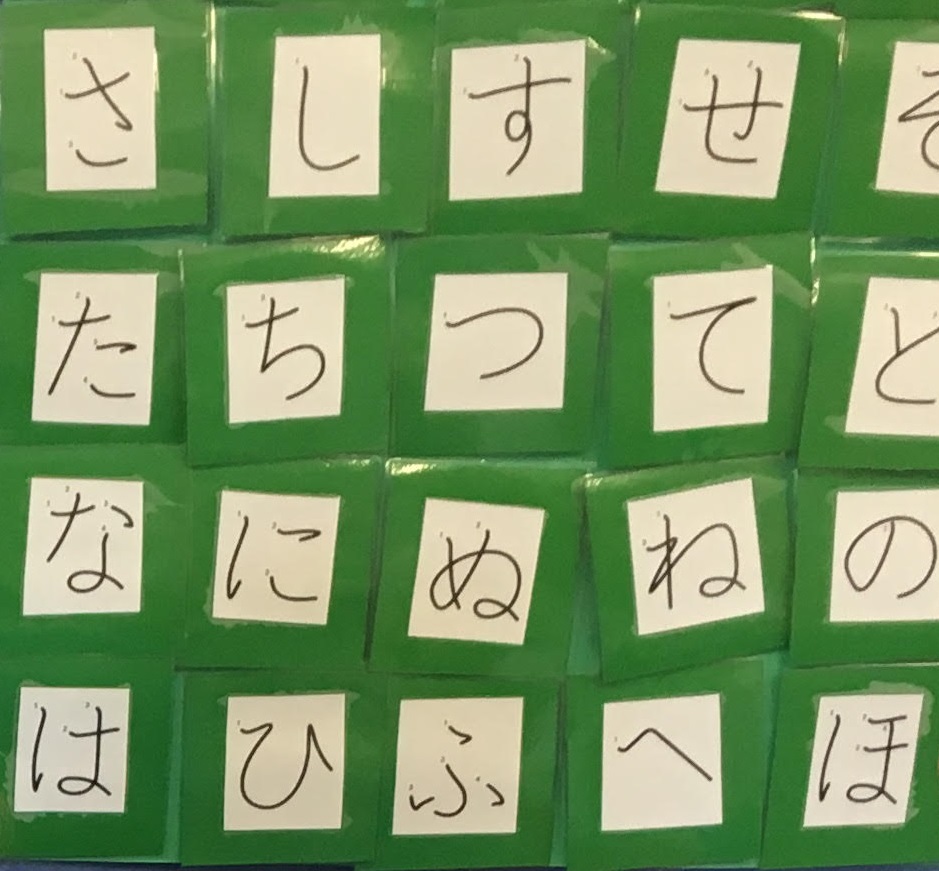
You need a piece of cardboard that you rule up into a table with 5 columns. These columns will house hiragana cards going left to right eg ka, ki, ku, ke ko. I make cards to fit these columns that are about 10cm by 10cm. Write a hiragana on each one and laminate if you like. I then use Velcro dots to stick the hiragana cards to the table. This means you can easily take the cards off to reveal what is behind each card during the game. It also makes packing up quick at the end.

On your cardboard table you can now write in pencil random points. I usually use a mixture of 5, 10, 20 and 50 points. I also hide one or two 100 points and 5 hearts and 5 crosses. I write these in pencil so that I can change the location in the future. Your students will quickly rote learn the location of the higher points otherwise!

Step 2: Question generating

Put students into table teams and name them after a colour in Japanese eg aka, midori. It doesn’t matter if you haven’t studied colours yet. They only need to remember it as their team name.

Give them scrap paper and 5-10 minutes in teams to write down as many questions with a sample answer as they can about anything they remember studying about last year in Japanese. It can include vocabulary, grammar, or cultural knowledge. They must write their team colour on every strip of paper. This is very important. Gather all the team questions, mix together then place in a bag.

Step 3: Playing the game

On the board draw a basic table with each team colour listed in a column. Give each team 20 points to start. You then ask the first team to pick a hiragana letter from the board. You then randomly pick out a question from the bag. Read out the question. That team will attempt to answer and if they get it correct, remove the hiragana card from the board to reveal their points eg 5, 10, 100 points. Add those points to the score chart on the board. If they get a heart though, it doubles their current score. If they get a cross, it halves their current score. If they get the question wrong, nothing happens. Do not reveal what is behind the hiragana card if they get it wrong.

When reading out the question, check which team wrote it and give them 5 bonus marks. This means that the team who writes lots of questions has an advantage so make sure you explain this to the students before they start writing questions. This really motivates them. You can also reject a question if you don’t like it. If the students who wrote the question have a good question, but a wrong sample answer you can still use it and give them points. This helps you understand their misconceptions. Just explain the correct answer to the class when you award the points.

The beauty of this game is you can make it as long or short as you need to and don’t need to prepare any questions in advance. The board can be re-used and you can change the hiragana cards for katakana cards for older students. If your students don’t know hiragana, I used it in primary by giving them access to a hiragana chart and they were fine.

As always, if you have any questions, please feel free to email me directly at jblog1help@gmail.com .

All the best for a fabulous 2020!

Filed Under: Professional development, Student Engagement, Teaching and Learning

2020 – The year of the metal rat!

November 26, 2019 by Manten Resources

According to very official sources on the internet, 2020 is going to be “a strong, prosperous, and lucky year” for all signs of the juunishi, and “everyone will show determination regarding their goals, and aspirations”. It is “a great year for founding and evolving”. So, what are you waiting for? Time to get excited about 2020 and sign up for our Noosa workshop. Sadly, there won’t be any fortune telling at the workshop, but we will be sharing future directions in Japanese education including:

  • Hansei habits for teachers and students – how can we help students prepare for success in language learning? How can we prescribe tools for change for individual students?
  • Task based learning – programming learning beyond the linear. What is the place of explicit grammatical instruction in contemporary language courses? How can we keep track of what students are learning?
  • Embedding Aboriginal and Torres Strait Islander perspectives in the primary and secondary context
  • Exploring soft CLIL through cross-curricular activities and play based learning
  • Multimodal texts – what are they? Beyond the metalanguage to classroom application
  • Surviving and thriving in the language teaching space – finding ways to align system goals with your personal values and strengths

The workshop is held Saturday July 11th which falls in the holidays for all the states, so we hope you can slot in a day with us. This year we are focusing on lots of take-away ideas and hands-on activities for primary and secondary teachers of Japanese.

This is the 3rd workshop Junko Nichols and I have run at Noosa and we would like to thank all those enthusiastic participants who keep encouraging us to come back. It is going to be a HUGE day of learning, escaping the winter cold at the beautiful Pepper’s Resort, Noosa. The range of ideas is sure to raise your motivation levels during the mid-winter slump.

Early bird offers apply to the end of Term 1 only and places are strictly limited as this is designed as an intimate workshop.

To book your place, click here or email me at jblog1help@gmail.com to discuss any aspects of the day. We hope to see you there!

Juunishi reference: Retrieved from https://www.thechinesezodiac.org/horoscope-2020/

Filed Under: Aboriginal and Torres Strait Islander perspectives, Professional development, Student Engagement, Teacher Wellbeing, Teaching and Learning

Christmas Countdown!

November 4, 2019 by Manten Resources

Term 4 is well under way and many of us are beginning to plan for next year – or fantasize about the Christmas holidays at least! As you begin to finalise your budgets and plan for the new year don’t forget to buy yourself a little something for Christmas. And what is the one thing all teachers need more of? Time.

Here is a list of 7 great time-saving resources under $70.

  1. Base Camp. This is definitely my new favourite resource and I have been thrilled to see small changes in my students as they learn the secrets of better study habits. $50 for the set.

https://www.mantenresources.com.au/teachers/our-resources/base-camp/

  1. The Platform. This is another new resource that builds on the work with Base Camp to develop student writing skills via a temptation bundle. This can be used as a formative assessment tool or ongoing classwork task. $50

https://www.mantenresources.com.au/teachers/assessment/assessment-inspiration/year-9-10-formative-task-the-platform/

  1. The Year 9/10 Values task. This task provides students with an opportunity to identify their own values, and to explore the profiles and life experience timelines of famous Aboriginal and Torres Strait Islander role models. This can be used as a formal assessment task or as a group task for NAIDOC week celebrations. Many of us want to embed Aboriginal perspectives in a more authentic manner but run out of time or ideas. This one is done for you. $70

https://www.mantenresources.com.au/teachers/assessment/assessment-inspiration/year-9-10-formative-task-the-platform/

  1. The Patch system. These are available for hiragana, katakana, Kanji basic and Kanji extension 1. This system allows students to have more autonomy in their script learning and provides much needed progress indicators as students work through the graded levels. This system is also supported by Education Perfect lists.$50 each

https://www.mantenresources.com.au/teachers/resources-teaching-scripts/

  1. Sample teacher marking guidelines. The biggest time-saving resource we have is the student workbook resources that have detailed tasks, listening drills and google forms with answers. If your budget doesn’t stretch that far though then the sample marking guidelines are a steal. They provide you with the tasks and sample answers giving you loads of inspiration even if you aren’t using our textbook as your main resource. Lessons for when you are away are suddenly done! $50

https://www.mantenresources.com.au/teachers/our-resources/student-workbooks/

  1. Speaking stations. The speaking stations game aims to maximise the time on task by placing the students in the driving seat. At all times both members are active either asking or answering the listed questions. The dice adds an element of luck so even the most talented student could be undone by unlucky dice throws. $50 https://www.mantenresources.com.au/teachers/blog/speaking-stations/
  2. Year 7/8 Japanese investment Expo. Students work through the reflection tasks that have them analyse details from a Japanese text, use hiragana and katakana tables to categorise export products and produce a bilingual video promoting their chosen agricultural industry using simple language and the scaffold provided. An optional extra would be to hold the “Expo” during a visit by Japanese students. $70

https://www.mantenresources.com.au/teachers/blog/making-language-relevant-in-regional-areas/


Good luck everyone with your 2020 preparations.

Filed Under: Aboriginal and Torres Strait Islander perspectives, Assessment, Student Engagement, Teacher Wellbeing, Teaching and Learning

Temptation bundling

October 18, 2019 by Manten Resources

Sometimes in life our actions have unexpected and even undesirable repercussions. I have a 12 year old son. He is an only child and has grown up in a somewhat nerdy household where we read a lot, believe learning another a language is normal and avoid a lot of mainstream media. His generation though are largely connected by the internet. When he started at a new school, we met some of his friends via video conference before we met in them or their parents in “real life”. We had encouraged him to be calm and quiet at home, but combined with his generation’s propensity for screen time, this had unexpected repercussions. We purchased him an exercise tracking device and realised that on a school day he would be lucky to reach 5000 steps – half the daily recommendation. We realised though that he had been merely doing what he was told. His teachers wanted him to sit still and listen – so he did. We drove him to school each day as it there are no buses from our suburb. When he came home, he wanted to read or go online. When was he supposed to be clocking up the 10 000 steps in this kind of lifestyle that we had created for him?

Around this time, I became aware of a concept called “temptation bundling”. This concept is a motivational strategy whereby you bundle an action you want to do with an action you need to do. For example, I had committed to a weekly task that I really wasn’t enjoying. I was beginning to dislike Thursdays because of this weekly commitment, even though the task was only a small part of the day. By contrast, something that I do enjoy is writing in the morning at a café that overlooks a marina. It is my special time to have a latte and look out at the boats as I play around with new ideas for resources or workshops. So, I combined the two in a temptation bundle. I allowed myself to only visit the café on Thursday mornings before I had to attend to the weekly commitment. In this way, I began to associate the commitment with my reward of writing time. The action I needed to do was the Thursday commitment, and the action I wanted to do was the café writing session.

We solved the problem of my son’s inactivity in the same way. The action he needed to do was move more for his long-term health. (I would like to emphasize that we were not concerned about diet or losing weight here, but rather the research into poor health associated with prolonged sitting for adults and children alike.) The action my son needed to do was exercise more, preferably outside in nature, to counteract his largely indoor school lifestyle. The action he wanted to do was purchase a mobile phone. We had told him he could have one when he started high school the following year. We also wanted him to appreciate the cost of such a device and to be responsible with such an expensive accessory. So, we developed a temptation bundle where he earned $5 for each day he walked 10 000 steps. We paid him in cash each week and then he banked it in a mobile phone account. We began by going for a walk after school to make up the shortfall. Soon though he came up with strategies like earning 2000 on the playground before school, and 2000 at recess and lunch. We had a bonus scheme where he earned an additional $5 if he made 15 000 or if he beat my score for the day. As his earnings grew, he came up with other ideas like joining me some days before school on my 6am walk. Exercise became a natural part of his identity as it fitted with his already present identity of someone who loves technology. His exercise was linked to his desire for technology. It has taken him months to earn the money and the habits of daily movement are now ingrained in his life.

So how does this relate to your teaching?

My latest project is called The Platform. This is a formative assessment tool pitched at Year 9 and 10 students. What do most students of this age want to do? In my experience, the answer is while away hours watching Youtube clips and drifting through social media posts. How can we make better use of this natural inclination to achieve learning gains in language study?

The Platform aims to create a temptation bundle where students become a member of a small group (2-4 students) to share videos that have interested them. They must write a minimum of 30 characters about each video and other members of the group have to respond to at least one post per learning cycle. I have created scaffolds to help them with this. Unlike regular tasks though, the students are rewarded for the quantity of writing they do, rather than the quality. We want them to experiment with language here, to focus on communicating with others for a real purpose and to practice vocabulary, grammar and script recognition on a regular basis. The teacher can then set group achievement goals such as a reward when all members of the group have written 100 ji each. Each post or comment is numbered and fortnightly reward draws could be held eg comment 21 wins a Japanese lolly or gets to sit in the tatami space or choose who to sit next to for that week. The more posts and comments you make the more chances you have of both improving your overall grade and winning the reward draw. There are two versions of this task included in the resource pack called Version 1 and Version 2.

This formative assessment tool could be used for writing in lieu of a formal task or it could be used as a tool to improve the learning culture and growth mindset of your cohort. You can read more about this task on our website at https://www.mantenresources.com.au/teachers/assessment/assessment-inspiration/ or email me at jblog1help@gmail.com .)

Good luck with your temptation bundling!

Filed Under: Assessment, Growth mindset, Student Engagement, Teaching and Learning

  • « Go to Previous Page
  • Page 1
  • Page 2
  • Page 3
  • Page 4
  • Page 5
  • Go to Next Page »

Primary Sidebar

Copyright © 2026 · Manten Resources - All Rights Reserved