• Skip to primary navigation
  • Skip to main content
  • Skip to primary sidebar

Manten Resources

Supporting your Japanese language program

  • Manten Resources
  • About
  • Teachers
    • Stage 6 Beginners
    • Jblog Textbooks
      • Jblog 1
      • Jblog 2
      • Jblog 3
      • Programming
    • Base Camp
    • Student Workbooks
    • Amazing Races
    • Assessment
      • Manten Exams
      • Assessment Inspiration
      • Script Resources
    • Blog Spot
  • Parents
  • Contact

Growth mindset

Investing in you

July 22, 2019 by Manten Resources

Every time you take a flight you receive some excellent advice on life that most of us not only ignore, we fail to even acknowledge at the time. I am referring to the safety demonstration. The wisdom in the words “secure your own oxygen mask before helping others” is applicable to all aspects of our lives. Yet as we roll into term 3 how many of us have spent the first half of the year helping our students, our staff and the school community often at the expense of our own time, relationships and personal needs.

One area I feel we are particularly poor at is prioritizing our own learning needs. I was fortunate to visit Japan these holidays and I was reminded of how the culture of learning permeates everything in Japanese society. It is not only students studying for exams, but adults taking proficiency tests and courses in everything from foreign language classes to needlework and tai chi. Stationery stores had special diaries to help people use their time more wisely and focus on daily goals. Even I became enthused by their slogan 「大切な一日を無駄にしない」.

So, I did what every Japanese teacher does and stocked up on resources – but this time for me. I purchased study guides for the Japanese Language Proficiency exam at levels suitable for the teachers I work with and me. I realised that the best way to model a growth mindset to my students, is to demonstrate how I continue to prioritize learning in my own life. Year after year, we let our own language proficiency decline as we teach to junior classes. We become used to only using the kanji that is listed on the syllabus. It was so exciting to be immersed in “non-syllabus” kanji again in Japan. It was like eating out with adults after weeks of sharing simple meals designed to suit your toddlers.

I know we are time poor but if you committed to 5 minutes a day 6 days a week you will be spending the same amount of time on Japanese that many of our primary students receive! It doesn’t have to be quality time either – 5 minutes on the commute, in the carpark before you drive home, at breakfast before anyone gets up or in the bath at night. My son loaded a fitness app on my phone recently that has a fabulous robot voice that offers no room to procrastinate. She loudly announces prior to each new set “Do the exercise.” There is no enthusiasm in her voice, she is not trying to convince me this will be fun, she simply wants me to get on with it.

Invest in you this term and start “securing your own oxygen mask before helping others”.

If you need some motivation to get started the JLTAV are running a language maintenance immersion weekend in October https://forms.gle/9mQHZStFNSsCbf1EA and the Japan Foundation run monthly speaking nights and courses specifically for teachers.

Filed Under: Growth mindset, Professional development, Teacher Wellbeing

Mid-year goal check

July 18, 2019 by Manten Resources

We are officially half-way through winter and half-way through the school year. Hopefully we can begin to find some fresh energy as we look towards the warmer days to come. This mid-point is a perfect time to pause and reflect on how your students are progressing. It is likely that some students are merging ahead in their learning of script whilst others may be lagging behind.

I was reminded the other day of how exciting learning to read for the first time can be. I had been showing a male primary student a few hiragana letters and then lined them up to spell basic words like sushi and sashimi. His amazement and excitement to realise that the letters spelt words that they knew was infectious. There is some concern that boys are often less motivated language learners than females, but deeper investigation reveals that this is often tied more to a lack of progress indicators than a lack of interest in the actual content.

Boys complain it is difficult to see the extent they have improved due to a lack of progress indicators (Pavy 2006). Without such indicators of achievement, their motivation wanes.
Pavy, S.(2006) Boys Learning Languages Babel, v41 n1 p4-11, 38

I have found that boys particularly enjoy kanji and find the visual meaning and the challenge appealing. I have watched students embrace their script studies via self-directed systems such as our Patch system. This system is available for hiragana, katakana, and two levels of kanji. It allows students to work ahead at their own pace and provides progress indicators as they pass each of the 15 levels. It can save teachers hours of preparation time and remove that nagging stress each day of needing to extend students on the spot who have finished the work faster than you expected. This systemic program of differentiation extends the students in a meaningful way.

As we approach the midpoint of the year, try to pause and reflect on one aspect of your students’ progress that you would like to improve upon in the coming months. Where possible, use a systematic approach that you can return to again and again.
If script is your goal, then you may be interested in our Patch system.
If improving student confidence in speaking is your focus, then you may like to try our Speaking stations game or develop your own. The speaking stations game aims to develop a growth mindset in your students and increase time on task in speaking skills.
Resources such as these are only $50. If the budget allows, it may be worth purchasing such an item rather than spending a few weeks making it yourself. Use the time instead to maintain your own well-being so that you can continue to inspire your students with your enthusiasm and energy.

All the best for the start of term 3!

Filed Under: Differentiation, Growth mindset, Teacher Wellbeing, Teaching and Learning

Choose your weapons wisely

May 11, 2018 by Manten Resources

This week I had an interesting conversation with a dedicated Japanese teacher. She mentioned casually that she felt “guilty” about purchasing some of our resources. I found this comment to be a real insight into our practice. It is also not a sentiment shared by many other industries or even other subjects. For some reason, as language teachers we are made to feel that not only do we need to know our subject well, our students well and have a good range of pedagogical strategies to draw upon, but that we also need to create every resource from scratch. Can you imagine a plumber rushing off to design his own pipes or a doctor being expected to manufacture his own medicines? Nobody has such expectations for other industries so please shrug off this unnecessary yoke of teaching.

In this month’s newsletter I am writing in more detail about some of the technological applications available to us to support formative assessment. Here are a few ideas we all need to consider when making decisions about ICT in general.

1. Choose the teacher strategy and content first

It is so tempting to jump on a bandwagon and start using technology because other people are doing it. This may have short-term benefits by grabbing the attention of the students due to the novelty factor. You may also become more enthusiastic as a teacher as you are excited about the new direction. These are both legitimate short-term benefits, but you also need to consider the longer term. Eventually the newness will wear off for both you and the students, so you need to ensure that there are other benefits from this technological choice. Is it more efficient? Is it saving you time because you can easily reuse or modify it for future lessons? Does it provide you with insights into the students’ progress and/or perspective/experience of the lesson?

2. Be mindful

Sometimes you may find a great youtube clip that you just want to use to settle the class or as a transition activity, rather than as a main source of content. That is fine, as long as you are mindful of what you are doing. Question each resource and activity before and after each lesson. Are you doing that task because you did it last year or because you feel it will suit this year’s cohort as well? What information is allowing you to make that decision?

3. What is your learning intention?

The term “fit for purpose” is often used when considering types of assessment. It suggests that formative assessment is preferable for certain purposes, and summative for others. Similarly, your technology and use of it, needs to match the purpose of your lesson. If you are promoting a growth mindset, you may want to question why you have grades/marks on your google form, or why the students do not have the option of editing the form? How you use the tools is just as important as how you select them.

Three Resources that will save you time and don’t cost the earth

  1. Manten Exams. Choose from our content library to create your own exams. Listening tasks rendered to your personal selection without an embargo date! https://www.mantenresources.com.au/teachers/assessment/manten-exams/
  2. Hiragana Patch and the Katakana and Kanji equivalents. Script resources that emphasise growth mindset and a formative approach to script mastery. https://www.mantenresources.com.au/teachers/resources-teaching-scripts/
  3. Amazing Race sets. Collaborative tasks covering all skills and mapped to Australian Curriculum outcomes and cross-curriculum content such as literacy and Aboriginal and Torres Strait Islander perspectives. https://www.mantenresources.com.au/teachers/our-resources/amazing-races/

Yes, we know you are capable, of creating everything from scratch, because language teachers are creative and talented people. But is this the best use of your precious time? You do deserve a weekend too!

Filed Under: Assessment, Growth mindset, Teacher Wellbeing, Teaching and Learning

Teachers as growth mindset role models

April 25, 2018 by Manten Resources

One of the most powerful aspects of teaching is the potential to influence students. Although many teachers may feel powerless personally in the larger educational system, they can be extremely influential on a student’s development.

Last week I presented in Melbourne on growth mindset research. We discussed the impact our individual position on the growth and fixed mindset continuum can have on our perspective of ourselves and of our students. We noted that a growth mindset means we believe that anyone can improve with focus and practice, including ourselves and the students in our classes. If we have a fixed mindset, we may focus on the “best” students and discourage others from continuing due to their lack of “natural talent”. Dweck’s research showed that students who had a strong growth mindset had greater learning gains over time than those with a fixed mindset – even when the fixed mindset was a belief that they were clever or natural at something.

Recently I have developed a passion for formative assessment research (or Assessment for Learning as it is also known as). One of the key findings is that students around the world (including research in Japan, Hong Kong, Norway and Sweden) appreciate and learn well from task samples. This means if you are setting a self-introduction letter as a task, they want to look at other sample letters and have the opportunity to learn from those exemplars. They need opportunities to calibrate their understanding and expectations of themselves against the samples, and to reflect on the reactions of others towards those samples.

So how does this relate to us as teachers? Dweck’s research demonstrated that we vary in our degree of fixed or growth mindset according to the context, and that we all have the potential to change our mindset. So we may have a growth mindset about learning language but a fixed mindset about technology. The key is to develop our metacognitive (thinking) skills to help us consciously transfer some of our growth mindset skills in one area, to other areas where we may be a little more fixed.

The best way to do improve the growth mindset of your students is to act as a growth mindset role model yourself. Show them how you face your own insecurities about a field (eg technology) and push yourself to have a go. Try a new website/activity/app with them and talk them through your thinking skills. Admit this is the first time to try it and that there may be some issues. Ask for feedback about what went well (or not so well), and more importantly how you could improve it next time. Commit together to trying it again. They will learn from your bravery and begin to see that feedback can be used as a tool for learning. It does not need to be a weapon of judgement in a summative context.

My personal challenge this month is Nearpod. I attended the talented Shingo Gibson-Suzuki’s workshop at the JLTAV conference on this topic. Shingo is very good at technology – but I recognise that his expertise is not only due to a natural talent in the field, but a honed skill developed through years of being curious about new applications and experimenting with them. Just watching Shingo doesn’t make me proficient in Nearpod. I need to use it myself and learn from the obstacles that arise. So this week I have made two Nearpod lessons. The first I loaded on my Facebook page to keep myself honest. I learned from that attempt. If I am honest with myself, the first attempt found me trying to do what I usually do in a new medium.

The second attempt I will share via the link below. In this version, I tried to take more on board the essence of Nearpod – that it is there to collect feedback and formative information from the students. This activity is linked to a unit on Okinawa which is chapter 4 of Jblog textbook 3.

https://share.nearpod.com/WtYQSIkJoM

If you find this lesson useful, you can email me (jblog1help@gmail.com) for an editable copy that you can use in your own classes. I also have a PDF with sample answers.

My challenge to you this month is to stretch yourself in an area of development. Choose one thing you have wanted to try and give it a go. Maybe it is an activity from some recent Professional Learning or just an idea you have been putting off due to other commitments. Prioritize your own learning and growth and model to your students your effort, bravery and commitment.

You may find your students will learn just as much from the experience as you do.

Reference : Dweck, C.S. (2006). Mindset: the new psychology of success. Random House.

Further reading:

You may also be interested in our post on growth mindset at https://www.mantenresources.com.au/teachers/blog/growth-mindset-more-than-just-a-poster-on-the-wall/


Filed Under: Growth mindset, Professional development, Teaching and Learning

How to have fun with questions

February 26, 2018 by Manten Resources

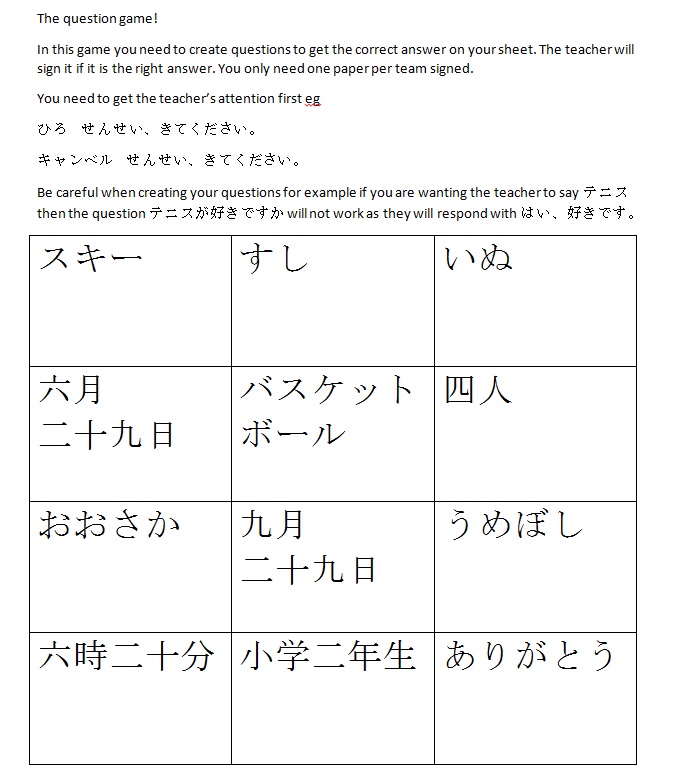
If you are looking for a exciting way to have students practice making questions then look no further than “the question game”. It is free and fun but also ticks the boxes of differentiation and developing growth mindset and teamwork skills.

How to play

This is a great game to play when you have a practicum student or a Japanese assistant. You will need to know a little about the person to make the worksheet. The worksheet can be 3 by 3 squares or larger depending on how long you want the game to take. In each box, write in Japanese a word or phrase. The students will need to look at the words or statements on the sheet and think of a question or statement or action that will make you say that word or phrase. As such, pitch the stimulus phrases to their current ability level.

The idea is that the students are seated in groups at tables with a copy of the worksheet each, plus one team copy that they will use to get signed by the teachers.

When they have thought of a question they call, either you or the assistant over by name, using phrases such as “Campbell せんせい、きてください”. This is good for less confident speakers as they have to say it many times and get quite good at it.

When you come they will ask you the question but the fun part is their question may be grammatically correct but needs to be asked to the other teacher. Eg our assistant liked basketball so asking me 「好きなスポーツは何ですか。」 wouldn’t work. They love it when this happens and are frantic to ask the question again to the right person.

The more they have to think, the more fun they have. For eg I put in the example below the grade my son is in in primary school. They had to think about me and what they knew about my family to generate a good question. (Click on the image to see it in more detail)

The best stimulus phrase though is 「ありがとう」. This can lead to a wide range of responses from compliments about how much they love you to offering you a seat. One time when we played this, a particular group became stuck on this question. The quick thinking Japanese assistant, seeing their dilemma, dropped his pencil intentionally. The boys picked it up for him and said 「どうぞ」 eliciting the 「ありがとう」 they had been searching for.

Why this game works

I love this game because it naturally differentiates and enables all students to utilise higher order thinking skills regardless of their Japanese ability. Students develop teamwork skills as they work together to translate the stimulus word or phrase, consider options that may elicit the correct response considering their knowledge of the person and/or Japanese culture, and translate these questions into correct Japanese. It develops growth mindset skills as students ask the wrong questions and consider new possibilities. It acknowledges social constructivism theory as it encourages students of varying abilities to work together, learn from each other and consider other ways of arriving at an answer. It is also very flexible and the same question sheet could be used by various classes with only the questions changing.

How to mix it up

Idea 1 : You can make it specific to a grammatical structure you want to practice by including more specific phrases such as「はい、行ったことがあります。」when you want to practice questions like 「日本に行ったことがありますか。」. If you want to keep it more general, use instead a phrase like 「はい、あります。」as your stimulus. This could lead to other options such as 「自分の部屋にテレビがありますか」.

Idea 2 : You could test cultural knowledge using the target language via this game. For example your stimulus could be a date eg 「三月三日」which would elicit questions like 「ホワイトデーはいつですか」. Or it could be a specific cultural term eg 「ちゃんこなべ」which would elicit questions like「すもうさんは何を食べますか。」.

Further reading:

You may also be interested in our post on growth mindset at https://www.mantenresources.com.au/teachers/blog/growth-mindset-more-than-just-a-poster-on-the-wall/

Filed Under: Differentiation, Growth mindset, Student Engagement, Teaching and Learning

We’re going to Noosa! Do you want to come too?

January 23, 2018 by Manten Resources

This year we are excited to announce that we will be holding our first workshop for Manten Resources on July 17th 2018. We have met many of you at other conferences, during school visits or online but this year we thought we would try something new. We have so many ideas and we realised we needed more time to unpack these with you. So come and escape the winter blues with some time at Noosa in July!

Why is it at Noosa?

There are two main reasons why we are running our first workshop at Noosa. The first is that chapter 6 of Jblog textbook 3 is set in Noosa. The chapter revolves around a house swap exchange between Noosa locals the Clark family, and the Yamada family from Tokyo. So we thought if you are teaching this unit, you will be sure to get some ideas to make it more real whilst you are here.

The second reason is about you. Teachers work so hard with very little “perks” of the job. Tired of hearing about friends in other industries swanning off to conferences in fancy locations, we thought it was time Japanese teachers had their day in the sun too – literally! The workshop is on a Tuesday so we encourage you to fly up with your family the weekend before, if you are from out of town. Don’t forget to talk to your tax accountant about how you can claim your expenses for accommodation, travel and daily expenses.

When is the workshop?

Tuesday July 17th 2018. This is the second week of the school holidays for NSW, ACT, Tasmania, South Australia and Northern Territory schools. It is the first week of Term 3 for Queensland, Victoria and Western Australian schools.

Where is the venue?

The workshop will be held at Peppers Noosa resort & Villas, 33A Viewland drive, Noosa heads, QLD, 4567. It is a few minutes walk from Hastings street and the beach.

Where can we stay?

There are various forms of accommodation in Noosa ranging from hotels to apartments and caravan parks. Contact http://www.visitnoosa.com.au/ for more information about what would suit your needs best. You may want to share accommodation or lifts with other teachers, so start talking with your colleagues and start planning your Noosa escape!

Is the workshop suitable for all teachers?

Yes! The workshop will be divided into a series of shorter modules that will discuss topics such as Growth mindset, soft CLIL, differentiation, and feedback to improve student performance. Check out the schedule below for more detail.

The day will be presented by Liberty Campbell and Junko Nichols.

Junko Nichols has taught Japanese and English as a Foreign Language at pre-primary, primary, secondary and tertiary levels in Japan, China, England and Australia over the past 20 years. She has taught at a Japanese immersion program at Central Queensland University and has been involved in language teaching and language teacher training at a variety of schools, using a range of methodologies and approaches. She has many fabulous ideas for primary teachers including how to use “soft-CLIL” in a variety of topics such as poetry and art.

Liberty is the Catholic Education Commission’s representative on the NSW Languages advisory Panel, the Project officer for Languages in the Broken Bay diocese and the author of the Jblog textbook series. She is passionate about supporting Japanese teachers and students with research based resources and practical teaching strategies. Liberty has spoken at various conferences for the MLTANSW, JTAN, JLTAV, DETNSW and at the National Symposium for Japanese Teaching in 2016.


How much is it?

The full day workshop is $135. This includes a fabulous buffet lunch and snacks, a beautiful location, lots of ideas and great company in the form of other inspiring Japanese teachers. This is designed as an intimate workshop so places are limited to 31 delegates. Make sure you are one of them!

How can I book?

You can book and pay for the workshop via the Trybooking link below.

https://www.trybooking.com/TQDQ

If you have any other questions about the day, please email us at jblog1help@gmail.com .

Workshop Schedule Session Overview

Session 1 : 9:00-10:30am : 1.5 hours

  • Growth mindset versus fixed mindset – How to develop more resilience in our students
  • Closing the feedback loop – Using peer and self-feedback to improve writing skills

Morning tea : 10:30-11am

Session 2 : 11:00am -1:00pm : 2 hours

  • Soft CLIL : What is it? What does it look like in a primary and secondary context?
  • How can I dabble in CLIL without committing to it every day?

Lunch : 1-2pm

Session 3 : 2:00-3:30pm : 1.5 hours

  • Differentiation – Acknowledging that teachers and students need to accommodate their own strengths, weaknesses and learning preferences
  • PERMA in language teaching – How can we teach hope? How can we develop it in ourselves and our staff?

Total 5 hours PD

Filed Under: Assessment, Differentiation, Growth mindset, Professional development, Teacher Wellbeing, Teaching and Learning

  • « Go to Previous Page
  • Page 1
  • Page 2
  • Page 3
  • Go to Next Page »

Primary Sidebar

Copyright © 2026 · Manten Resources - All Rights Reserved