• Skip to primary navigation
  • Skip to main content
  • Skip to primary sidebar

Manten Resources

Supporting your Japanese language program

  • Manten Resources
  • About
  • Teachers
    • Stage 6 Beginners
    • Jblog Textbooks
      • Jblog 1
      • Jblog 2
      • Jblog 3
      • Programming
    • Base Camp
    • Student Workbooks
    • Amazing Races
    • Assessment
      • Manten Exams
      • Assessment Inspiration
      • Script Resources
    • Blog Spot
  • Parents
  • Contact

Differentiation

5 REASONS TO LOVE GOOGLE FORMS

February 3, 2018 by Manten Resources

Are you a novice to google forms or bored of them already? Here are 5 reasons why I love this tool and how you can benefit more from your own usage. (Click on the images to view the detail.)

1. Easy to differentiate

I love to do my listening drills using a google form. I embed the sound file as a linked youtube clip and differentiate the questions in the form. This means that the whole class can be listening to the same sound file but working at the pace and level that suits them. They can pause the sound file to look up a word or repeat the text until they can hear the detail they need. They can choose to work at different levels of difficulty for every question. Sometimes when a topic is familiar or of particular interest to them they can stretch to a harder level of question. The forms allow them to choose as they go and have the time to think about this.

2. Can be used to improve literacy skills and catch misconceptions

When I am having students complete a form that is predominately English based (eg when checking comprehension of aspects of culture) I direct the students to complete the forms individually. Then without marking them, I bring the responses up in “summary” mode. We then talk through as a class which answers are better than others and why. For example in this image, the first response is superior because it is a full sentence and they used a capital letter for Tokyo. After we discuss the answers and ensure we are clear on the original misconceptions, I allow students to then go back into their form and edit their work. I only mark the forms after they have had time to apply the feedback their peers and myself have given them in this general discussion.

3. Time saving

I love the fact that you can export your student responses from the google form to an excel file spreadsheet. This means you can then clear the form to reuse again next year. No more reinventing the wheel.
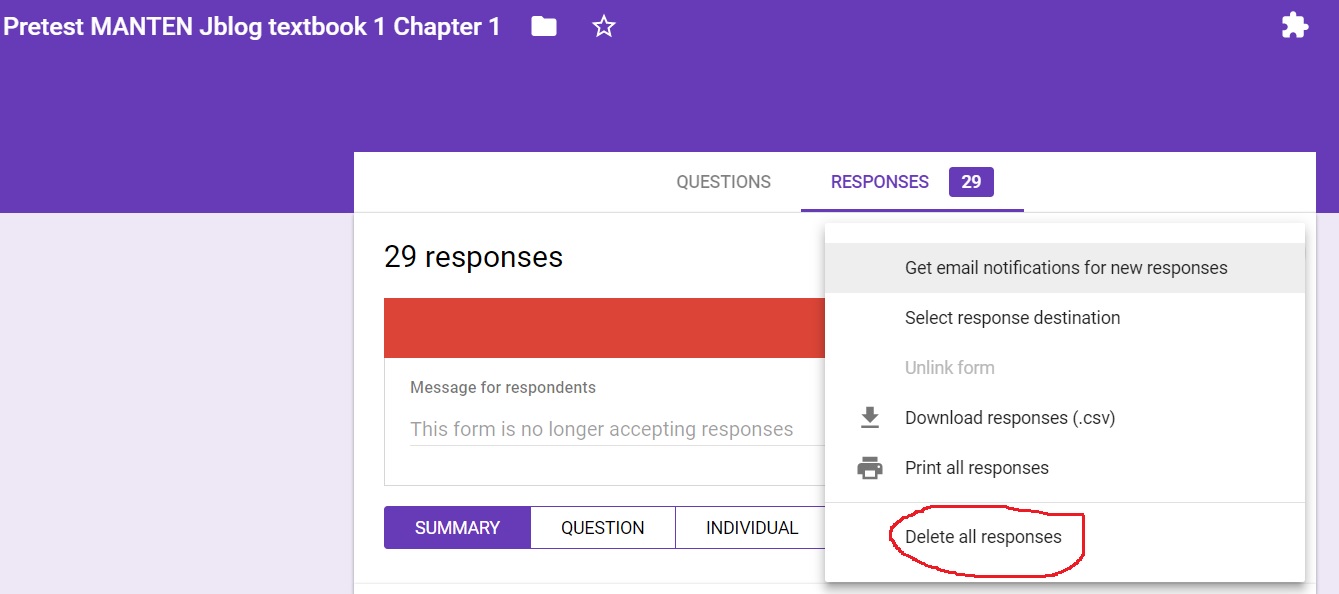
4. You can personalize shared forms

You can modify the shared resources of others to suit your unique class. Simply make a copy of the original and then edit away! Not sure where to start – there are 288 forms available for the Jblog series already made. We encourage our users to edit their copy to add in their own favourite links or images etc. (These are available as part of the student workbook resources pack – see our website for more details: https://www.mantenresources.com.au/teachers/our-resources/jblog-textbooks/student-workbooks/)

5. You can personalise the feedback

When I create my google forms, I embed the generic feedback in the form. I also have the option of adding to that with specific individual feedback. In this example, all students received the top line of correctional feedback but the other 2 lines are specific to that student only. This saves you time as the basic answer is already there in the feedback and you only need to personalise it.

Technology is there to help us but it needs to serve a pedagogical purpose. Hopefully you can see some new uses for google forms now. A free example of one of our google forms is available as part of the following post on the Australian Curriculum. The sample form is on the topic of Okinawa.

Australian Curriculum – NSW Begins the Journey

Filed Under: Differentiation, Student Engagement, Teaching and Learning

We’re going to Noosa! Do you want to come too?

January 23, 2018 by Manten Resources

This year we are excited to announce that we will be holding our first workshop for Manten Resources on July 17th 2018. We have met many of you at other conferences, during school visits or online but this year we thought we would try something new. We have so many ideas and we realised we needed more time to unpack these with you. So come and escape the winter blues with some time at Noosa in July!

Why is it at Noosa?

There are two main reasons why we are running our first workshop at Noosa. The first is that chapter 6 of Jblog textbook 3 is set in Noosa. The chapter revolves around a house swap exchange between Noosa locals the Clark family, and the Yamada family from Tokyo. So we thought if you are teaching this unit, you will be sure to get some ideas to make it more real whilst you are here.

The second reason is about you. Teachers work so hard with very little “perks” of the job. Tired of hearing about friends in other industries swanning off to conferences in fancy locations, we thought it was time Japanese teachers had their day in the sun too – literally! The workshop is on a Tuesday so we encourage you to fly up with your family the weekend before, if you are from out of town. Don’t forget to talk to your tax accountant about how you can claim your expenses for accommodation, travel and daily expenses.

When is the workshop?

Tuesday July 17th 2018. This is the second week of the school holidays for NSW, ACT, Tasmania, South Australia and Northern Territory schools. It is the first week of Term 3 for Queensland, Victoria and Western Australian schools.

Where is the venue?

The workshop will be held at Peppers Noosa resort & Villas, 33A Viewland drive, Noosa heads, QLD, 4567. It is a few minutes walk from Hastings street and the beach.

Where can we stay?

There are various forms of accommodation in Noosa ranging from hotels to apartments and caravan parks. Contact http://www.visitnoosa.com.au/ for more information about what would suit your needs best. You may want to share accommodation or lifts with other teachers, so start talking with your colleagues and start planning your Noosa escape!

Is the workshop suitable for all teachers?

Yes! The workshop will be divided into a series of shorter modules that will discuss topics such as Growth mindset, soft CLIL, differentiation, and feedback to improve student performance. Check out the schedule below for more detail.

The day will be presented by Liberty Campbell and Junko Nichols.

Junko Nichols has taught Japanese and English as a Foreign Language at pre-primary, primary, secondary and tertiary levels in Japan, China, England and Australia over the past 20 years. She has taught at a Japanese immersion program at Central Queensland University and has been involved in language teaching and language teacher training at a variety of schools, using a range of methodologies and approaches. She has many fabulous ideas for primary teachers including how to use “soft-CLIL” in a variety of topics such as poetry and art.

Liberty is the Catholic Education Commission’s representative on the NSW Languages advisory Panel, the Project officer for Languages in the Broken Bay diocese and the author of the Jblog textbook series. She is passionate about supporting Japanese teachers and students with research based resources and practical teaching strategies. Liberty has spoken at various conferences for the MLTANSW, JTAN, JLTAV, DETNSW and at the National Symposium for Japanese Teaching in 2016.


How much is it?

The full day workshop is $135. This includes a fabulous buffet lunch and snacks, a beautiful location, lots of ideas and great company in the form of other inspiring Japanese teachers. This is designed as an intimate workshop so places are limited to 31 delegates. Make sure you are one of them!

How can I book?

You can book and pay for the workshop via the Trybooking link below.

https://www.trybooking.com/TQDQ

If you have any other questions about the day, please email us at jblog1help@gmail.com .

Workshop Schedule Session Overview

Session 1 : 9:00-10:30am : 1.5 hours

  • Growth mindset versus fixed mindset – How to develop more resilience in our students
  • Closing the feedback loop – Using peer and self-feedback to improve writing skills

Morning tea : 10:30-11am

Session 2 : 11:00am -1:00pm : 2 hours

  • Soft CLIL : What is it? What does it look like in a primary and secondary context?
  • How can I dabble in CLIL without committing to it every day?

Lunch : 1-2pm

Session 3 : 2:00-3:30pm : 1.5 hours

  • Differentiation – Acknowledging that teachers and students need to accommodate their own strengths, weaknesses and learning preferences
  • PERMA in language teaching – How can we teach hope? How can we develop it in ourselves and our staff?

Total 5 hours PD

Filed Under: Assessment, Differentiation, Growth mindset, Professional development, Teacher Wellbeing, Teaching and Learning

  • « Go to Previous Page
  • Page 1
  • Page 2
  • Page 3
  • Page 4

Primary Sidebar

Copyright © 2026 · Manten Resources - All Rights Reserved